
Lincoln Third-Graders Learn About Frogs
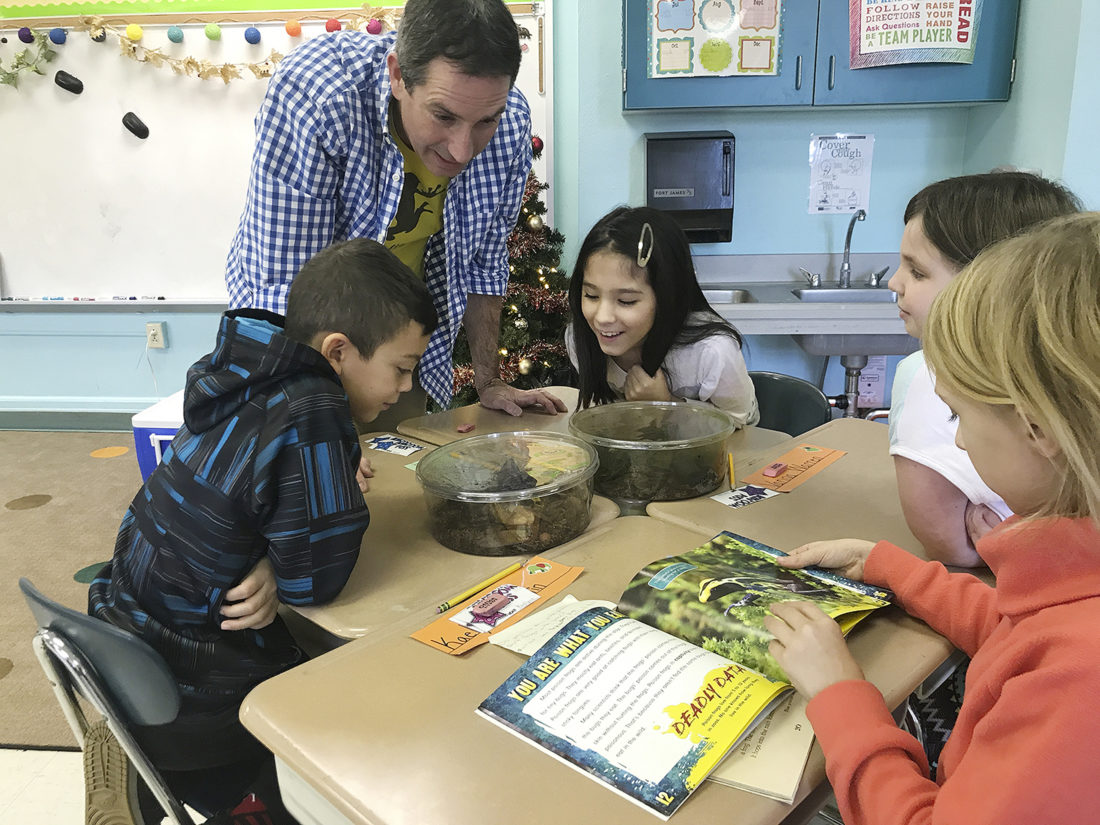
Twan Leenders, Roger Tory Peterson Institute of Natural History president, shows Lincoln Elementary School third-graders Cassidy Monroe, Varina Warren, Kaelynn Martin and Noah Gonzalez one of the frogs he brought to compliment their ELA “Freaky” Frogs unit.
The sounds of squeals filled Lincoln Elementary School third-grade classrooms right before the holiday break.
Students weren’t reacting to a visit from Santa Claus but frog friends brought in by Twan Leenders, president of the Roger Tory Peterson Institute of Natural History. Students in Cassie Stronz, Rhonda Ricker, Heidi Maggio and Mary Neumann’s classes complete a “Freaky” Frog English language arts unit and Leenders visit was a complement to what they were learning in the classroom. Stronz connected with Leenders five years ago when his daughter was a third-grader in her class. During Leenders’ visit, he also discussed his career, gave time for observations of the frogs and answered students’ questions.
“Part of our curriculum is discussing how people become experts,” Stronz said. “It is beneficial for students to meet a real-life expert that connects to what they have been learning about, especially an expert right from our Jamestown community. Having this hands-on learning experience affords students the opportunity to make observations based on some of the topics we have discussed in class. They are able to make real-life connections. Students were so excited to pull out their poison dart frog books to compare what they read to what they were actually observing.”
As part of the ELA unit, students use literacy skills to become experts — people who use reading, writing, listening and speaking to build and share deep knowledge about a topic. Students begin with a class study of the bullfrog, an example of a “true frog,” that exhibits quintessentially frog characteristics.
Then, students form research groups to become experts on various “freaky” frogs–frogs that push the boundaries of “froginess” with unusual adaptations that help them to survive in extreme environments throughout the world.
Students build their reading, research, writing and collaborative discussion skills through studying their expert frog.
Community
St. Luke’s to host guest preacher Sunday
Studio Dance Conservatory to present recital Saturday
Chautauqua County Fair tickets on sale
Tickets for the 2026 Chautauqua County Fair are now on sale in your community and online. The fair runs July ...
McClurg Museum to host annual fundraiser Saturday
County reviewing Agricultural District 10 boundaries
Per New York State Agriculture and Markets Law Section 303-a(1), the Chautauqua County Legislature is required ...
Deputies say driver who hit bicyclist was drunk
A Dunkirk man who allegedly hit a bicyclist while intoxicated over the weekend was arrested. On Saturday ...