
Your Set-Up Makes The Difference
Everyday Hunter
Trending
Here, at the halfway point of the spring gobbler season, maybe you've been calling gobblers but haven't brought one into shooting range. A likely reason is your set-up.
Your mileage may vary, but for me, the number one problem that has cost me shots at gobblers -- more than calling, more than impatience -- has been the way I have set up to call.
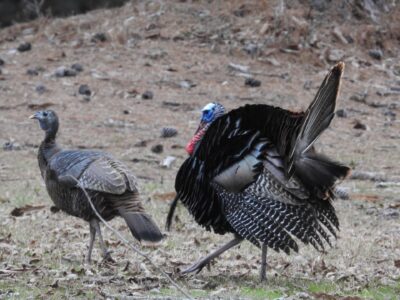
With turkeys, you must always make some guesses, and therein lies the problem. You can't always be right. For example, it's a great set-up when you're 30 yards from a drop-off on a hilltop or a bench and the gobbler is below you. He won't be able to see very far, so he won't expect a hen to be visible. He usually keeps coming until he can display his fan for his female consort. When you see his head and his beard, he'll be in range.
But what if he hasn't read the script, and he hangs up just below the crest? He's expecting the hen to come to the edge and look down at him. Four hours later he's still expecting that. Then your patience runs out, you move back, and all bets are off. He comes into view and hangs up, 60 yards away.
Patience is very important for the turkey hunter, but sometimes it's the gobbler who loses patience and decides to leave. As he increases the distance between you and him, he keeps gobbling. You think you have one option, to follow him or try to get in front of him. That tactic is often difficult. Fortunately, you have another, easily overlooked option. You wait.
Why wait if he's moving away? Because the odds are good that another gobbler is nearby, waiting for this opportunity. When the fired-up dominant bird walks away, a subdominant gobbler might quietly sneak in to take advantage of his absence. It happens often enough to make staying put an option well worth choosing.
In my experience, the biggest problem in setting up has been distance. It's possible to call in a gobbler that's 200 or even 300 yards away, but every yard increases the odds of something going wrong. That means the fewer yards between you and the gobbler, the better your chances of calling him in.
The greater the distance, the more things can go wrong. You might not know about some kind of barrier between you and him, and he doesn't want to cross it. Maybe it's an old fenceline, a logging road, a creek, or even a change in vegetation.
Or maybe a hen will intercept him before he gets to you. Or a predator will intervene. I once was calling a gobbler in a perfect set up. I watched him walking toward me on a logging road. Then he turned and went down the hill. The reason? Calling. Yes, mine -- but also the gobbler's. Calling alerts predators. In that case it was a bobcat. The cat scared the gobbler off, then took up an interest in me.
Turkey hunting has few rules aside from safety rules, but if you want rules for setting up, here are three:
First, set up close. Don't worry about spooking him. Setting up close solves more problems than it causes. I want to be within 100 yards before I start talking to him. I strive for 80 yards, and 60 yards is even better. If it's dark and he's on the roost, I'd like him to be in range when he flies down. Don't start the conversation with him before you're ready.
In late season when everything is leafed out, you think you're at a disadvantage because visibility is limited. You're not, because he has the same disadvantage. So, the second rule is to set up where you can see several open areas at your maximum shotgun range. He will have to use those spots to see you. He's yours when he walks into one of them.
The third rule is to set up where turkeys don't mind going. This knowledge comes from experience. Every hunt adds to your inventory of knowledge. Where have you seen turkeys in the past? Where have gobblers stopped coming to you? It's safe to assume that's a spot he liked. Where do turkeys feel safe? Make it your business to know the property and how the turkeys use it.
***
When "The Everyday Hunter" isn't hunting, he's thinking about hunting, talking about hunting, dreaming about hunting, writing about hunting, or wishing he were hunting. If you want to tell Steve exactly where your favorite hunting spot is, contact him through his website, www.EverydayHunter.com. He writes for top outdoor magazines, and won the 2015, 2018, and 2023 national "Pinnacle Award" for outdoor writing.