
ISO: Power Grid Margins Dwindle
Trending
Electric prices are skyrocketing and the state's Independent System Operator is forecasting narrowing reliability margins for the state's power grid this summer.
At the same time, state Democrats are blaming President Donald Trump for the mess with little agreement on the future of the 2019 Climate Leadership and Community Protection Act.
The state ISO said late last week that its annual Summer Reliability Assessment finds the reliability margin under baseline summer conditions is 417 megawatts - the lowest margin in recent history. The assessment notes that 34,615 megawatts of power resources are available to meet forecasted peak demand of 31,578 MW. As established by the New York State Reliability Council, under normal system conditions, the ISO is required to maintain 2,620 MW from the available resources in reserves. The report forecasts reliability challenges under extreme temperature scenarios despite the addition of new capacity in the past year. Aging generation, transmission constraints, and rising demand pose major challenges as reliability margins continue to decline.
"This assessment reflects the challenges of the grid in transition - declining reliability margins, performance issues with aging generators, and an absence of new dispatchable resources," said Aaron Markham, vice president of operations for the New York Independent System Operator. "Coordination with generation owners, utility companies, neighboring grid operators, and government officials will be essential as we work to maintain grid reliability this summer."
Under extreme weather scenarios, reliability margins are forecasted to be deficient. If the state experiences a heatwave with an average daily temperature of 95 degrees lasting 3 or more days, the capacity margin is forecasted to be -1,679 MW. That number declines further to -3,370 MW under an extreme heatwave with an average daily temperature of 98 degrees. Under those conditions, NYISO operators would initiate emergency operating procedures to secure up to 3,166 MW to maintain system reliability. It could also mean a return to grid alerts like the ones issued in the summer of 2025 if reserve margins drop below regulated levels. The alerts are designed to raise awareness about grid conditions and inform the public if electricity conservation is necessary.
The Empire Center for Public Policy said Monday that recent data from the Energy Information Administration shows New York's average residential electricity prices are 29.99 cents per kilowatt hour, 70% higher than the U.S. average of 17.6 cents per kilowatt hour, and 50% higher than in Pennsylvania, and nearly double the price in Florida or Texas.
New York's electricity prices rose 5.7 percent over the past month and 14.4 percent over the past 12 months. Over that same 12-month period, electricity prices in New York increased at twice the national rate and four times faster than in Texas.
The Empire Center's analysis comes after recent passage of several environmental bills in the state Senate. During floor debate of bills that include S.1553, which allows credits for excess electricity generated by customer-generators subject to net energy metering be carried over and used to offset electricity used, Republicans and Democrats debated power prices and power supplies.
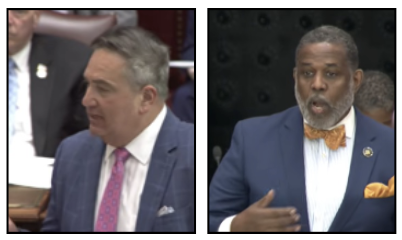
"We've heard a lot about things," said state Sen. George Borrello, R-Sunset Bay. "It's the reliance on fossil fuels in New York state, that's the reason why our utility bills are so high. That's simply not true. Electricity through natural gas and nuclear power, at our rates, are 50% higher than the national average. So it is not that. It is once again that we have told utility companies, do not invest here. Do not invest in infrastructure. And the infrastructure is failing and our supply is dwindling. That's why our rates are so high, because of bad policies passed in this chamber."
Borrello argued that the CLCPA is leading fossil fuel companies not to invest in New York state because New York has said, in essence, that it wants to put those companies out of business. Borrello said the state Public Service Commission and NYSERDA have also raised concerns about the state's inability to bring new sources of power online. Democrat Kevin Parker, D-Brooklyn, said the state ISO is blaming the cost of natural gas as it spikes globally as reasons for the increase in prices. He also said rising prices is not just a New York problem.
"We're responsible for New York," Parker said. "And what we're doing is standing here and taking the lead as we always do here in the Democratic conference in the state Senate. So people can ignore science, they can ignore geopolitics, they can ignore Donald Trump, who has caused illegal war. ... We need more generation. But we try to do offshore wind. Donald Trump, who is the leader of his party, put the kibosh on it. When we tried to invest in new generation and create more electricity, it was the leader of the other party that went and decided that we should not be able to produce offshore wind to produce more electricity for our state."