
Borrello: Pricing Bill Hurts Retail Stores
Trending
State Sen. George Borrello says legislation that has passed the state Senate will do too much to hurt brick-and-mortar retail stores at the expense of online competitors.
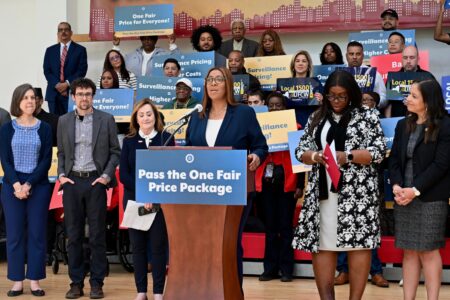
The Senate recently passed a bill (S.8616) that will prohibit food and drug retail establishments from engaging in personalized algorithmic pricing or surveillance pricing. The use of electronic shelving labels at these establishments would also be prohibited, as well as setting prices using protected class data or data collected from minors under 17. The legislation doesn't apply to online retailers like Instacart or DoorDash.
Borrello, R-Sunset Bay, said in his comments on the bill that it takes employee time to change paper price tags, especially in larger stores. The fact the legislation only affects physical retail businesses was one reason Borrello voted against the legislation, which was approved 50-10 with a handful of Republicans voting along with the Democratic Party majority.
"The bigger issue for me is we've seen this shift to more online purchases, much, much easier," Borrello said. "Is Amazon going to be impacted by this bill? No. Is Instacart going to be impacted by this bill? No. Who will be impacted? Brick and mortar businesses that employ people right here in New York State, that pay property taxes, that in the end are the driver of our economy. And that is a concern for me."
Digital price labels, which are rapidly replacing paper shelf tags at U.S. supermarkets, haven't led to demand-based pricing surges, according to a 2025 study that examined five years' worth of prices at one grocery chain. But some shoppers, consumer advocates and lawmakers remain skeptical about the tiny electronic screens that let stores change prices instantly from a central computer instead of having workers swap out paper labels by hand. Sen. Michael Gianaris, D-Astoria, is among them. Gianaris sponsored S.8616, saying in his legislative justification that offering goods at different prices due to customer demand is a phenomenon as old as time. His concern is possible discriminatory pricing schemes that electronic labeling can allow, such as personalized algorithmic pricing, surveillance pricing, and electronic shelving labels that Gianaris said exploit consumers’ personal and protected data to maximize profits.
Gianaris, who is retiring at the end of the session, also took a verbal jab at Borrello's opposition of S.8616.
"So, once again, my colleague has taken up the mantle of the defender of large corporate abuse so I’m happy to
defend this bill against that onslaught from Senator Borrello," Gianaris said. "This bill will prohibit the practice of electronic shelf labeling, which is digital labels that appear at grocery stores, and large box stores, and the reason for that is because as technologies is emerging, that those labels can be used to scan or listen to a person’s conversation or scan their faces, and download personal data and set prices to specific to that individual that would result in what is effectively price gouging."
A study published in late May 2025, according to the Associated Press, found "virtually no surge pricing" before or after electronic shelf labels were adopted. The study was authored by Ioannis Stamatopoulos of the University of Texas, Austin, Robert Evan Sanders of the University of California, San Diego and Robert Bray of Northwestern University. The researchers looked at prices between 2019 and 2024 at an unnamed grocery chain that began using digital labels in October 2022. They found that temporary price increases affected 0.005% of products on any given day before electronic shelf labels were introduced, a share that increased by only 0.0006 percentage points after digital labels were installed.
The study also determined that discounts were slightly more common after digital labels were introduced.
Companies say electronic price labels have tremendous advantages. Walmart says it used to take employees two days to change paper price labels on the 120,000 items it has in a typical store. With digital tags, it takes a few minutes. Companies say electronic price labels have tremendous advantages. Walmart says it used to take employees two days to change paper price labels on the 120,000 items it has in a typical store. With digital tags, it takes a few minutes. Walmart, the nation's largest grocer and retailer, hopes to have digital price labels at 2,300 U.S. stores by the end of the year.
"Am I concerned about what Senator Gianaris described?" Borrello asked rhetorically. "Absolutely. I'm concerned about it. But you know what? Back in my day, as I'll say, if you wanted to find the price of something, you had to go out and buy a Consumer Reports magazine or something like that to determine the price. Now, you pick up your phone, and you can instantly know where that item is, and probably 10 different locations, in three seconds. So, if you think you’re being price gouged, check it out. But in the event of this bill passing and becoming law, we may end up raising prices for people which I don’t think is the intent. So for that reason, I'll be cautiously voting no."