Would Proposed CDBG Project Work Here?
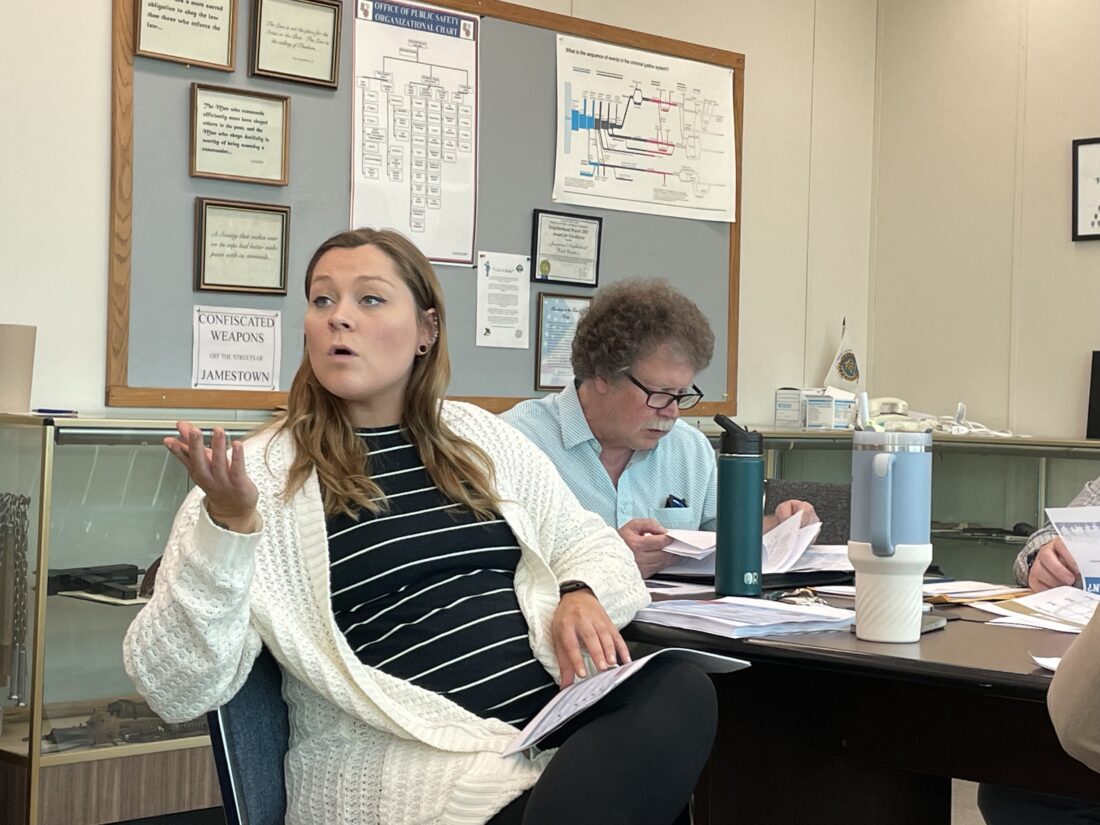
Kacie Foulk, city deputy director of housing policy and development, discusses a demolition and rebuild program that may be included in this year’s Community Development Block Grant and HOME program action plan. P-J photo by John Whittaker
There aren’t a lot of specifics yet on a proposal to start a new demolition and rebuild program in Jamestown.
That’s partially by design, according to Kacie Foulk, city deputy director of housing policy and development, and Crystal Surdyk, city development director. The city officials want to gauge interest in both the demolition and rebuild program as well as a Tenant-Based Renters Assistance Program before spending a lot of time actually writing the documentation and program guidelines.
“The details still have to be fleshed out,” Foulk said during Monday’s City Council Housing Committee meeting. “Which one we decide we don’t know quite yet. So we definitely are looking for your input.”
The demolition and rebuild program is, for now, likely to use the Jamestown Urban Renewal Agency to purchase a property that is scheduled to be demolished, solicit bids for demolition and then is sold with the new owner paying half of the demolition cost. A home would then be built on the site using some money from the city’s HOME program allotment from the federal government.
The proposed TBRA Homebuyer Program would see JURA partner with an agency that actively rents single family housing units and subsidize rent for up to 24 months to help tenants enter a lease-purchase agreement plan. The rent subsidy would go into an escrow account to be used as a down payment to purchase the home at the end of the 24 months. The money put into the escrow account would be replaced by the federal money and paid to the agency so it receives all the rent it is scheduled to receive. Such homebuyer programs are relatively common.
But what about demolition and rebuild programs?
SUCCESS IN TEXAS
There are similar programs elsewhere in the country.
A report by the National Association of Home Builders found 9% percent of new homes resulted from teardowns in 2021, with the same report finding 76% of new home builders reporting the overall supply of lots in their regions is low to very low. The difficulty in finding vacant lots may be one reason cities are turning to demolish and rebuild programs.
Golden Valley, Minn. openly advises those visiting its website that the city is a Tear Down and Rebuild city whale Carrollton, Texas, has a Single Family Demolition/Rebuild Incentive as part of its Neighborhood IMPACT initiative. The program gives homeowners or home builders who demolish an existing single-family home located in an Empowerment Zone 24 months to build a home on the same lot in order to receive incentives.
The program with perhaps the most documented record of success is in Farmers Branch, another Texas city, which has had a demo and rebuild program since 2015. Farmers Branch’s Demo/Rebuild Residential Incentive Program grants residents and builders upfront cash and tax rebates to demolish an old home and build a new home. Cash grants are issued in two payments – half following the demolition of the old home and half when the certificate of occupancy is issued for the new home. Farmers Branch also provides a city property tax rebate equal to 100% of the difference between the city property taxes assessed and paid on the new improvement value and the assessed value prior to the demolition.
The newest Farmers Branch comprehensive plan, approved in 2023, calls on the city to not only continue the Demo/Rebuild program, but to expand it.
“This existing program has strengthened the market value of its single family neighborhood through the infill redevelopment of a set of smaller homes,” the plan states. “That activity has strengthened the property values of nearby properties and boosted the city’s tax base. An upfront financial payment has incentivized builders or property owners to purchase and redevelop some of the lower value properties in these neighborhoods. One hundred sixteen new homes have been built utilizing the program, and other new homes have been built without the program in some of the same neighborhoods. The opportunity in a next generation of the program is to broaden the eligibility of the program while adjusting its funding stream to a self-funding model that doesn’t compete with other city priorities.”
COULD IT WORK HERE?
Demolishing homes and rebuilding makes a lot of sense on its face, so whether or not a demolition and rebuild program works in Jamestown has a lot to do with demographics.
The cost to build new homes can range from between $100 and $200 per square foot, which is one reason Foulk said April 22 that a demolition and rebuild program may not be right for the 2024 action plan. The price may be out of reach for many with the income limits a federal CDBG or HOME program aims to help.
Another concern is demographics.
Farmers Branch, at 38,286 residents, is bigger than Jamestown (28,243) and is located close to Dallas, which fuels annual population growth in Farmers Branch of about 2% a year from 2020 through 2022. Jamestown is losing about 1.6% of its population each year. That helps explain the 116 new homes build through the demolish and rebuild program in Farmers Branch – its not only seeing residents moving into the area because of its proximity to Dallas, but the median household income in Farmers Branch is roughly double that of Jamestown ($88,282 in Farmers Branch compared to $39,507 in Jamestown).
Top stories

Judges to be required to visit jails
Symbol of ‘pride’
Legislature to again take up job creation resolution
Floating stage creating issues in Celoron
Four years ago, the floating stage in Bemus Point hosted its final concert. The end of the Chautauqua Lake Pops ...
State warns of extreme heat conditions for region
New Yorkers are being urged to prepare for a period of extreme heat starting Tuesday with "feels-like" temperatures ...