
Mayor Proclaims MPS Awareness Day In City
Trending
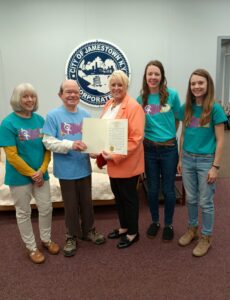
Mayor Kim Ecklund is pictured presenting the Rev. H Wayne Eppehimer and his family with a proclamation at City Hall declaring May 15, 2026, to be International MPS Awareness Day in Jamestown.
MPS and ML diseases are a little bit like the movie The Curious Case of Benjamin Button in which a baby begins as an old man and ages in reverse. In MPS and ML each child begins life as a healthy baby and continues to develop normally until somewhere between the ages of 18 months and four years old. MPS and ML patients all lack specific enzymes in their bodies. Inside the body's cells are tiny organelles called lysosomes, often dubbed the stomach of the cell. Their main job is to digest and break down molecules sent into the cells so they can be recycled in the body or eliminated. Powerful enzymes accomplish this task. Each MPS patient lacks an enzyme that decomposes complex sugar molecules and those with the ML condition lack enzymes that disintegrate lipids in the cell. Both cases cause substances to build up and be stored in each cell that were not meant to be there causing them to be known as Lysosomal Storage Diseases (LSD). Over time the build-up becomes toxic to the cell and causes damage which in turn causes progressive health problems. Thus, patients are in a race against time to find treatment to slow and prevent the progression of the disease.
Until the 1950s scientists did not even know the lysosome existed. Today progress has been made in developing treatments for some of these disorders. The missing enzymes for several of the MPS types have been created scientifically and can be administered once a week intravenously, known as enzyme replacement therapy (ERT). Treatments do not cure the disease, but they help to slow its progress.
Avlayah, an ERT just approved by the FDA in February 2026 for MPS II represents a significant advancement in treatment. This therapy can replace the deficient enzyme both in brain tissue as well as the rest of the body. It is the first ERT treatment for MPS II that can cross the blood-brain barrier to address neurological symptoms. Previously, there was no hope of preserving cognitive skills such as speech and neuromuscular abilities like walking. Developed over 20 years, Avlayah was even found to improve hearing in many trial participants.
Currently, Avlayah is only approved for patients under 18, leaving local resident Rev. Wayne Eppehimer and his nephew Jason Madison of Allentown, Pa., unable to access the new treatment. Both have the attenuated (mild) form of MPS II but are outside the approved age bracket for this new therapy.
There are still some MPS conditions without any available treatments, but the National MPS Society announced this month some large grant funding for research and a new treatment on the horizon for MPS IIIB (Sanfilippo syndrome type B). This is one of the types that currently does not have any available therapy. The clock is ticking in the bodies of children and adults with MPS, but as Terri Klein, CEO of The National MPS Society notes in referring to the new drug for MPS IIIB, "This kind of long-term clinical data represents exactly the progress our community has been fighting for."
For more information visit mpssociety.org/en/