
Hydrogen Engines Coming To Local Cummins Plant
-
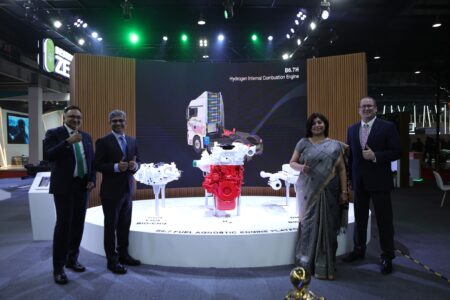
- From left, Ashwath Ram, Managing Director, Cummins Group in India; Srikanth Padmanabhan, President, Engine Business at Cummins Inc.; Anjali Pandey, Chief Operating Officer, Cummins Group in India; and Brian Wilson, general manager of New Power Business, Cummins Inc.; are pictured at the AUTO EXPO 2023 in India with one of Cummins’ fuel agnostic engines.
-
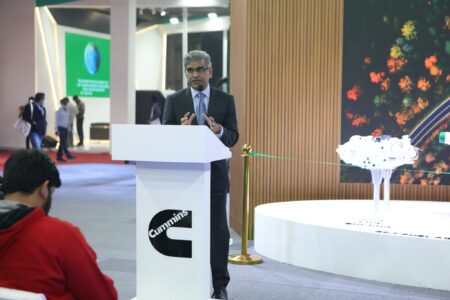
- Srikanth Padmanabhan, president of Cummins Inc’s Engine Business, speaks during AUTO EXPO 2023, India’s biggest automobile expo, in January. Padmanabhan recently told Freightwaves magazine hydrogen-powered engines will be made at Cummins’ Jamestown Engine Plant in Busti starting in 2024.

From left, Ashwath Ram, Managing Director, Cummins Group in India; Srikanth Padmanabhan, President, Engine Business at Cummins Inc.; Anjali Pandey, Chief Operating Officer, Cummins Group in India; and Brian Wilson, general manager of New Power Business, Cummins Inc.; are pictured at the AUTO EXPO 2023 in India with one of Cummins’ fuel agnostic engines.
The Jamestown Engine Plant appears to be a big part of Cummins Inc.’s future with the addition of hydrogen-fueled engines to its manufacturing line.
Srikanth Padmanabhan, the president of Cummins engine division, recently told Freightwaves magazine that years of research and development leading to the 15-liter ICE engine sold in China for the last two years have given the company enough information about the engine’s reliability, duty cycles and durability to be confident the engine will perform on hydrogen, propane and gasoline.
There hasn’t been an announcement from Cummins on the upcoming change at the Jamestown Engine Plant, but Padmanabhan told Freightwaves in the magazine’s December issue that the 15-liter ICE engine will go into production in Jamestown in 2024. Busti officials discussed the change during a recent meeting while Cummins Inc. leaders recently touted the importance of the hydrogen-fueled engine to the company’s future in a recent conference call with investor analysts. The Jamestown Engine Plant is the largest private employer in Chautauqua County with roughly 1,400 employees.
“And so really, we see a lot of interest in those platforms, both as a way to improve efficiency of diesel engines and then create flexibility to move to other fuels such as natural gas or hydrogen with the platform and really minimizing the integration pair up that’s required for customers as they move between those platforms,” Rumsey said. “So, we’ll begin to launch those with the natural gas version here, in North America in late ’23, early ’24 and then accelerate introduction in the coming years after that.”
KEY AGREEMENTS
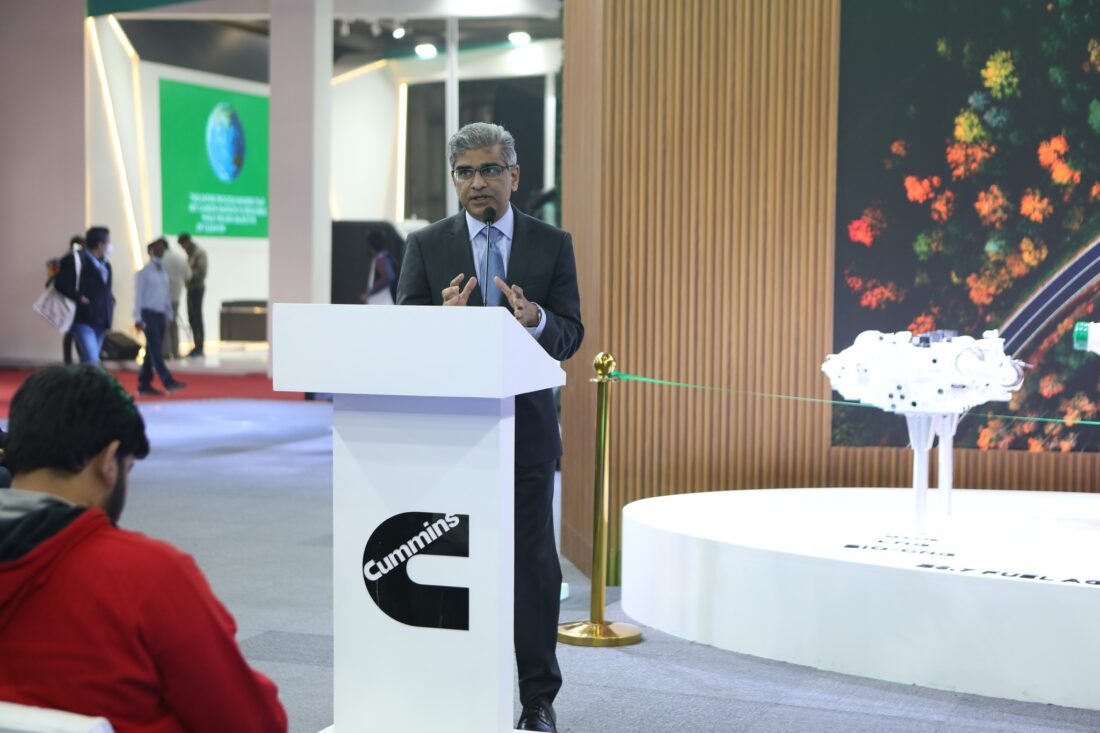
Srikanth Padmanabhan, president of Cummins Inc’s Engine Business, speaks during AUTO EXPO 2023, India’s biggest automobile expo, in January. Padmanabhan recently told Freightwaves magazine hydrogen-powered engines will be made at Cummins’ Jamestown Engine Plant in Busti starting in 2024.
Orders have already begun coming in for the new engine. In August, PACCAR and Cummins jointly announced that the Cummins X15N natural gas engine will be used in new Kenworth and Peterbilt trucks. The engine will include the integration of the Cummins Clean Fuel Technologies fuel delivery system. Cummins also has a memorandum of understand with Tata Auto Group, which owns the TitanX plant in Jamestown, for hydrogen-fueled engines. When operating on renewable natural gas, also known as RNG or biomethane, the X15N engine will be able to achieve major reductions in the lifecycle greenhouse gas emissions of Peterbilt and Kenworth trucks. This can range from a 90% reduction to carbon neutral, or even carbon negative, depending on the bio-source and waste feedstock used to produce the fuel. The new X15N is capable of lower nitrogen oxide levels than the 2024 EPA and CARB standards.
“We now have clarity on the EPA 2027 (nitrogen oxide) regulations that happened late last year, and they finalize that standard at a 0.035 gram (nitrogen oxide),” Rumsey said. “And our intention is to offer a full product lineup with our new fuel-agnostic engine platforms to meet that regulation, and we’re finalizing our product plans right now with our customers on those. But we really feel well positioned to invest in really as a part of our Destination Zero strategy, reduce (carbon dioxide) and (nitrogen oxide) impact to the environment and offer products — market-leading products to our customers with that regulation.”
In addition to the Tata and PACCAR agreements, the X15 engine is a key part of Cummins’ efforts to build business in China, which has adopted more stringent emissions standards. Cummins’ total revenue in China is projected to increase 7% in 2023 with slow improvement in sales of on-highway vehicles.
“The biggest uncertainty is really around China,” Rumsey said in response to an analyst’s question. “And as I said in my comments, we do project some slow recovery throughout 2023. With the lift of the stringent lockdowns that they had in the last couple of years in December, we expect that that may result in economic strengthening and certainly, less operational disruption, but we’re still monitoring what happens with the COVID waves there, is there any government stimulus into the economy. We feel really well positioned there. We’ve launched our NS VI products, which we think will enable Cummins to grow our position in the market. We’ve launched the automated manual transmission there. We’ve got a new natural gas platform. So, we’re really well positioned as China continues to strengthen and just uncertainty on exactly what the shape of that will look like.”
MAJOR NEW DEVELOPMENT
Earlier in the year, Padmanabhan said Cummins Inc. was expanding its powertrain platforms with the industry’s first unified, fuel-agnostic engines. The platforms use engine blocks and core components that share common architectures that can then be optimized for different low-carbon fuel types — making the Jamestown Engine Plant a player to make the alternative-fueled engines.
Below the head gasket of each engine will largely have similar components and above the head gasket will have different components for different fuel types. Each engine version will operate using a different, single fuel. The new design approach will be applied across the company’s B, L and X-Series engine portfolios, which will be available for diesel, natural gas and hydrogen.
Cummins’ existing agreements are encouraging, but Rumsey said the Inflation Reduction Act passed by Congress in August 2022 could broaden the market for fuel agnostic engines. The Inflation Reduction Act contains about $375 billion over 10 years to encourage industry and consumers to shift from carbon-emitting to cleaner forms of energy. Spending, tax credits and loans would bolster technology like solar panels, consumer efforts to improve home energy efficiency, emission-reducing equipment for coal- and gas-powered power plants and air pollution controls for farms, ports and low-income communities.
“How I would describe it is, the Inflation Reduction Act and the investments around that are really going to be key to enable the adoption rate that we anticipate is going to drive an acceleration in hydrogen investment. The details around that investment are being clarified right now,” Rumsey said. “So, it’s going to take several years before you really see that translate into actual projects and business. Definitely, it’s going to drive growth in the hydrogen market in the U.S. between now and 2030 as that — as those incentives come in place to both put the hydrogen production in place as well as drive adoption of some of these technologies, which today, frankly, just cost more. So, you need those incentives in order to start to drive customer adoption and bring down the costs and make them more viable in the market.”
— Eric Tichy contributed to this report.
Top stories

17 Democrats Ask Court To Enforce CLCPA
Former City Man’s Appeal Denied By Court
A former Jamestown man who has been accused of being part of a drug ring that included several Jamestown residents ...
Updated State Plan Aims To Assist Dunkirk
Cash-strapped Dunkirk could soon receive some much needed relief. On Thursday, state Sen. George Borrello and ...
Under New Management: Ashville Bay Marina To Receive Programming Facelift
Confirmed Closing: County Pushed To Save Company; Local Officials React To Closure
Wicked Warrens eyes improvements to hold banquets
A newly established Jamestown restaurant is getting some assistance as it looks to expand. During the Chautauqua ...