
17 Democrats Ask Court To Enforce CLCPA
Trending
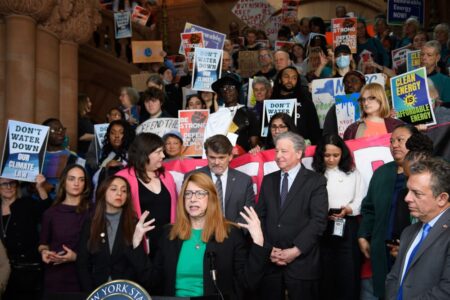
Seventeen Democratic Party members of the state Assembly are asking an appeals court to require New York state to proceed with regulations to further implement the 2019 Climate Leadership and Community Protection Act.
The CLCPA mandates a 40% reduction of greenhouse gas emissions from 1990 levels by 2030 and 85% by 2050, aiming for net-zero emissions economy-wide by 2050. The CLCPA also calls for 100% clean electricity by 2040, with specific goals for offshore wind, solar, energy storage, and directing benefits to disadvantaged communities.
Section 75-0109 of the Environmental Conservation Law requires the Department of Environmental Conservation, no later than 2023, to devise rules and regulations to ensure compliance with the statewide emissions reduction limits required under the CLCPA. The DEC did not meet that deadline, prompting a lawsuit by several environmental groups. A state Supreme Court Judge in Albany ruled in favor of the environmental groups and set a Feb. 6 deadline for the regulations to be released. The state appealed that ruling to the Third Department Appellate Division - which means the February 6 deadline is also on hold while the appeals court hears the case.
The lawmakers filed a 35-page brief asking the appellate court judges to rule in favor of environmental groups pushing the state to act now. Among the arguments the lawmakers make is that the state DEC's inaction issuing regulations threatens New York's status as a climate leader, that the legislative intent of the CLCPA is to address air quality with "utmost urgency," that the presence of federal support for renewable energy is irrelevant to the DEC's obligations under the CLCPA, that economic arguments saying implementing the CLCPA are too expensive to dismiss should be rejected by the court and that the separation of powers doctrine requires the DEC to comply with the CLCPA.
The brief comes at a time when Gov. Kathy Hochul is trying to negotiate new CLCPA timeframes and conditions as part of the now month-late state budget. Those negotiations include many of the lawmakers who signed the amicus brief filed with the Third Department Appellate Division.
"The Legislature knowingly enacted a statute that would require large-scale economic transformation, including substantial and uncertain costs, and delegated to DEC the task of implementing that transformation," the brief states. "Critically, cost was not a condition of DEC's mandate to adopt regulations, and increased cost estimates therefore do not excuse DEC's noncompliance. Accordingly, the legislature did not fail to anticipate the bill's economic consequences; it chose to proceed after considering them. DEC asks the court to second-guess that legislative judgment by elevating economic concerns that were already fully aired, debated, and resolved in favor of enactment. That attempt should be rejected."
The brief was signed by lawmakers including Senate Health Committee Chairman Gustavo Rivera, Assembly Housing Committee Chair Linda Rosenthal, Democratic Socialists of America Assembly members Emily Gallagher, Diana Moreno and Phara Souffrant Forrest, Assemblyman Steve Englebright, former Assembly member and current state Senator Nathalia Fernandez, Sen. Robert Jackson, Assemblyman Manny De Los Santos, Assemblywoman Jessica Gonzalez-Rojas, Assemblywoman Marcela Mitaynes, Assemblywoman Mary Jane Shimsky, Assemblywoman Sarahana Shrestha, Assemblywoman Jo Anne Simon, Assemblyman Phil Steck, Assemblyman Al Stirpe, and Assemblywoman Claire Valdez.
As The Post-Journal reported earlier this week, the status of the CLCPA is one sticking point in the state budget, which is now more than a month late. According to a NYSERDA analysis, implementing the CLCPA on its current timeline will increase annual household energy bills by an additional $4,000 for upstate oil and natural gas households and $2,300 for NYC natural gas households by 2031. Implementing the CLCPA could also add $2.39 to gas prices -- on top of whatever the price is by that time. Businesses will also be impacted, with the potential for their energy prices to increase 46 percent. Those cost increases would come on top of already high energy prices.
The Empire Center for Public Policy said recently that data from the Energy Information Administration shows New York's average residential electricity prices are 29.99 cents per kilowatt hour, 70% higher than the U.S. average of 17.6 cents per kilowatt hour, and 50% higher than in Pennsylvania, and nearly double the price in Florida or Texas.
New York's electricity prices rose 5.7 percent over the past month and 14.4 percent over the past 12 months. Over that same 12-month period, electricity prices in New York increased at twice the national rate and four times faster than in Texas.
The Democratic Party lawmakers said in their amicus curie brief that the DEC's cost concerns were considered by the state Legislature when it passed the CLCPA in 2019, and says those economic considerations were explicitly debated, raised by opponents during floor debate and rejected or other addressed by the state Legislature.
"Notwithstanding these observations, and with full acknowledgement that implementation costs remained uncertain and could be in the billions, the Assembly majority viewed those expenditures as necessary investments to avoid 'the [significant] cost of not going forward with this type of initiative.' Assemblymember Englebright repeatedly
emphasized that the CLCPA's economic impacts must be weighed against the "cost of inaction," which would impose far greater long-term harm on New York's economy and public resources. Thus, far from "unanticipated," as DEC argues (DEC Brief at 2, 27, 30), legislators had factored in economic considerations when passing the CLCPA."