
Jamestown Native Reflects On Ancestor’s Involvement In 1917 Halifax Explosion
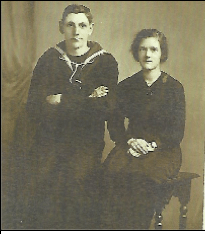
William Harford, a British Royal Navy gunner with ties to Jamestown, is pictured in his sailor’s uniform with an unknown woman, believed to be his wife at a young age. Harford was present during the now famous World War I-era maritime disaster known as the Halifax Explosion, which occurred Dec. 6, 1917, in Nova Scotia, Canada. Though he had two siblings who immigrated to Jamestown, Harford lived out his days in England with his family. Submitted photo
One century ago, a British Royal Navy gunner with ties to Jamestown was interviewed by the local daily news publication while visiting family.
The subject of the subsequent news story was William Harford’s firsthand, eyewitness account of the now famous World War I-era maritime disaster known as the Halifax Explosion, which occurred Dec. 6, 1917, in Nova Scotia, Canada.
The Halifax Explosion was the result of a collision between the “SS Mont-Blanc,” a French cargo ship laden with high explosives, and the Norwegian vessel “SS Imo” in The Narrows — a strait connecting the upper Halifax Harbour to Bedford Basin. A fire on board the French ship following the collision ignited her cargo, causing a large explosion that devastated the Richmond district of Halifax.
Approximately 2,000 people were killed by the blast, debris, fires or collapsed buildings, and an estimated 9,000 others were injured. The blast was the largest man-made explosion prior to the development of nuclear weapons, releasing the equivalent energy of roughly 2.9 kilotons of TNT.
Shortly following the incident, Harford was in Jamestown visiting his siblings — John Harford, his brother, and Mrs. George Jowett, his sister — and was interviewed on his experience by the The Post-Journal.
“To be thrown from the top deck of an auxiliary cruiser onto a pier by the terrific explosion at Halifax on Dec. 6 was the experience of Gunner Willie Harford of the British navy,” the article began.
When asked about the Halifax disaster, Harford said: “Words cannot explain the terrible nature of the disaster. I will never forget it. I talked to a Canadian soldier who had seen service at the front and he told me it was as bad as the battlefields of France… The blizzard that reached Halifax that night added to the suffering. Our crew worked faithfully, doing whatever it could to aid the victims.”
The original article came to the great-niece of Harford, Sherry Kelly, a Jamestown native and current resident of Lake St. Louis, Mo., by way of Harford’s descendants in England. Kelly submitted the article to her local Lake St. Louis paper, “Newstime,” which published the article in its entirety on Nov. 4 as a 100th anniversary retrospective piece.
Kelly said she has been doing genealogy and has been in contact with her relatives in England — Harford’s son, Bryan, and granddaughter Christina Dare — as a result. Bryan Harford is Kelly’s mother’s first cousin.
She said her family in the U.S. has been in possession of a photo of Will Harford in his sailor’s uniform for generations, though, strangely, Harford’s own family in England had never previously seen a photo of him in his uniform. Pictured with Harford in the photo is an unknown woman, though his relatives believe it may have been his wife at a young age.
In return for her English cousins having sent her the article, Kelly then sent the original copy of the photo to them. Unfortunately, it was lost in the mail and never reached her extended family; but, thankfully, she had made a copy of the photo before she mailed it and the copy did reach her family overseas.
“The original photo was on a postcard,” Kelly said. “I sent it a few years ago to Will’s son (Bryan), but he never received it. Luckily, I had made a copy. Who knows where the original went? I just think the story is amazing about the photo and the article coming together just in time for the 100th anniversary (of the Halifax Explosion).”
“I find it strange nobody in Will’s family ever saw a photo of him in his sailor’s outfit before,” she continued. “They are not quite sure who the girl was in the photo. It may have been his wife when she was younger, but they had not seen a photo of her like this before so they can’t say with certainty.”
William Harford was stationed aboard the British auxiliary cruiser “HMS Knights Templar” at the time of the Halifax incident, which acted as a convoy for merchant ships. Prior to Dec. 6, 1917, he had made six trips across the Atlantic Ocean, three times to North America and back — twice coming to New York City, and the other time to Halifax.
In the original 1917 article, Harford said he had accompanied 75 ships during his time on the cruiser, and none of them had been torpedoed or sunk; an amazing feat in the midst of World War I, when German U-boats (submarines) were wrecking regular havoc on enemy passenger and cargo ships alike.
Harford also stated that he liked America so much that he had considered living in the U.S., as his siblings chose to do, though he ultimately lived out his days in England.
Top stories
Warren Man Faces Prison Time In Case Involving Jamestown Teen
A Warren man faces up to 27 years in prison after pleading guilty in the Court of Common Pleas to three felonies ...
Four City Residents Charged In Pa. Drug Probe
ERIE, Pa. — A Jamestown man faces life in prison as part of a federal grand jury indictment. Fifteen ...

M&T Bank Partners With Local Little Free Pantry Project
‘Huge Family Reunion’: Clymer’s Biannual Tulip Festival Honors Dutch Heritage, Celebrates America’s Birthday

Providing The Foundation: Bassist Recalls Why He Loves The Instrument
Ellington, Charlotte eyeing court merger
Two neighboring towns in Chautauqua County are considering merging their courts. A public hearing has been ...