Housing Court, Threat Of Hefty Fines Assists In Resolving Code Complaints
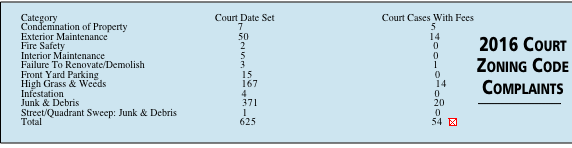
The threat of paying hefty fines seems to be working in resolving most zoning code complaints.
In 2016, there were 625 zoning code complaints that were ticketed for housing court. However, only 54 cases ended up with the court levying a fine.
Vince DeJoy, city development director, and Todd Peterson, city code enforcement officer, said once the court appearance is issued, it seems to motivate property owners to fix the zoning code violation.
“The homeowner is given a deadline to take care of (the violation). If they take care of the issue and meet the deadline, they don’t go to court. In most cases, you don’t have to go to court if you resolve the issue,” Peterson said.
Peterson said it is not surprising people take care of the code complaint prior to court. He said there is a $100 administration fee for each zoning code violation case that goes to court and, if the homeowner continues to procrastinate in fixing the problem, city officials start asking for additional fines to start at $100 to be levied by the court judge.
“People are really smart about it. The majority of people are good at taking care of things before it goes to court,” Peterson said.
In 2016, there were six types of housing code violation categories that were issued housing court appearance notifications — condemnation; exterior maintenance; fire safety; interior maintenance; nuisance; and street/quadrant sweep.
More than half the cases — 560 — fell under nuisance, which included categories like failure to renovate or demolish property; front yard parking; high grass and weeds; infestation; and junk and debris.
Of the 560 nuisance complaints, 371 were for junk and debris and 167 for high grass and weeds. Most of those complaints were fixed before court, because only 20 junk and debris and 14 high grass and weeds cases had court fines levied.
Peterson said when a fine is levied, the homeowner has usually 30-60 days to pay the fine. He said they are told to pay the city clerk’s office. He added the city clerk’s office does a quality job of following up on fee collection. DeJoy said the department of development doesn’t follow how many cases with fees levied have been paid by code violators.
“We are in the enforcement business, not the collections business,” DeJoy said about the role of the department of development.
DeJoy said fines that are collected go into the city’s general fund.
Top stories

Busti approves 3 moratoriums tied to energy

All-American celebrations
Council approves Neighborhood Watch effort
BPU fiber project reaches ‘milestone’
A “huge milestone” is being reached on the Board of Public Utilities’ Fiber project, as BPU General Manager ...
Judges to be required to visit jails