
Solar growth and local voices
Trending
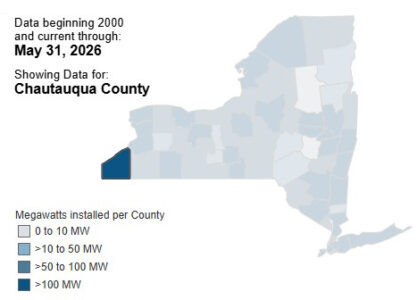
As New York accelerates its transition to renewable energy, utility-scale solar projects continue to expand across Western New York. Chautauqua County alone has seen several major proposals, including the permitted South Ripley Solar project in the town of Ripley, the proposed Empire Solar project near Westfield, and the York Run Solar project in the towns of Busti and Kiantone. These projects reflect the state's effort to meet its clean energy goals, but they have also sparked an important conversation closer to home.
The question isn’t whether renewable energy is important. Most people agree that reducing emissions and strengthening America’s energy independence are worthwhile goals. Instead, many residents are asking a different question: How much influence should local communities have when large energy projects are proposed on farmland and open space?
Under New York’s Office of Renewable Energy Siting and Electric Transmission, projects larger than 25 megawatts follow a state permitting process designed to streamline approvals while still requiring environmental reviews and opportunities for public comment. Local laws are considered, but the state can override provisions it determines are unreasonably burdensome.
Public comment periods and hearings are part of the process. In fact, ORES held public hearings for the York Run Solar proposal in early 2025. Yet many residents say they remain unaware of these opportunities or feel they occur too late in the process to meaningfully provide input or shape outcomes.
There are also environmental questions worth discussing. Developers must study impacts on wetlands, wildlife, agricultural soils and other natural resources, and projects often include measures such as pollinator-friendly vegetation and habitat protections. Even so, conservationists and local residents continue to ask whether converting productive farmland and grasslands into solar facilities could affect bird populations, pollinators and the rural character that defines communities like Chautauqua County. Consider the impact to the deer, bear, rabbits, squirrels, pheasants and a hundred other species of wildlife, fish, fauna and more.
Perhaps the greatest opportunity is not to debate solar itself, but to improve communication. Community information sessions, educational forums and early public outreach could help explain why sites are selected, what environmental safeguards are required, and how citizens can participate before decisions are finalized with a timeline.
Clean energy and local conservation do not have to be competing priorities. Likewise, state leadership and local voices need not be mutually exclusive. If New York hopes to build public confidence in its renewable energy future, the best investment may be greater transparency, stronger community engagement, and a genuine conversation with the people who call these landscapes home.
True, the sun shines for everyone, but if you have questions, contact the New York State Office of Renewable Energy Siting and Electric Transmission. ORES oversees permitting for large-scale renewable energy facilities and maintains project documents, public hearing schedules, and opportunities for public comment. Visit the ORES website or call 518-473-4590.
The Chautauqua County Department of Planning & Development can help explain local land-use policies, agricultural districts, and how county government can participate in project reviews. Call 716-661-8900.
The town supervisor and town board with locally elected officials can explain how proposed projects affect their communities and what role local governments play during the state review process.
Finally, the Chautauqua County Soil & Water Conservation District can answer questions about farmland conservation, soil resources, and environmental stewardship. Call 716-664-2351.
Gotta love the outdoors.
CALENDAR
July 5: Ellington Rod & Gun, "Don't Know Partner Trap League," 1045 Hagerdon Hill Road, Ellington; Info: 716-287-3987.
July 10: 21st annual Con Club Walleye Tournament in-person registration day, 4-7 p.m., 1 N. Mullet St., Dunkirk. For more info: email Chris at ncccwalleyederby@protonmail.com.
July 11: Firecracker Shoot, Hanover Fish & Game, 125 sporting and 50 five-stand, register on "SCORECHASER;" 9 a.m. start time for shooting; chicken barbecue on site; Info: Matt Holtz, 716-912-2624.