Gypsy Moth Outbreak Possible Despite Fungus, Virus
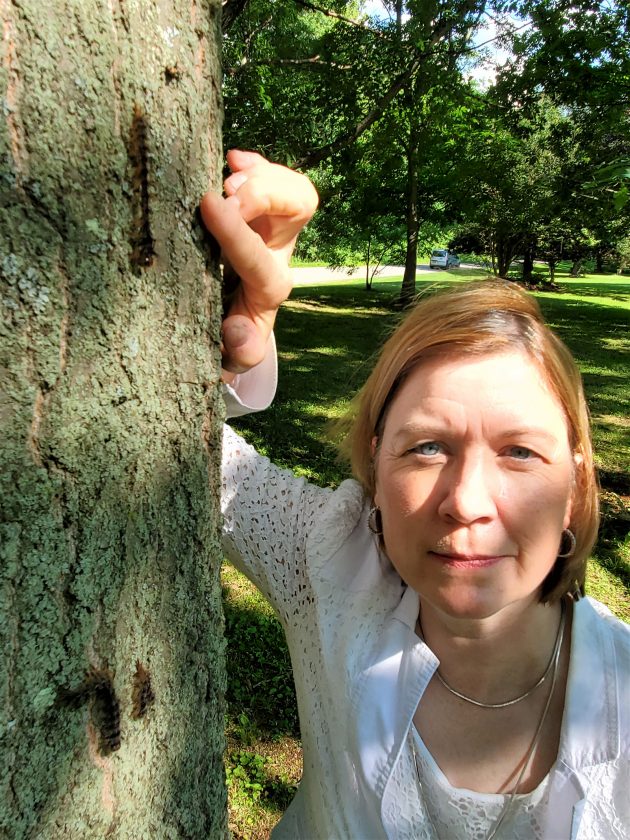
Cornplanter District Forester Cecile Stelter talks about the pathogens helping keep the gypsy moth population in check and why dead caterpillars are hanging on trees. The dead caterpillar pictured was killed by a fungus. Caterpillars lower on the tree, that are hanging in an upside-down V shape, were killed by a virus. Photo by Brian Ferry
WARREN, Pa. — Lymantria dispar versus entomophaga maimaiga and nucleopolyhedrosis doesn’t have the same ring as Godzilla vs. Mothra and King Kong. But, the former battle is being waged in Warren County.
In less scientific terms, it’s the moth versus the fungus and the virus.
“People are seeing a lot of gypsy moth caterpillars because it’s hot and because they’re dying,” Cornplanter District Forester Cecile Stelter said.
As the temperature rises, the larvae crawl down trees, closer to the ground, to cool off. That makes them easier for people on the ground to notice.
And, many of the caterpillars are staying in sight. The fungus and the virus are killing the gypsy moth larva.
Both of the killers leave their victims hanging on trees — in distinctive positions.
The virus – nucleopolyhedrosis or NPV – leaves the caterpillars hanging dead in an upside-down V shape.
The dead caterpillars liquefy and “will produce a foul odor when handled,” according to a study out of Michigan State University. The virus is carried naturally by the insects, Stelter said. “It’s in the population. It’s not weather dependent.”
According to Michigan State, the virus is more of a factor when the moths are stressed by other factors — which can happen as competition for food increases when there is a gypsy moth outbreak.
“The fungus was introduced from Japan,” Stelter said. The name of the fungus comes from the Japanese words for gypsy moth and insect eater. The fungus lives in the ground,” she said. “It is released in warm, humid weather.”
Caterpillars that are infected with the fungus die hanging straight down and dry out.
Right now, both pathogens are killing larvae.
“We don’t know if the virus and the fungus will have enough effect” to prevent an outbreak, Stelter said.
The Department of Conservation and Natural Resources Bureau of Forest expected some problems this year and is keeping a close eye on the situation. “We did counts last August,” Stelter said.
“We knew there were going to be areas of defoliation this spring.”
Those areas are being hit hard.
“We are seeing some areas of severe defoliation,” Stelter said. “We’re seeing defoliation on a scale we haven’t seen in 20 years in some areas.”
The area of effect isn’t as broad as the devastation that took place in the 1980s and 1990s, but “in some areas, it is that bad,” she said.
The fungus was introduced after that devastating era and the virus was discovered later, too. So, those natural enemies of gypsy moth may help keep the damage down.
The bureau is not counting on it.
“In July, the Bureau of Forestry is going to do some aerial recon flights,” Stelter said. “They will map the defoliation.”
Then, crews will follow-up on the ground to confirm – “ground truth” – what was seen from the air and make sure gypsy moths are to blame.
Crews will return to those areas impacted by gypsy moth later.
“In August, we are going to start doing egg mass counts,” she said.
The caterpillars do the damage. The moths — the female ones — lay the eggs that lead to more caterpillars.
An egg-mass count will give the bureau a feel for how bad the gypsy moth situation will be in 2022. “If we start seeing a lot of egg masses, there will probably be another spraying program” in the spring, Stelter said.
DCNR will publish lists of spraying providers. Property owners who are concerned about their trees may want to look into the situation.
“We’d really like people to get out and start taking a look,” she said. “It is expensive for individuals. If they are concerned, they may want to consult with their neighbors.”
For now, even if the caterpillars eat all of the leaves from a tree, that tree should be able to recover.
“If the tree doesn’t have any other stresses, one defoliation, even if it’s total, there shouldn’t be any mortality,” Stelter said. “The trees should leaf out again this summer.”
Local News
City Kayak Rental Business Closes
The Chadakoin Paddle Company announced its closure this week. The business was located at 701 W. Eighth St., ...
‘Disgruntled Employee’: Mayor files suit on former dog officer

No Magic Can Fix Dunkirk’s Disappearing Funds

Langworthy wants brake on CDLs for illegals

New Owners Announced For Pumpkintown