
Spring Is The Season For Nature’s Babies
Trending
The sunshine and blue skies outside my window are doing their best to remind me that it is currently spring, despite the bouts of cold and snow this past weekend. Though the weather is inconsistent, the natural world continues to forge on and do its best to bring about what spring is known for, new life and energy. The dandelions and violets are blooming, trees are budding, and the robins are calling.
In addition to the songs, I have also regularly spotted robins flying up into trees and bushes with beaks full of grass and mud to be used in nest construction. Spring is noted for being a prime season for baby animals. While some animals reproduce all year round and even have their babies in the depths of winter, it is true that a large number of animals have babies in the spring. With the changing weather, presence of predators looking for food after a long winter, and all of the other usual dangers, animal parents need ways to keep their babies safe.
Birds are returning to old nests or beginning to build new nests. Songbirds tend to build their nests up in tree branches, deep in the shrubbery, or even inside tree cavities. Some, like American Robins, use mud and grass to create a stable structure on a branch or ledge. Bluebirds create a nest of grass in a tree hole or nest box, and House Wrens use the same space but stuff it full of sticks before lining it with soft grasses, animal fur, or feathers. These eggs can hatch anywhere from late April to early July, and putting their nests in a hard to reach area with some sort of cover helps protect the largely helpless babies. Newborns that are unable to move around and require their parents help to mature are known as altricial species. These species often make sure their babies are born somewhere safely tucked away.
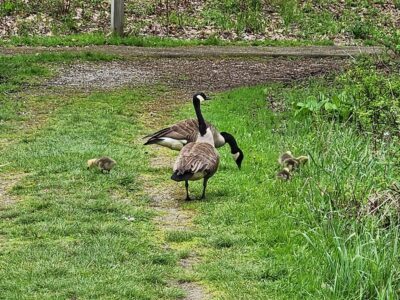
Other birds, like geese, are well on their way by early May. Over the last couple weeks, goslings have been making an appearance left and right. These little balls of yellow fluff emerge ready to go and will promptly leave the nest with mom and dad in search of food. Goslings are precocial newborns, which means they hatch with down feathers, are able to get up and move independently, find food, and eat on their own. However, they still rely on their parents for protection since they do not have the feathers required to fly away from dangers yet. I'm sure many of you know that a goose parent is a protective parent, and they are happy to let you know they don't want you anywhere near their babies.
Many animals that are born on the ground are precocial, as even a shelter won't fully protect them if they are unable to move independently. Most mammals still spend the first few weeks or even years with their parents. Mom and dad act as both a protector and a teacher. Fox kits are also an early spring sight, if you are lucky enough to spot them. Foxes will dig or perhaps find an existing underground den to raise their kits, and often they have more than one den just in case one location is disturbed. The kits will stay with mom throughout the summer, slowly gaining independence until they strike out on their own in the fall.
Fawns are also precocial, but they are often left alone for short periods of time. Don't worry though; most of the time they have not been abandoned. Mom is coming back for them, so please don't move a fawn you come across and give them their space. They are doing their best to hide, so help them out and let them be after taking a quick look.
Some animals take this precociality to a higher level and are fully on their own after they hatch. Almost all reptiles are born this way. Reptiles typically bury their eggs somewhere and leave them to hatch on their own. When the reptiles hatch, they are on their own to make it to a safe place and begin finding food.
Then there are insects and invertebrates. Many people don't often think of the baby stage of these little crawlers and flyers, but a lot of them do have a larval stage in their life cycle. Recently, Audubon started doing spring field trips, where schools in the area come down to explore the trails, forests, and ponds of Audubon's grounds for an hour and a half. While on these field trips, a favorite activity is flipping over logs. Snail and slug eggs were found under several logs already. These slimy friends lay small, white clusters of eggs which will hatch into juvenile versions of their adult forms. Other insects like butterflies, moths, dragonflies, and even mosquitoes have a larval stage before they eventually transform into their winged adult stage.
Spring is full of babies of all shapes and sizes, from caterpillars to baby skunks to fawns. All of that cuteness might seem irresistible, but if you do come across a baby animal, please make sure to give them their space. Even the cutest foxes and bunnies are still wild animals and should be kept at a respectful distance, both for your safety and for theirs. Keep them in mind as you are driving or hiking, observe from a distance, and give them a chance to make their way into adulthood over the coming days, weeks, or months.
Audubon Community Nature Center builds and nurtures connections between people and nature. ACNC is located just east of Route 62 between Warren and Jamestown. The trails are open from dawn to dusk and birds of prey can be viewed anytime the trails are open. The Nature Center is open from 10 a.m. until 4:30 p.m. daily except Sunday when it opens at 1 p.m. More information can be found online at auduboncnc.org or by calling (716) 569-2345.