How Fishing Changes With Weeds
This past week I was fortunate enough to spend a little time fishing Chautauqua Lake with a father and his two sons. The fishing was as hot as the midday sun, everything from bass to walleye to pan fish, the action was good and the boys never realized how fast the four hours had passed.
While I run many of the these such trips every year, this one reminded of me the time I had spent with my own sons and daughter on the water. Of course, I was already in a place in my mind where I was a little nostalgic. You see it was just a few days before that I had walked my daughter down the aisle to the man she chose to share the remainder of her life with.
Like most father-daughter relationships, we had our ups and downs – mostly ups – and I will always cherish and remember the time we spent on the water and in the woods. It seemed that during these times, we would generally solve all of the world’s problems, but like most young ladies, life will change daily.
Early summer fishing trips on Chautauqua Lake are always exciting because one never knows what’s tugging on the end of the line.
Recently, I came across some old issues of local newspapers, and I am talking way back. It seemed back in the early ’60s the main concern regarding Chautauqua Lake was weed growth. I then uncovered a series of articles from the early ’70s and the main concern was weed growth on Chautauqua Lake. Continuing my search I looked in the early ’80s, and guess what, the main concern and topic that seemed to be at the top of most folks’ minds was the weed growth on Chautauqua Lake.
If history teaches us anything, it teaches us that if we don’t learn from our mistakes we are sure to repeat them. Well the issue with weeds on Chautauqua Lake will, I am sure, continue until some major issues are dealt with and everybody gets on the same page.
With that being said, anglers still have an excellent fishery in which to go chase their favorite species of freshwater fish. But during the early days of summer one can see things changing. The past couple of years, the talk of weeds hasn’t really been a hot topic, but from what I have observed I believe that issue will bring to discussed more and more.
Our lake is changing and there are different species of weeds that are showing up. This isn’t something that has happened overnight, as some would suggest it has taken decades for Chautauqua Lake to get to this point. The non-indigenous vegetation we are finally seeing has been showing up for a few years now. For those that spend time on the water instead of talking about it would know these simple facts.
The recent heat wave in Western New York has had an interesting impact on friends that call local lakes their home.
The difference in the adjectives hot, warm, cold, high and low are open to personal interpretation. I think warm temperatures are in the mid-80s and cold is subzero. High is 20-plus feet and low is a few feet. Hot is in the 90s. Others may have individual differences and that’s OK. But let’s assume for the sake of argument that no matter who you talk to they will say, our summer so far has been hot.
Hence, the critters that swim in local lakes, ponds and streams are feeling the stress.
With that being said how does one go about and catch these critters during the dog days of summer?
There are a couple things that we have found that work well during summer months.
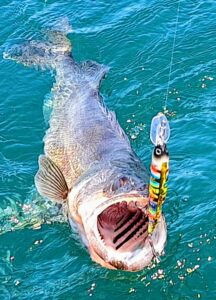
First, deep weed edges, yes Chautauqua Lake has them this year, but one has to search them out. When found, the deep weed beds tend to hold good schools of bait fish. Where ever the bait fish are, their larger cousins aren’t far away. Earlier this past week we found schools of bait fish with deep water and weeds 2 feet down off Lighthouse Point and upper Dewittville Bay. Over a couple days several nice smallies and three Muskie were caught off these spots.
No matter what the temperature, fish have to eat to survive. Now, they may not eat as often or they may change their feed patterns but done the less they still have to eat sometime.
Matching your bait selection with the natural forage fish of the fishery your fishing is the key.
Next, keep your offering close to where the bait are hanging out. With warmer-than-normal surface-water temperatures, large fish aren’t going to hang out in the shallower water long. If they do they will end up like the floaters that have been showing on the lake this week.
Finding and keying your fishing on deep water with shallow water close by will increase your creel. When the surface temperature gets in the high 70s and into the 80s, larger fish can’t handle the warmer temperatures and they get stressed out much faster. Just like we do when our body tells us its warm and we need to cool down.
Knowing where these critters go is important to your success. Understanding why fish go were the go, will make you a better angler.
The great thing about Chautauqua Lake is its diversity. The lower end of the lake offers some great shallow-water fishing opportunities, with the upper end playing home to some of the finest summer deep-water action in the Northeast.
There are areas in the upper basin of the lake that I call Dog Days fishing hotspots. For years I would troll for muskies in 20 feet in what I thought was deep water. Then a few years later I have been able to find areas that hold good numbers of big toothie critter in 30-40 feet of water. When presented properly with the right bait the fish can be caught and safely released alive back into the lake.
Now I am not saying that I am pulling fish off the bottom at these depths but they are hanging on drop-offs at these depths. Here again I prefer to fish the shelves close to deep water. What makes shelves great is their close proximity to shallow and deep water.
Fishing and releasing fish to be caught another day under these conditions isn’t easy, but with a little work and changing your way of thinking, it can be done and done successfully.
Local Sports

Late goals sends Argentina past England in semis
Southwestern outlasts Interstate for No. 2 seed
FREWSBURG — Southwestern scored three runs in the top of the seventh inning and held off Interstate for a 6-5 ...
Batavia retakes 1st place

JCC Golf Classic raises more than 15K

Summer 7-on-7 passing league action continues