
Boots In The Water: Starry stonewort data collection takes place as plan takes shape
Trending
The Everwild Land Trust is helping lead the way in the fight against starry stonewort.
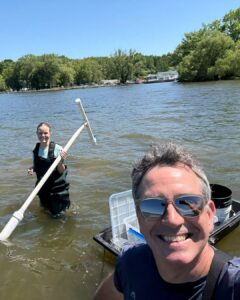
Randall Perry, Chautauqua Lake Watershed and Management Alliance director, told board members that GEI Consultants, the alliance's lead consultant on Chautauqua Lake, has performed novel data collection of starry stonewort reproductive bulbils alongside staff from Everwild Land Trust. The group is also planning and coordinating diver-assisted suction harvesting of the invasive algae and the creation of a technical advisory group.
Twan Leenders of the Everwild Land Trust said the team has been collecting core samples of sediment at starry stonewort work areas in Ashville Bay and at Prendergast Point, and filtering out the cores to count reproductive bulbils. Leenders said Prendergast Point, which has a larger area of starry stonewort growth, appears to have a greater bulbil density than Ashville based on preliminary analysis of the data. Leenders said the bulbils are small white stars which appear to be germinating around this time of the year. Leenders indicated that there is currently no visible starry stonewort growth, and that Everwild Land Trust staff are also growing bulbils in small-scale, enclosed experimental ecosystems that model a natural environment.
Starry stonewort is an invasive algae that functions like a plant but forms in dense stands that choke out native plant and fish populations. It has been seen sparsely in Chautauqua Lake since 2009, but has been seen more often in recent years, specifically in the towns of North Harmony and Chautauqua at Ashville Bay and Prendergast Point. The starry stonewort plan being proposed by A.J. Reyes, GEI Consultants lead consultant for Chautauqua Lake, is proposing would be a priority work item for 2026, according to meeting minutes posted on the alliance's website, and include achievable goals, thresholds and milestones; utilize a Technical Advisory Group (TAG) made up of experts; and provide feedback to service providers and stakeholders. Reyes said GEI is working to form the technical assistance group that includes local officials and outside experts and is working to draft a management plan as well as conduct novel reproductive bulbil sampling on Chautauqua Lake. Creation of that group has progressed from the initial discussion in May to the alliance's meeting in June.
Alliance board members also learned that the Chautauqua Lake Partnership has received permits to perform herbicide treatments of commercial navigation lanes sometime before the end of August.
Exactly where treatment will take place will be determined based on actual conditions on the lake as the summer unfolds, according to discussion during a recent Chautauqua Lake Watershed and Management Alliance board meeting.
FUNDING DISCUSSIONS
The alliance board also discussed 2026-27 Alliance Consolidated Local Funding Program. The alliance will be scheduled to make a program funding request from the local foundations by October 2026, with a letter of interest broadly outlining the anticipated request due to the Ralph C. Sheldon Foundation in September. Perry said he plans to have Alliance staff use the alliance's Multi-Criteria Analysis Tool for an initial screening to evaluate general alignment with the stakeholder and consultant-derived criteria. GEI will perform its technical review based on its professional judgement and experience and provide its feedback to the board. Perry said he will also work to streamline the application as well as incorporating GEI's 2025 recommendations into the process.
Discussion occurred regarding the overall economy, possible adjustments in funding levels for the coming year and considerations for engaging new and existing local funders to update them on the recent improvements made by the alliance and its members.
The application window is open for the 2026 New York State Consolidated Funding Application grant program with applications due by July 31. Perry said one likely CFA is underway with Chautauqua Institution and the town of Chautauqua for a green infrastructure stormwater management project at Elm Lane at Chautauqua Institution. Perry also said there is a lot of interest in possible state grants for harmful algal bloom research or in-lake nutrient management, but alliance members are awaiting the DEC's own internal loading study. That study, Perry said, is not expected to be ready until after the CFA window closes. Dredging at the mouth of Bemus Creek is also being evaluated for potential funding. Perry said the alliance does have money available for potential matching requirements for 2026 CFA projects if necessary.
Perry said alliance staff met with DEC officials on June 23 for a debrief of the 2025 Invasive Species grant application that was not funded. Perry said following that meeting, GEI will address the board's request for a review of state scoring criteria and recommendations for how they may be improved to better consider Chautauqua Lake's particular challenges. Perry said during the debrief, he also plans to inquire about the possibility of any remaining or unused DEC invasive species grant funds that may be available for Chautauqua Lake.