
Sons Of American Revolution Vice President Reflects On Revolutionary War Connection As 250th Birthday Approaches
Trending
With America's 250th birthday coming up this July, those locally with connections to the American Revolution, such as Paul Fardink, Sons of the American Revolution vice president, are reflecting not only on their own connection to America's beginning, but on the importance of reaching this anniversary as well.
Fardink's ancestor was Thomas Howard from Massachusetts. Howard lived to be 92 years old, and is buried by the Finger Lakes, serving in the Continental Army and at West Point. Fardink is a retired Lieutenant Colonel in the United States Army, so he graduated from West Point as well, saying that that part of the connection is also unique.
"He was there during the Revolutionary War and helped with a lot of the structure and fortifications at West Point during the Revolutionary War," Fardink said.
Fardink said he did not know about his connection to the Revolutionary War until he began to investigate his lineage back to Howard, and it became important to him because of Howard serving in the place where Fardink would later go to school for four years at the military academy at West Point. Fardink noted that West Point was not fully in existence until 1802 when Thomas Jefferson was president.
When it comes to America's upcoming 250th birthday, Fardink said not only his connection but the connection of all of the Revolutionary War veterans buried in Chautauqua County are important to look at, not only now but every year.
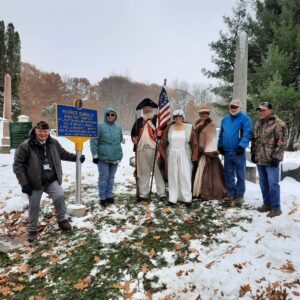
Fardink is the one who actively works with the Pomeroy Foundation on setting up Patriot Markers in Chautauqua County cemeteries to recognize the Revolutionary War Veterans buried there. This is a passion of Fardink's and he said 370 Revolutionary War veterans are buried in Chautauqua County.
"I don't think people really know the great number of patriot soldiers who are buried here," Fardink said. "What's also unique is that of those 370, not one was from here."
Fardink said after the French and Indian War which ended in 1763, King George III in October 1763 followed the Treaty of Paris to end the war with the French and established a territorial boundary following the Appalachian Mountains from Northern New York down to Georgia. Everything on the west side of the line was Indian Reserve and Chautauqua County was included in that reserve, with no settlers in the county at the time as it was mostly those in the Seneca Nation. Fardink said no settlers or white men came to the county until the 1790s or 1800s with the Holland Land Company.
"That just makes it interesting, because a good majority of those veterans were born in the 13 original colonies, but those in New York and Chautauqua County were mainly from Connecticut and Massachusetts, where my ancestor was from," Fardink said.
Fardink has done a lot of studying on the demographics of the 370 soldiers buried in the county, which has included making a powerpoint presentation that he has presented in a few places, including at the Daughters of the American Revolution's President's Day Lunch on February 21. There, he also received the DAR America 250 Commendation Award, something he said he was honored to receive.
"There was a lot going on with the 370," Fardink said. "My powerpoint talks about who was taken prisoner, who was wounded, where they served, etc."
Recognizing and celebrating America's 250th birthday is something that Fardink said is important because he feels that very few people realize the sacrifice that the patriots in the Continental Army went through. When they came home, Fardink said they did not have a Veterans Administration or medical support.
"They were lucky if they came home and their homes hadn't been destroyed or sold or the land hadn't gone unattended," Fardink said. "It was critical too, because of their lack of pay or the use of what they were paid with, which was this useless Continental currency. It became worthless, a nickel on a dollar."
Soldiers also faced promissory grants that never happened and received no pension. Fardink said they would come home to what was left of their farm that had hopefully been taken care of by their wives and children or neighbors, and it was not until 1818 that Continental soldiers were eligible for a pension. In 1820 it changed to a pension with it needing to be proven that there were needs based requirements.
"In other words you had to appear before a magistrate, which a lot of them did in Chautauqua County, and claim to be destitute," Fardink said. "How embarrassing and terrible. If they were 20 years old in 1776 they are now 64 years old and they had to go before a magistrate and say 'I'm destitute, I need a pension.' That's why it's so important. These patriot veterans sacrificed everything to defeat the British and give us our country."
The hardships that these soldiers went through are one of the most important things people should know about, Fardink said, because they did not come just during the war but at places like Valley Forge. The Continental Congress had no money to support George Washington or the army, and at Valley Forge things were very destitute. 22 of the Chautauqua County soldiers were at Valley Forge, and Fardink said his personal favorite was Drum Major Barnabus Wellman.
Wellman is buried in Wellman Cemetery on Wellman Road in Busti. Wellman served for four years, not just as a drummer but a drum major, or a senior drummer.
"He was right there with George Washington," Fardink said. "Drummers would play the different calls, like the call to formation or the charge. That's how soldiers knew what was going on at the battlefield by what was being played on the drums."
In his research, Fardink found that things were so bad at Valley Forge that Wellman ended up boiling his shoes and eating shoe leather to survive. Other hardships for the soldiers buried in Chautauqua County included 16 of them being taken prisoner in New York Harbour on Prison Ships, which Fardink said the worst one was known as The Jersey.
"I don't think people realize, but over 11,000 people, not just the soldiers but those deemed patriot supporters, would die in New York Harbour, either on the ships or in the prisons there," Fardink said. "16 of our patriot soldiers in Chautauqua County experienced that, and those are the 16 that survived and were able to move here."
Being responsible for the Patriot Marker program, Fardink said, he and the SAR have done 15 markers in cemeteries in Chautauqua County. With it being the 250th birthday year, Fardink said the plan is to put up five more this year. Upcoming ceremonies include at Allen Cemetery in Falconer on May 17, Dewittville Cemetery in Dewittville in May, with three others without dates in Tefft Cemetery in French Creek, Greenwood Cemetery in Stockton -- with Stockton also being named after a Revolutionary War veteran, Fardink noted -- and Redbird Cemetery in Ellery.
Fardink said the SAR will always get help from the VFW, American Legion and Jamestown Vietnam Veterans Honor Guard.
"We try to encourage maximum participation by the community, especially kids," Fardink said. "This is what's super important is that we involve our youth and that they really understand what the founders of this country went through. Some of them really paid the price."