
Equipment Replacement Included In Jamestown Fire Dept. Budget
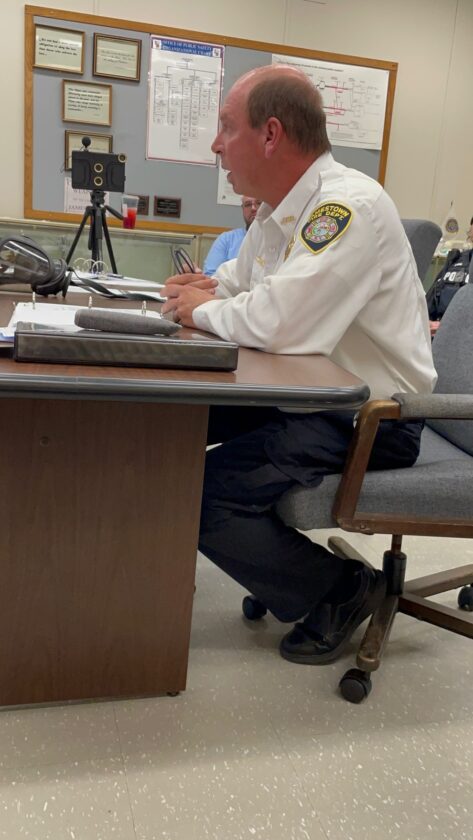
Deputy Fire Chief Matthew Coon presents the anticipated 2025 budget for the Jamestown Fire Department to the city council. P-J photo by Sara Holthouse
The Jamestown Fire Department’s 2025 budget is sound, but there are some big decisions coming in 2026.
The replacement of certain types of equipment, including the department’s most expensive truck, was among the big ticket items discussed for the Jamestown Fire Department’s 2025 budget during a budget presentation held during this week’s City Council meeting.
Deputy Fire Chief Matthew Coon presented the department’s budget to the council, beginning with a letter thanking the council and looking over some of the highlights of the budget.
“We are fully aware of what the fiscal state of the city is so we tried to present to you the budget that we think we can live with for next year,” Coon said.
Fire department staff has grown slightly over recent years due to ARPA and SAFER grant funding. Coon said there is grant funding to take those positions through this year while also decreasing the city’s Impact arbitration payments to zero this year. He added that as they go through next year the fire department will continue to evaluate to make sure they are being as fiscally responsible as they can be and that they can continue to provide the best service at the best cost to city residents.
Some notable items that are requested in JFD’s 2025 budget request in regards to salaries includes; all members of JPFA Local 137 will not see an increase in wages for 2025 following the expiration of the union’s contract with the city at the end of 2024, though firefighters will receive step increases that are included in their contract.
“All of the ARPAs and all of the SAFERs have all been onboarded, so the last of the SAFER group is going to graduate from the academy on Nov. 7 of this year,” Coon said. “So any replacements going into next year would be basically budgeted with this if the administration chooses to fund this.”
Additionally, Coon said the fire impact payments are expected to decrease to zero due to the anticipated opening of all of the fire stations and being fully staffed. The maximum impact payments if the department runs at nine members per shift would be just under $100,000. In more recent years, Coon said while the department has not been running at the full 10 members per shift, they have been budgeting for that.
Equipment replacement for the department includes turnout gear, which is everything a firefighter needs to wear to go into a fire. Coon said each set costs about $4,000 and for the department lasts about seven years, though they aim for a five year turnover.
“Generally what will happen is we will try to maintain the gear but what will happen is if the gear is serviceable we will have that gear repaired locally so it still passes inspection and then members will have a secondary set to wear if they get their clothing contaminated or if its soiled from fighting fire,” Coon said.
Each member does not get two sets, and instead Coon said they aim to roll it over as they continue along in the ranks.
The other gear that Coon said the department is looking to replace this upcoming year is the self-contained breathing apparatus, which allows firefighters to breathe when entering a fire. The apparatus is replaced in 15 year intervals and the department is looking to replace 32 of them next year through the awarded grant funds from the Assistance to Firefighters Grant.
“There’s an NFPA standard that requires replacement of these devices in 15 year intervals,” Coon said. “Generally the technology will change prior to getting to those 15 year benchmarks. Also for our equipment that way the air pack is designed to last just about that long.”
The purchase of 32 devices will be fully funded through the grant, which comes from FEMA, and cost about $10,000 a piece. Coon added that they are due to replace all of the devices in 2026, but adding them into the budget now with the grant puts them a year ahead.
“They’re getting to the end of their service life, and the other portion of that is the bottles,” Coon said. “The bottles have a 15 year service life as well. They take a lot of abuse just through general service.”
Coon said that the number of devices goes with the number of seated positions and it is not that each new firefighter gets a new one. It was determined that the department has 32 seated positions total, and while Coon said not that many firefighters are run each shift, the number allows for enough air packs to outfit the department for an initial response with full staffing, and again once over if there is a large incident. Air packs are not member specific, and the only equipment that is is the mask. Coon said that he understood that it is difficult to replace the entire inventory all at once, but there is a long history of the department replacing them all at once, giving them new inventory to last 15 years that stays consistent across the board.
Coon said the department is looking to replace its ladder truck, which will cost about $2.1 million and take four years after being ordered to be delivered. There is no funding for that purchase in the 2025 budget.
Coon also told council members the city’s second ambulance will be in use as soon as the radios are in it, and building maintenance goals, parking lot repairs, and other general budget expenses such as cell service, utilities, apparatus fuel, and replacement of things like computers and a new office copier.
Top stories

17 Democrats Ask Court To Enforce CLCPA
Former City Man’s Appeal Denied By Court
A former Jamestown man who has been accused of being part of a drug ring that included several Jamestown residents ...
Updated State Plan Aims To Assist Dunkirk
Cash-strapped Dunkirk could soon receive some much needed relief. On Thursday, state Sen. George Borrello and ...
Under New Management: Ashville Bay Marina To Receive Programming Facelift
Confirmed Closing: County Pushed To Save Company; Local Officials React To Closure
Wicked Warrens eyes improvements to hold banquets
A newly established Jamestown restaurant is getting some assistance as it looks to expand. During the Chautauqua ...