
Sundquist Reflects On Tenure As Jamestown Mayor
Trending
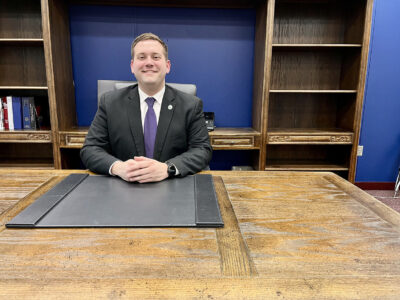
With two weeks still to go before the end of the year, framed photographs and a smattering of boxes lined the floor of Mayor Eddie Sundquist's office in the Jamestown Municipal Building. His desk and the shelves behind it were mostly bare as well.
The scene inside the fourth floor office Dec. 18 had all the hallmarks of a politician whose reelection efforts fell short one month earlier.
But Sundquist found himself in a vastly different position nearly four years earlier when he had his hands full with the arrival of COVID-19 just months into his tenure.
"I remember the first couple of council meetings we were talking about things like removing trees down on Third Street," Sundquist said in reflecting on his term that expires this Sunday. "We hadn't even heard of (COVID)."
He added, "No one knew what to expect. There's no handbook -- I searched this office hi and low for a handbook. At the height of the pandemic, the No. 1 concern was, 'How do we, as a city, come out with the least amount of fatalities possible? How do we keep the public, our community, calm throughout it?' It was a really difficult thing."
In addition to the pandemic and the influx of millions of dollars in recovery aid it delivered, the city also saw rallies and a heightened need for community policing brought on by the killing of George Floyd; the need for emergency shelter to combat a swelling homeless population; and the arrival of refugees that is expected to grow in the future.
"There's been a lot in four years," Sundquist said of his time in office.
It was COVID-19, though, that shaped Sundquist's administration in its infancy. The mayor was part of a regional "control room" with Chautauqua County Executive PJ Wendel that coordinated regularly during the pandemic to monitor Western New York's reopening plans.
The control rooms also allowed leaders an opportunity to air local concerns to state officials, including then-Gov. Andrew Cuomo.
"Jamestown was in the mix of it all," Sundquist said of the city's seat at the table during the pandemic.
Sundquist's term also coincided with the death of Floyd in Minneapolis, Minnesota. His killing in May 2020 resulted in protests across the country against the use of excessive force by police against Black individuals.
Sundquist, along with the city's police chief and Chautauqua County Sheriff James Quattrone, met with protesters at events held at Dow Park. The mayor remembered the meetings and the changes to policing that resulted.
"We asked, 'What can we do to be better? What is it that you see as an issue here in Jamestown?' And that resulted in just a complete change in the way we look at policing," Sundquist said. "We focused more on community policing. We focused on what they call hotspot policing. Where are the crimes occurring and how do we try to snuff those things out?"
During his time in office, the Jamestown Police Department established a community services outreach officer, added a comfort dog and a domestic violence unit.
During the pandemic, the city also saw an increase in shootings, something Sundquist said wasn't unique to Jamestown. "Our approach was to openly talk about it and to work through the community -- go after the illegal guns," he said.
With his term coming to an end, Sundquist acknowledged that some of his goals did not come to fruition while in office. That includes the creation of a municipal internet service.
"I think the pandemic really showed how vulnerable our homes and our children are to be able to access the internet," said Sundquist, who alluded to a feasibility study that showed the average cost of internet access is "just too high for a family in Jamestown."
Establishing a municipal internet service has taken longer than expected. The mayor attributed some of that to the state working with the federal government.
"I am still a big proponent of municipal internet service," he said. "We should treat the internet as a utility, and I think that is one area where I would have liked to see more. I think it was a timing issue. We're now starting to see funding slowly trickle down from the federal government to the states."
Regarding his accomplishments, Sundquist points to three areas:
-- the easing of financial stress the city had been under prior to 2020. That includes unresolved contracts with collective bargaining units.
"Our team was able to not only settle all of those lawsuits but also settle every single contract in this city, on top of developing a plan to deal with retiree health care for Medicare-eligible individuals," Sundquist said. "That was a huge undertaking because it brought labor peace in the city, something that we hadn't seen in a while."
-- the expansion of the police and fire departments.
-- workforce development.
"I was proud that the city was selected as part of the workforce development program, the 'Good Jobs, Great Cities' program, which was a national program with the Department of Labor to try to figure out what's the best model for workforce development, for retooling our community," the mayor said. "Because we need workers to build our bridges, to build our infrastructure."
Sundquist would not rule out ever running for office again; however, at present, he plans to move from the mayor's office to private practice as an attorney.
"I'm still going to help serve my community," he said.