DOD Outlines Demolition, Redevelopment Strategy
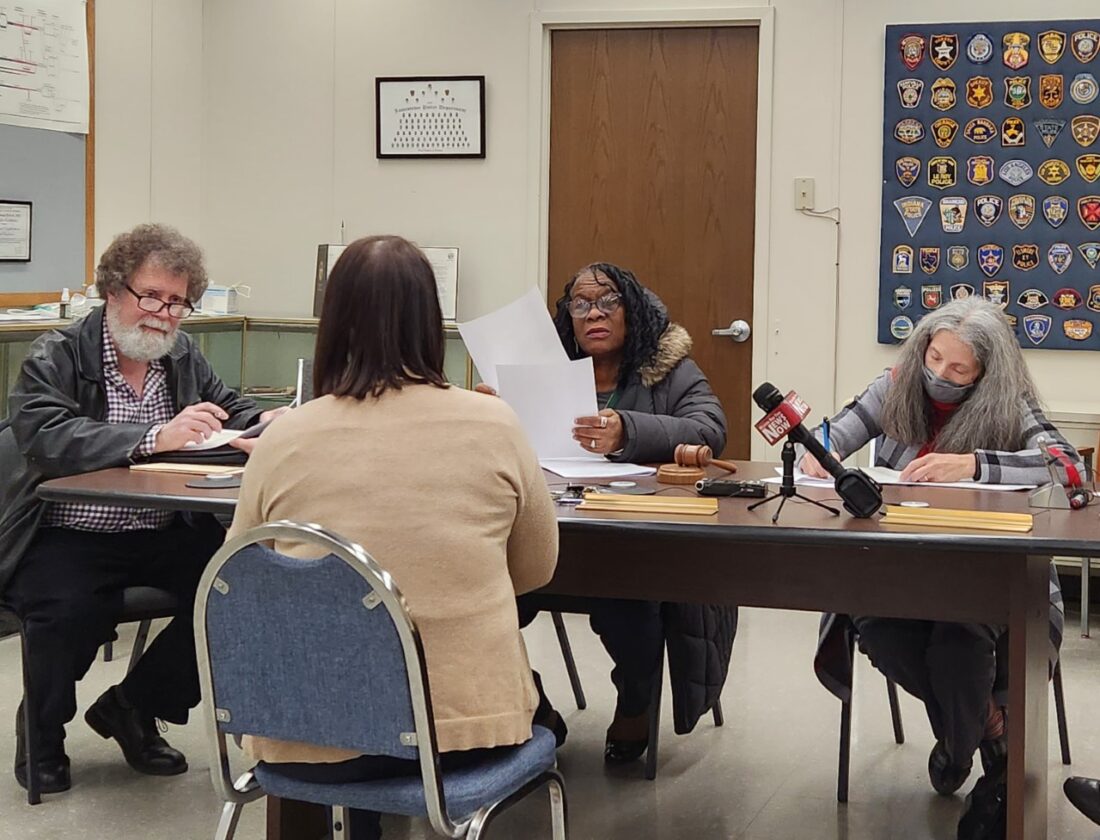
Crystal Surdyk, city director of development, outlined the city’s approach to demolition and the redevelopment of Jamestown during Monday’s Housing Committee meeting. Pictured, from left, are Councilman Brent Sheldon, R-Ward I, Crystal Surdyk, Councilwoman Regina Brackman, D-Ward III, and Housing Committee Chairwoman Marie Carrubba, D-Ward IV. P-J photo by Timothy Frudd
City residents may see quicker action on demolition activities in the city soon.
The Jamestown City Council’s Housing Committee received an update from the Department of Development this week, outlining the city’s demolition and redevelopment strategies.
Crystal Surdyk, city director of development, provided City Council members with a list of properties that are slated for demolition. She explained that multiple properties on the list are already in “some kind of phase” in the demolition process. Some of the demolition properties that remain a “high priority” for the DOD were previously started prior to funding running out.
With the City Council’s allocation of $1 million in American Rescue Plan Act funding for demolition and rehab programs through the Land Bank, many of these projects are expected to be completed.
“As far as the demolition funds go in our contract with the Land Bank, the Land Bank has a copy of the contract,” Surdyk said. “They now have to do their review process, so hopefully we’ll have a signed contract by the end of the week. They’re already working on there and as far as getting things lined up, so we can kind of hit the go button when we’re set.”
Surdyk also provided the Housing Committee with a list of potential demolition properties; however, she explained that the city requires additional investigation into the properties before confirming them for demolition.
After presenting City Council members with an update regarding the status of the city’s contract with the Land Bank and lists of possible properties slated for demolition, Surdyk presented the Housing Committee with an overview of the city’s demolition strategy.
“There’s some properties that just are structurally unsound and have to come down for public safety,” she said. “There are properties that we put more money into to rehab than what they’re worth and rehabbing them will not stabilize the neighborhood. Then there’s the strategic demolition, where we will look at okay, where are the vacant lots, where are other properties that the city already owns or Land Bank might own, or someone else has control of that, if we were to tear them down, could give us a really good location to do something like infill sort of development.”
Surdyk explained that the Department of Development is considering each of these categories and factors “all of the time” when the department approaches demolition. She stressed that from her perspective demolition is never the first option.
“I don’t like to demolish things because it goes into the landfill and leaves a hole in the urban fabric,” she said. “There are so many negatives that if we can avoid demolishing properties that is always my first choice, but in many cases, it makes sense.”
Regarding potential areas for infill development, Surdyk said the city is currently awaiting the state’s review and approval of a request for proposal for a comprehensive plan and zoning code update. Surdyk said she anticipates the state will finalize their review process within the next month so that the city will be able to send out the request for proposal and continue with the process of updating Jamestown’s zoning code.
“When we do a demolition, we do have a vacant property that is tucked between two houses,” she said. “Right now, our code is prohibitive of building something new, so as we do the zoning code update, that is something that we are going to take a close look at and adjust it so it makes sense, so it’s modernized.”
When considering the future of Jamestown, Surdyk said the city is currently in a difficult situation if a house is demolished and an adjoining property does not want to take care of the vacant lot. Without being able to build something new, in situations like these, the city ends up with a vacant lot that does not contribute any value to the community. As a result, Surdyk said the Department of Development is looking at all of the “different ways” to be able to make demolished property parcels “productive” and put the vacant lots back on the tax roll.
“There are a lot of different ways that we have to come at it but the zoning code and comprehensive plan will help steer us in that direction,” she said. “When we’re talking about the next five years, so much of the work that we’re doing right now, we’re not going to see benefits from for the next five years. That’s just what it is. It’s how long it takes.”
Surdyk said the city has also been involved in conversations regarding redevelopment opportunities such as modular housing in Jamestown. Recently, the city conducted a show with a Pittsburgh-based modular housing company called Module. According to Surdyk, the company recently received a housing grant and incorporates workforce development as part of the company’s model.
“They get college students in, so just like the partnering with Jamestown Community College, we’ve been talking with Module about that as a potential opportunity to partner with them on doing that,” she said.
Surdyk explained that the company is considering Western New York as a potential location to establish a manufacturing facility for its modular housing.
Surdyk indicated that partnering with a development company like Module could present the city with an opportunity to engage in pilot projects for net zero buildings, housing developments that meet the state’s climate action goals and requirements and utilize geothermal or micro grid technologies.
“Let’s try a bunch of different things and look for the different funding opportunities along with them,” she said. “Maybe it’s not Module, maybe it’s someone else because there are a lot of those companies out there now. Let’s bring it here and find a way to test it out and also partner with the college to get that workforce development training.”
Top stories
Confirmed Closing: County Pushed To Save Company; Local Officials React To Closure
Wicked Warrens eyes improvements to hold banquets
A newly established Jamestown restaurant is getting some assistance as it looks to expand. During the Chautauqua ...
Employees React To Bush Closure
One day after saying it had no public information to share, eSolutions, formerly known as Bush Industries, ...
eSolutions Says Market, Tariffs Are Reasons For Bankruptcy
The eSolutions Furniture Group is pursuing bankruptcy in a Canadian bankruptcy court, leading to the decision to ...

Jamestown airshow proposed in 2027