Longtime UPMC Chautauqua Employee Recalls Career
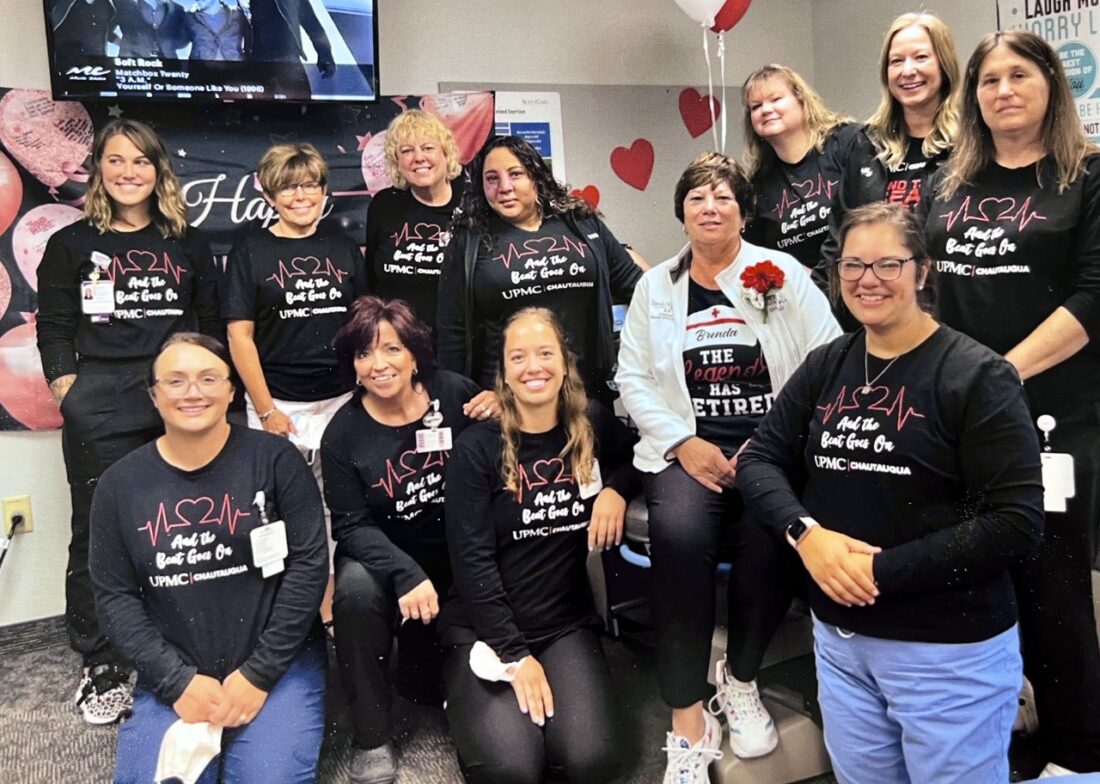
Brenda Fitzgerald, in white jacket, is pictured with her former co-workers at UPMC Chautauqua. Fitzgerald worked at the hospital for more than 40 years before retiring in August. Submitted photo
Bright-eyed and young, Brenda Fitzgerald always enjoyed meeting the nursing students who were nearing graduation.
Their energy and enthusiasm, she noted, was sometimes contagious.
When she left school decades earlier, nurses either worked in hospitals or nursing homes. Today, she said, there’s a host of career options: travel nurses, school nurses, public health nurses and clinical nurses, among many others.
“To see their passion, they are way more world-smart than I was in the ’70s,” Fitzgerald said of fourth semester students who came to the cardiac rehabilitation department at UPMC Chautauqua as part of their education. “I would tell them to give themselves some time, figure out where they want to go in their career.”
In her 40-plus-year-career, Fitzgerald worked in a variety of positions.
She graduated from Jamestown High School in 1975 and received a nursing degree two years later from Jamestown Community College.
Except for two years as a nurse at Brooks Memorial Hospital in Dunkirk right out of college, Fitzgerald stayed at WCA Hospital, and later UPMC Chautauqua, for her entire career.
ALWAYS LEARNING
“It’s changed immensely,” Fitzgerald told The Post-Journal of nursing today compared to her first years on the job. “When they say you can’t teach an old dog new tricks, you can, really. I’ve had to learn a lot of different things over the years.”
She was hired at the Jamestown hospital as a registered nurse in 1980. She moved to the intensive care unit where she worked for 14 years and eventually landed in the cardiology department.
In 2000, Fitzgerald took over the cardiac rehab department and remained in that position until her retirement this past August.
“When I started there really was nothing computerized,” she recalled. “It was all hand-written notes; doctors prescribed hand-written orders.”
“Eventually, we learned a lot of different techniques,” she said. “When we had new doctors coming in, we learned new procedures and new equipment, obviously. But it definitely changed over the years for the better, obviously, too.”
Before the hospital utilized helicopters to transfer patients to-and-from other facilities, Fitzgerald recalled the many trips she took inside the back of an ambulance. When she worked in the intensive care unit, it wasn’t uncommon for her to travel with a patient to ECMC in Buffalo. By the time she got back, it was late and her shift was already over.
“There was always a snowstorm,” she said of those long trips. “That’s part of living in Western New York. We never felt unsafe. Some of those trips stood out — getting those patients and ourselves there safely.”
TAKING CARE OF
THE SICK
Working in ICU meant caring for seriously ill patients with life-threatening conditions. While Fitzgerald worked in the unit, WCA kept many of the car accident victims, trauma cases and surgical patients that were complicated.
Today, many of those patients are transferred to larger hospitals in Buffalo or Erie, Pa., that can provide specialized care.
“We took care of patients who were hopefully going to survive,” Fitzgerald said. “They didn’t always survive. … A lot of the patients were locals, neighbors, friends, family.”
While she cared for countless people during her career, some patients stay with her.
While pregnant with one of her four children, there was a 13-year-old Canadian boy who slipped during a skiing trip in Ellicottville with his family and struck his head. The boy was braindead, and Fitzgerald remembered having to delicately work with the family to discuss organ donation.
“I remember crying with the mother,” she said. “The mother actually made me cry. She was singing ‘Rock of Ages’ to her son as they were preparing to take him off the respirator. I don’t think I’ll ever forget that. That was probably the hardest of all of them that I can remember.”
She moved from ICU to cardiology as it afforded her a better work schedule to raise her children. Whereas many patients in intensive care are bedridden, the cardiology department often requires getting patients up and moving around.
A TRANSITION
Fitzgerald believes the integration of WCA and UPMC toward the end of 2016 provided the Jamestown hospital with an important lifeline.
“Switching over from a small community hospital when it was WCA, and then switching on to UPMC, we probably wouldn’t have survived as a small community hospital without that change,” she said.
The level of care was enhanced by the integration. At the time, the Pittsburgh-based health care giant committed to providing at least $25 million to the local facility.
In May 2017, a ground-breaking ceremony was held for a new women’s and maternity care center and inpatient adult and adolescent mental health units.
“The care locally stayed the same,” Fitzgerald said. “I believe there was a lot of heart and compassion for patients, and then as the employees had to adjust to give that care, that was probably the biggest challenge.”
AND NOW MORE TRANSITION
When Fitzgerald took over the cardiac rehabilitation department in 2000, she knew it would be the last stop in her career. Despite having more than 40 years in the profession, there was always new training and dealing with computers.
With a pulmonary rehab program about to open, she figured it was time to allow others to come in and take over.
In January, she made the decision to set a retirement date. However, once that happened, she had a hard time talking about it, even to those she worked with.
“I didn’t want to talk about it,” Fitzgerald said. “I didn’t start counting down the days until August.”
Of course, there were some mixed feelings as her final day neared. When it did arrive on Aug. 19, she was surprised by her beloved co-workers with an open house where some of her previous cardiac rehab patients stopped by to wish her well.
“It was very emotional,” she said.
When she left UPMC Chautauqua for the last time, “It didn’t feel real to me. It kind of felt surreal, like I wasn’t really leaving for the last time. It kind of felt like, ‘I’ll be back in a couple weeks. I’m just taking a vacation.'”
Fitzgerald lives with her husband, John. They have four children, Michael and Sean Fitzgerald, Michele Clark and Shannon Quackenbush, as well as seven grandchildren.
Since retirement, she has babysat some of those grandchildren and has plans to go on vacation.
Top stories
Lawmakers Want Senior Dental Care On Marketplace
SKF: 2026 Outlook Unchanged

‘Singing Truth’: Rodney Atkins, Gary Allan To Perform In Salamanca In August
Unitarian Church Hears From Non-Profit Founder
She didn’t plan on starting a non-profit organization. But when Randolph native Destiny Gates lived in a ...
Committee Defeats Borrello Electric Bus Repeal