Chautauqua Breaks Ground On Watershed Work
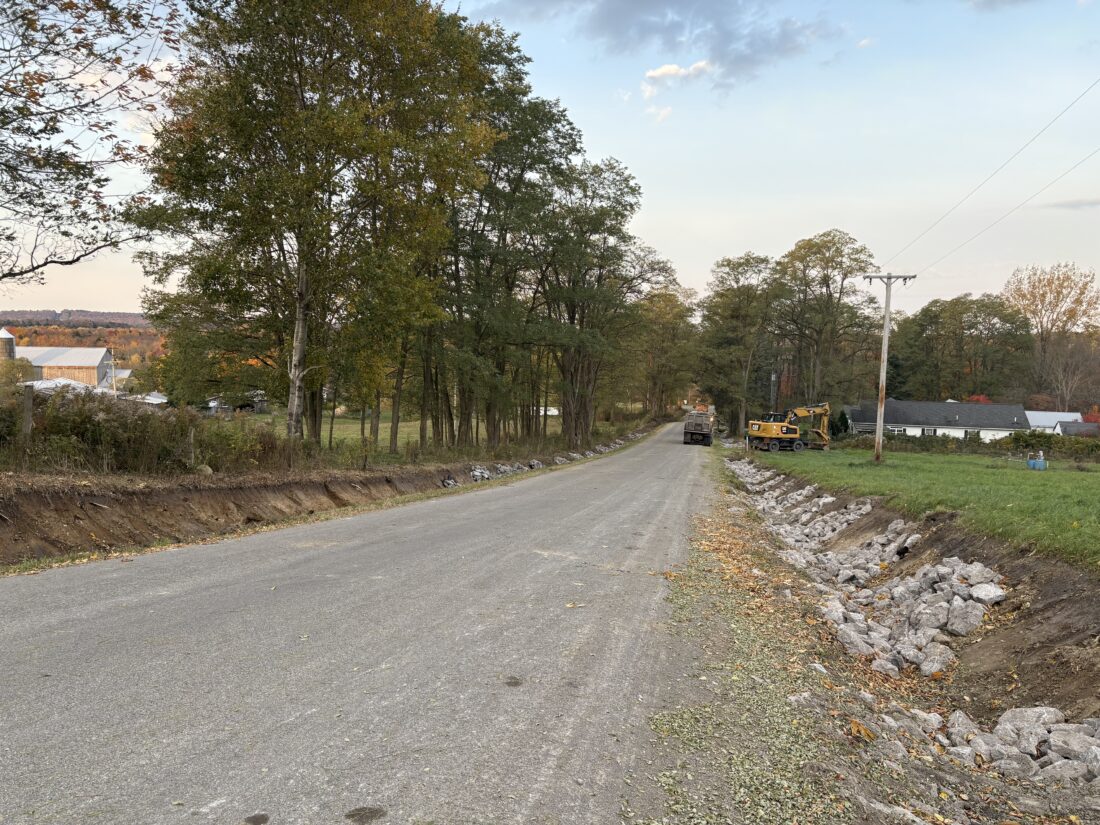
Pictured above are newly constructed swales along Haight Road in the Town of Chautauqua. Stone check dams at right are designed to slow stormwater and reduce the flow of nutrients and sediment to Chautauqua Lake. Photo by Randall Perry.
The town of Chautauqua Highway Department has been hard at work improving the lake’s watershed this fall, getting a head start before the county was hit by a recent string of winter storms.
While activity on the lake winds down during the colder months, water quality improvement projects in upland areas often continue to make progress year-round. In this case the ‘Chautauqua Roadside Swales Stabilization Project’ stems from a state grant award secured all the way back in 2021.
“It is great to see the town begin construction before winter hits,” said Randall Perry, alliance executive director. “These state grant projects work on fairly long timeframes, so it can be several years from the time you write the grant application, secure the award, complete the engineering, get your materials, and actually put shovels in the ground. A lot of this work in the watershed is going on quietly in the background, and these types of projects will provide significant water quality benefits for years to come.”
In this case, the history of the Chautauqua swales project actually goes back further than the state grant award. From 2017 to 2019 the town partnered with the village of Mayville on a stormwater management engineering study for a portion of the lake’s northern watershed. Among the many pieces of information produced by this document were a list of recommended improvement projects, including plans for retrofitting roadside swales. These sorts of planning and engineering studies are oftentimes a key first step towards pursuing shovel-ready projects.
Around 100,000 acres of land and 300 miles of streams feed the lake with water on a constant basis. With that water comes nutrients that fuel plant and algae growth, as well as dirt that gets washed away and deposited at creek mouths. The goal of the Chautauqua swales project is to improve about three miles of roadside ditches at around a dozen different sites. A similar project was completed in the Town of Busti in 2022, and there are a number of different ways that this work aims to improve water quality.
Following engineering plans from Barton & Loguidice, the Town Highway Department will regrade roadside ditches and construct features designed to slow and filter stormwater. Common techniques include building stone check dams, stabilizing shoulders, native plantings, hydroseeding, and installing special materials that can actually capture nutrients before they enter the lake. Addressing erosion with these practices doesn’t just help keep sediment out of the lake, it also improves roadway safety and prevents land loss. While these types of projects use similar best management practices, they are also designed to suit individual worksites and communities. With this work taking place in the Town of Chautauqua, the engineers prescribed specialized shoulder stabilization designed to accommodate the buggies of the community’s Amish population.
You are never going to perfect your watershed, but projects like these are significant steps in the right direction, particularly for a lake that is impaired by excessive plant/algae growth and sediment loading. The only way that these long-term state grant awards make it all the way from engineering study, to application, to completion, is through collaboration. In this case, the Town’s Highway Department was able to leverage state dollars by performing the construction themselves. On other projects grantees can elect to hire an outside firm for construction.
These projects also require the hard work of municipal staff and officials who understand how the process works and want to bring state dollars to bear on local issues. Local cash matches can also be an important component, which can be provided by the municipalities that receive the grants, or local contributions. No matter the approach we are very fortunate to have local grantees and funders willing to tackle these important jobs. “We’re proud to work with our Alliance Members to identify local needs and state funding opportunities to address them,” said Perry. “There are a lot of partnerships needed to take these projects from the conceptual stage, all the way through to completion.” State funding for this project was provided from the Environmental Protection Fund as administered by the New York State Department of Environmental Conservation.
Local News
Jamestown to use new mobile parking payment system
Motorists in the city of Jamestown now have new options when it comes to mobile parking payments, though other ...

‘Wonderful’ results
4-H meat animal sale takes place July 24

How to handle a layoff as a working senior citizen
What does patriotism look like?
I hope you’re feeling a little more patriotic. The visiting international spectators at the FIFA matches should ...