
Performance About Holocaust Set At Jackson Center
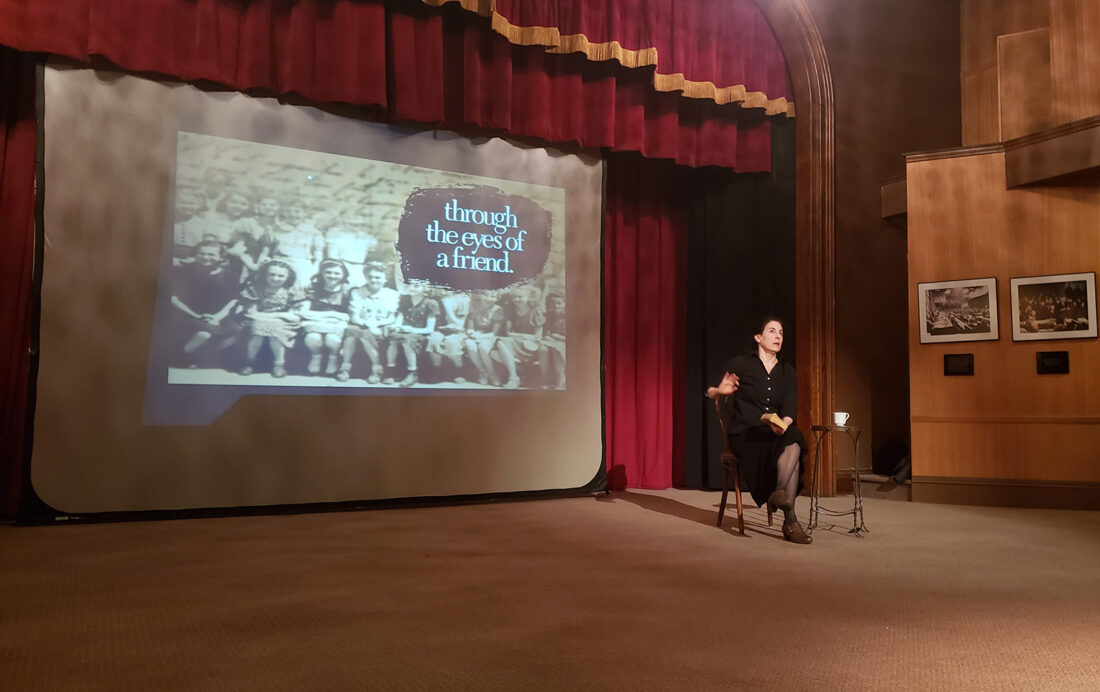
By using historical perspectives based on real people and events, Living Voices combines live performance with audio/video, visual aids, and discussion. Submitted photo
It’s a personal view that brings life to history.
When teaching about the Holocaust in school, Anne Frank is usually discussed. The curriculum connections are plentiful — in history classes, students learn about World War II, world history, ethnic studies, and in English Language Arts classes, students learn about Anne Frank through books, plays, and movies. The subject matter is still very relevant today.
“Living Voices: Through the Eyes of a Friend” will be performed in the Cappa Theatre at The Robert H. Jackson Center on Tuesday, at 10 a.m., 1:15 p.m., and 7 p.m., and Wednesday, at 10 a.m., and 1 p.m.
According to roberthjackson.org, during the live, interactive performance, the audience will bear witness to the world of Anne Frank and other young people living through the Holocaust, from the point of view of Anne Frank’s “best friend.” Sarah is an historically accurate composite character, based on the testimonies of those who knew Frank, as well as other victims, resisters and survivors of the Holocaust and World War II. Like Anne Frank, Sarah is a young Jewish girl in Amsterdam when Hitler comes to power in the 1930s, whose experiences under Nazi rule, in hiding and through the concentration camps parallel Frank’s story.
“The actress in this instance, starts by asking the audience questions and really trying to get a sense of what is the information base, said Kristan McMahon, center president.
“It’s an audio visual (performance). While she is acting, there are images being shown on the screen behind her. There might be voices, because in some instances, she’s having a conversation with characters, but since she’s one performer, those conversations are part of the the audio-visual part of this,” McMahon added.
Once the performance is complete, McMahon noted, the actress will go into question/answer mode with audience members to “allow them to ask questions on anything they heard or experienced, or any of the audio visuals that they saw.”
McMahon said through Living Voices, the center also offers programs on immigration, suffrage, and civil rights. She said the program is artistic.
“This is a great way to start introducing pretty complex subject matters and pretty complex thoughts., in a way that students can digest it, understand it, not be frightened by it. So, this is all part of that priming, of that education ramp to more complex subjects,” McMahon said.
Livingvoices.org noted that by using historical perspectives based on real people and events, Living Voices combines live performance with audio/video, visual aids, and discussion. Archival film and photos, blended with sound and synchronized with a live actor, provide a dynamic, interactive experience of how the world looked, sounded, and felt during a significant time in history. The website said the recommended age of the audience is fifth grade through adult, and it covers common core educational standards such as reading, speaking and listening, and literacy in history/social studies.
Local News
Trolley Car 93 project marks car’s 100th birthday with poster project
Southwestern officials honor retiring teachers
Ripley man injured after being struck by train
RIPLEY --- A Ripley resident escaped serious injury after being struck by a train Saturday evening. Chautauqua ...
‘Start soon’
A long awaited housing project in Westfield has yet to begin, but one county leader believes it will start before ...
America gleams from sea to shining sea during World Cup
Falconer Christmas events may be one-day festival
The village of Falconer may be getting a little bit jollier this December. Nikki Pierce, a member of the Falconer ...