
Bizarre Trees
Trees can be the backdrop to our outdoor adventures. They are key in defining the forest. But how often do we take in the bigger picture and not focus on the individual? Earlier in the year trees get plenty of attention for showy flowers, interfering pollen or delicious fruit and in the fall for their short bursts of color.
Now that the beautiful colors of deciduous trees are once again memories, we are left with their skeletons – the tall trunks and bare branches that hold next spring’s buds.
The branch shapes as well as buds, bud scars and bark can indicate identity down to the species. However, what caught my eye on recent warm winter walks are the bizarre things that trees do. They are hardly ever the perfect shape. Even as we search for Christmas trees that are grown, heavily pruned and often sprayed with the goal of perfection in mind, we struggle to find a tree without a flaw. There is always the good side that faces the room and the not-so-good side that faces the wall.
So with an attitude that embraced imperfection I went out in search of the bizarre, the wonky, the incredibly ridiculous trees and the shapes that tell stories of damage, survival and competition.
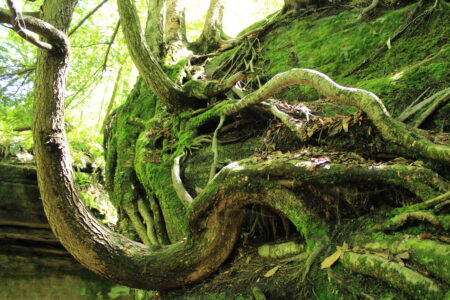
At College Lodge, a State University of New York at Fredonia property, I walked through a hemlock forest. Many of the trees have long, leggy roots. “Giraffe trees” I’ve heard them be called by kids, for their trunk extends up above these exposed roots. Along the trail the roots of an eastern hemlock and yellow birch were intertwined, as if holding hands.
I can imagine these two starting their lives as a seed – one of hundreds fortunate enough to fall on a moist decaying log. The old forest gives birth to the new as the two seedlings use the nutrients from the old tree and the moisture it holds to grow. At the same time they destroy the nurse log that supports them. While the old tree’s energy lives on in the current trees, all that is visible is negative space. A hint of its shape remains in current trees roots that had to reach over and around it. (Kids’ adventure hint: While exploring hemlock/birch forests like these with kids, it is fun to crawl in between the roots.)
While hiking in Blue Knob State Park in southern Pennsylvania, a funny tree caught my eye. I’m afraid I didn’t pay much attention to the kind of tree because the shape was so odd. It had a little kink or fold in the trunk. The trunk grew straight up for about 4 feet and then took a 90 degree turn for 2 feet and then continued straight up. It reminded me of the trail trees that have popped up on social media recently. The idea is that Native Americans and perhaps early settlers shaped young trees to mark a route to a significant location.
I don’t want to romanticize this tree. This particular tree, along with the surrounding trees, didn’t seem to be any older than I am, so I doubt it was shaped by people 200 plus years ago. Its kink was more likely shaped by natural causes such as disease or damage. But the idea that we use trees so we, both the tree and the humans, live captures my imagination.
After the sun sets I “walk” through old pictures. I found a photo from a trip to Yosemite National Park. I recall hiking up to the top of a mountain. I left the car in sun and warmth but questioned the absence of railings at the top of the mountain. It would have been comforting to hold on to something in the wind and snow at the summit. On this mostly barren mountain top stood one tree. It was long dead but beautiful with its curves and weather-worn wood. It was still anchored in the rock, its trunk twisted from years of living face on into the weather- sun, wind, snow, rain and more.
I was told about a woman who, when pregnant with her children, wanted to walk in forests of big trees. I wonder, as she faced major changes in her own life, she found comfort and strength in the trees.
These trees grow where they are planted. The seed has no choice weather it lands on a rotten log, is dropped by a bird on a rock or buried by a squirrel in rich, loamy soil. Once there, they do the only thing they know. Get what they need, make food and grow. They heal themselves when damaged, even when it makes them look bizarre.
Every day they reach out for resources – sun, water, air – nutrients in order to survive. And it doesn’t matter what they have to reach for. Trees literally break rocks to survive.
These trees are shaped by the genes inherited from their parents but are also shaped by their surroundings. There is evidence or the constant weather, the damage from storms, insects, fire or even humans. Some break but some keep going- living.
Katie Finch is a naturalist at the Jamestown Audubon Nature Center located at 1600 Riverside Road in the town of Kiantone, one-quarter mile east of Route 62 between Jamestown and Warren, Pa. Our trails are open year round from dawn until dusk were you can find almost perfect and far-from-perfect trees. For more information, visit our website at jamestownaudubon.org, or call 569-2345.
Nature
Bryophyta And No Rolling Stone
Staying Warm During A Cold Winter

What To Know About When We Get So Much Snow

The Secret World Beneath The Snow
There Is Life Beneath The Snow
Winter Exposes Troubled Trees, Bark
The seasons are changing from fall to winter, and one of the major changes to the environment is that the deciduous ...