No Decision Yet On Chautauqua Lake Lawsuit
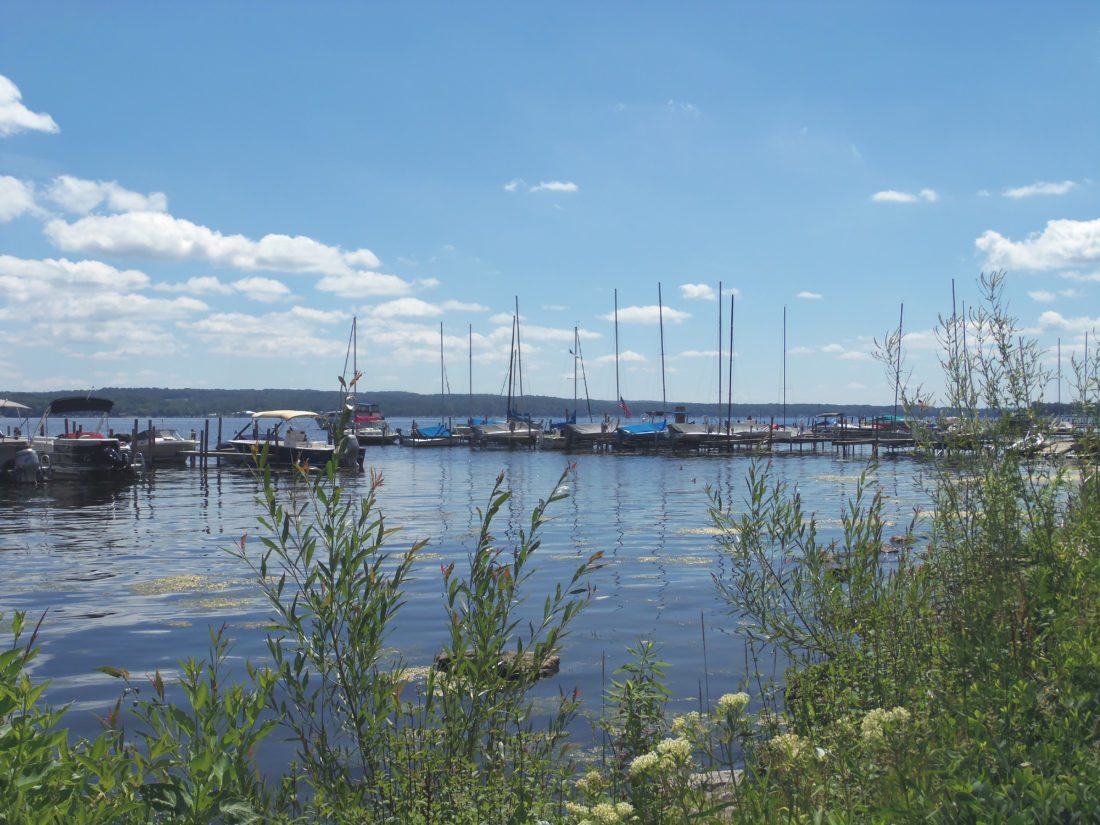
Docks are pictured on Chautauqua Lake in this file photo. Two Chautauqua County organizations have filed lawsuits seeking to annul the state’s Freshwater Wetlands Act, with two more lawsuits filed in state Supreme Court in Albany also seeking to annul the new wetlands regulations. P-J file photo
It’s been nearly two months since oral arguments in four lawsuits challenging the state’s Freshwater Wetlands Act were heard in state Supreme Court in Albany.
There are four total lawsuits that were part of a consolidated oral argument on Jan. 30. The first lawsuit was filed by the Chautauqua Lake Property Owners Association, followed by the Chautauqua Lake Partnership. Lawsuits were also filed the village of Kiryas Joel and the town of Palm Tree as well as the Business Council of New York state with seven co-plaintiffs. The suits raised many of the same issues, though the two Chautauqua County lawsuits raised issues specific to Chautauqua Lake.
When a decision may be handed down by state Supreme Court Justice Richard Platkin is uncertain, but the transcript of the Jan. 30 oral arguments provides some light on aspects of the cases the judge felt needed more discussion.
“I think we have all covered a lot of ground here and I appreciate counsels’ arguments,” Platkin said after a day of oral arguments. “You have all given me a lot to think about.
So, I’m going to reserve decision, ask the parties to purchase a transcript from the court reporter, get it filed on NYSCEF when you receive it, and I will work on
trying to resolve these issues.”
Of all the arguments raised in hundreds of pages of legal briefs and the administrative record generated by the state DEC, Platkin needed more clarification from the attorneys whether or not the jurisdictional determinations the DEC uses to determine whether or not an area is a wetland creates an actionable injury to lakefront property owners.
Meredith Lee-Clark of the state Attorney General’s office argued on behalf of the DEC in all four cases.
“There is no proof before this court that they have sustained any sort of direct, concrete injury,” Lee-Clark said. “When it comes to the Chautauqua Lake jurisdictional determinations, no one has challenged those jurisdictional determinations, to my knowledge. And the application that those permit applicants sought, the permission that they sought was to apply herbicides, pardon me. And they were able to do that within the window of application. There was simply no injury that flowed from the fact that the area within which they wanted to apply those herbicides was now considered jurisdictional.”
Platkin asked Lee-Clark whether or not people who are subject to a positive jurisdictional determination that they didn’t seek are harmed by the new regulations. Lee-Clark responded there is no evidence of decreased property values or any sort of stigma.
“So, the burdens of being subject to the regulatory scheme and the permitting scheme, aren’t an injury, in your view?” Platkin asked.
Allison Giuda, the attorney representing the Chautauqua Lake Partnership, argued that the opposite.
“if you have wetlands and you take steps without getting a permit under both regimes, you are subject to civil
and criminal enforcement,” Giuda said. “So, yes, immediate injury, no matter what factors are being considered.”
Another area where there was significant interplay between the attorneys and the judge was the whether or not the regulations should apply to inland lakes – though Platkin pushed the attorneys for the Chautauqua Lake Partnership and Chautauqua Lake Property Owners Association on what, exactly, they were challenging.
Giuda argued that Environmental Conservation Law Article 15 is meant to regulate lakes and surface
water bodies while Environmental Conservation Law Article 24 is meant to regulate wetlands, marshes,
swamps, sloughs, bogs, and flats. The Freshwater Wetlands Act, she argued, is different from the purpose of Article 15.
While Lee-Clark had argued that there was no injury to the lake organizations by having to get a jurisdictional determination and a heightened review of herbicide applications that fell within areas determined to be wetlands, Giuda argued that the issue caused a delay in the summer of 2025 and an overgrowth of invasive species in the late summer months.
“I understand that, but I guess I’m not sure what exactly you are challenging,” Platkin said. “I mean, it’s not the statute and it’s not really even the regulations. I mean, it just seems like you are challenging the application of the statute in the particular jurisdictional determination.”
Giuda responded by pointing back to the state’s conservation law.
“I would agree that there is nothing in there that says that lakes should be regulated,” Giuda said. “And to
the contrary they should not.”
Platkin then turned the question to Lee-Clark.
“I mean, lakes aren’t wetlands, right?” Platkin asked. “Are they?”
Lee-Clark said Chautauqua Lake has always been a problem because it is relatively shallow and weedy. Because it is shallow and weedy, Lee-Clark said, there is a need for permits under both Article 15 for those who want to control invasive species as well as Article 24 because they want to apply herbicides in areas that also qualify as a wetland.
“And the portions of Chautauqua Lake that are now regulated have always met these statutory definitions that we discussed earlier that have always been in place since the beginning of the Freshwater Wetlands Act,” Lee-Clark said. “So, DEC is certainly not saying that a lake is a wetland. However, a portion of a lake, including this shallow portion that qualifies as a wetland under the statutory definition, as well as its adjacent area, which can extend into the lake, can be regulated under Article 24. And the fact that it also regulated under Article 15 is not exclusive of jurisdiction under Article 24. They do different things.”
Top stories

State Legislators Try Again On Rural Treatment Rules
No Decision Yet On Chautauqua Lake Lawsuit
CHQ Transit Hub Receives Approval
Former Bank Becomes Home Of New Gift Shop
Public Works Committee Talks Equipment Purchases