Jefferson Project Issues Lake Report, Stream Stations Under Construction
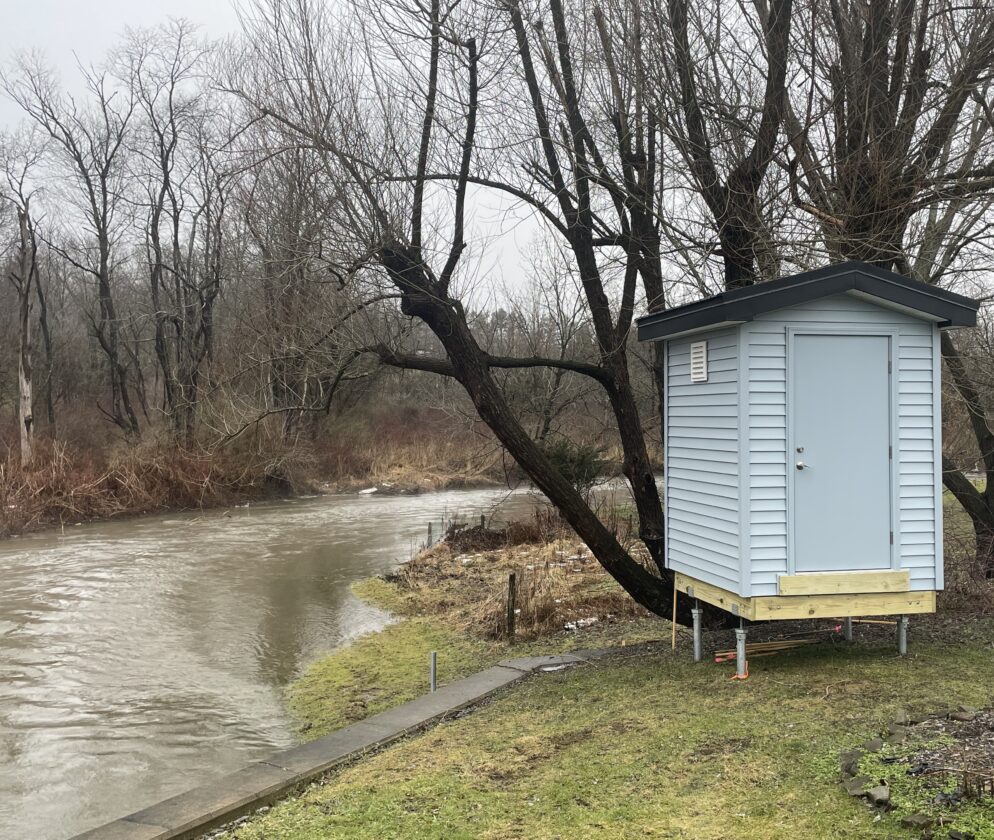
Pictured above is a stream monitoring station located along Goose Creek. This is one of six stations under construction by The Jefferson Project and Chautauqua Institution thanks to funding from the Ralph C. Sheldon Foundation.
The quest to better understand and ultimately address harmful algal blooms on the lake took a major step forward on Wednesday when The Jefferson Project delivered its 2023 report to the Chautauqua County Legislature.
Dr. Kevin Rose of Rensselaer Polytechnic Institute and Dr. Harry Kolar of IBM Research led the presentation, while County Executive PJ Wendel and Chautauqua Institution President Dr. Michael Hill offered remarks on behalf of local partners. The evening’s presentation offered a glimpse into all that has been learned thus far, while also laying out next steps for research and work. In addition to the presentation, a recording of which can be found on the County Executive’s webpage at chqgov.com/county-executive/county-executive, the full written report is available at bit.ly/jp_cl_2023 on the County’s Planning Department website.
Starting in 2020 this group launched a comprehensive water quality and ecological monitoring program on the lake. Most visible are The Jefferson Project’s vertical profilers–floating monitoring stations deployed to the North and South basins each year which record a dizzying list of data on water conditions. Research also involves advanced computer modeling of the ecosystem, lake current measurements, satellite imagery, direct water sampling and testing, and a new algal growth study that was added in 2023.
Taking and adapting its blueprint from ten years of work on Lake George, The Jefferson Project has rolled out its Chautauqua program in several stages. The latest step in this rollout is the construction of six stream monitoring stations, which will collect important information about the waters feeding our lake. The stations will operate year-round, have the ability to pull water samples directly from streams, and include a suite of sensors that can rapidly monitor things like flow, temperature, oxygen, and nutrients. While stream monitoring has been done in the past, this will be the first time that continuous stations are in place to record the ‘diet’ of water that is being ‘fed’ into the lake. Just like a person, improving the health of the lake starts with understanding what is being fed into it. Stations are scheduled to be operational this year on Dewittville, Mud, Prendergast, Ball, Bemus, and Goose Creeks, while a seventh station will monitor flow in the Chadakoin River.
A main focus of this work is establishing a nutrient budget for the lake. That is to say–getting a clearer picture of how nutrients enter, exit, and cycle within the system. In the same way that a doctor will look at a patient’s blood panel to get a picture of their health before prescribing a treatment, scientists will monitor nutrients to better understand lake impairments like HABs. The presentation to the Legislature highlighted the importance of both the internal loading of nutrients (from within the lake itself), and the external load (from land draining to the lake). While we continue to address the external load–via watershed work like extending public sewers, restoring streams, managing stormwater, and improving agricultural practices–the internal load remains a gap that requires our attention. By continuing to seek answers to these questions we can adjust how we manage the lake and watershed to give ourselves a better chance at reducing, preventing, or even predicting HABs. We have known for some time that phosphorus is a major health issue for the lake, a problem in its ‘diet’. However, questions remain about: How much of this nutrient are we dealing with? Where is it? When is it causing problems? The new stream stations are a major step in getting a better handle on the lake’s external nutrients, and will serve as a guide to address them more directly.
We have many partners to thank for making this work possible, as well as funders. Chautauqua Institution and the County have provided The Jefferson Project with operational funding since 2020, and the construction of the stream stations was made possible by a grant from the Ralph C. Sheldon Foundation routed through the Alliance. In the past, local stakeholders have often looked to the work being done on other lakes for examples of how best to understand and address our HABs. Now, thanks to the expansion of local research by multiple groups working together, Chautauqua Lake is charting its own path forward.
Top stories
Four buildings in Brooklyn Square sold for $2.1M
Local author seeing spike in international reviews on books
‘… A Very Devastating Disease’: Through Son’s Ordeal, Mom Stays Upbeat
Americold being restructured, lowers hiring projections
One Of A Kind: Italian Festival to return to St. James Parish in July