Potential Partnership
Council Considers Bird Bike Share Pilot Program
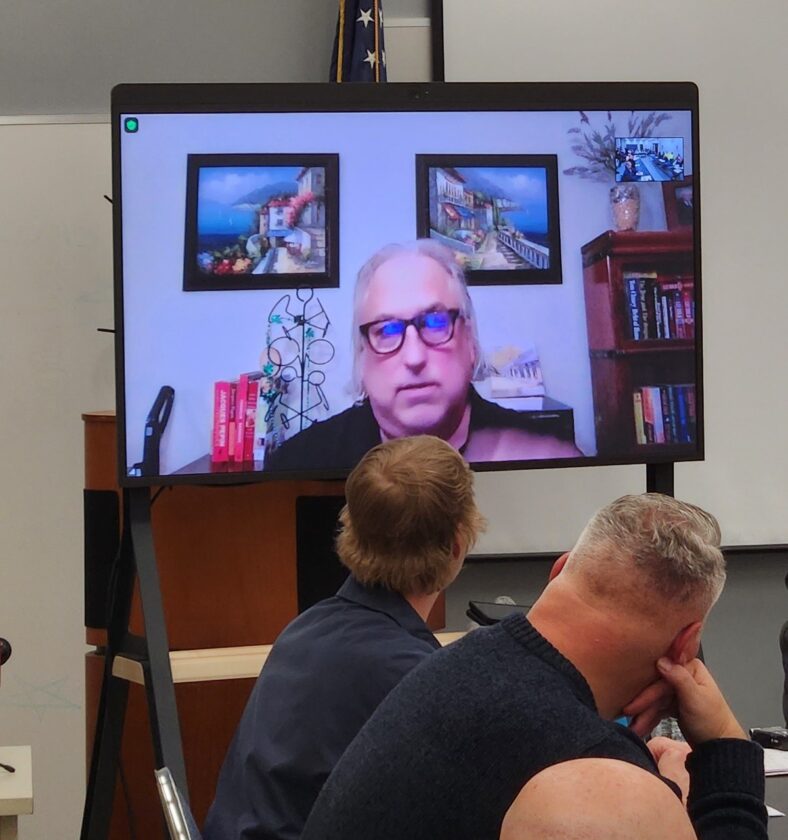
Pictured is Jeremy Lynch, who presented the City Council with an overview of the Bird Bike share program for the potential incorporation of an electric bikes and scooter pilot program in the Jamestown area. P-J photo by Timothy Frudd
The City Council is considering a resolution that would provide an electric bike and scooter program for the Jamestown community.
A presentation on a pilot program for electric bike and scooter rentals in Jamestown was held during Monday’s City Council work session. The city administration has been working with Bird Bike Share to develop a potential pilot program for the city that would provide residents without vehicles with an alternative form of transportation at an affordable cost.
Mayor Eddie Sundquist explained that the city had previously considered a similar program that could be adopted by the city for an electric bike share transportation method.
“In that time since, we’ve been having some conversations with Jeremy Lynch, who’s from Bird Scooters, about the city as well as about a potential partnership,” he said. “Bird is a bit unique as a company that focuses on micro mobility, both e-bikes and e-scooters.”
While other communities like Dunkirk have already implemented an electric scooter program, Sundquist explained that his administration was not “sold” on the electric scooters for Jamestown.
“We had a lot of heated discussions internally about scooters and the various issues, but we were very keen on e-bikes and the ways that we could potentially utilize e-bike programs,” he said.
Sundquist told City Council members that Bird Bike Share is a unique company, because the company provides all of the capital costs and management of the program. According to Sundquist, Bird Bike Share would hire a local operator to manage all of the scooters and bikes, maintain and service the equipment and ensure that the bikes and scooters remain in the proper locations. Sundquist also said the city would receive a “financial portion” of each scooter or bike ride in Jamestown.
As the city administration has discussed the potential of a pilot program with Bird Bike Share, Sundquist said one of the administration’s main concerns about the program has already been addressed.
“In our discussions, we’ve talked a lot about where those bikes and scooters should be placed, so we were very pleased to know that Bird has been utilizing technology to kind of force a bike rider or a scooter rider into various designated areas, the areas designated by the city where we would then have those at,” he said. “Bikes and scooters that don’t arrive in those designated areas, the person actually gets charged for the cost of those bikes and scooters, and they are also picked up by that local operator within a short timeframe.”
Sundquist told the City Council that the electric bike and scooter pilot program would be “in line” with the city’s Complete Streets and Vision Zero plans, as well as the city’s goal for “micro mobility” options. While Sundquist acknowledged that not every Jamestown resident can afford a car, he said the program could offer a “unique opportunity” to provide residents with an affordable mobility option during “non-winter times.”
Jeremy Lynch, a representative with Bird Bike Share said there are rules and regulations that provide guidelines for how the program can operate in New York state. He also explained that the company’s new electric scooters are “lightyears” beyond the electric scooters that were introduced just a few years ago.
“The newer scooters have 200 sensors on them, so it knows when the scooter falls over. It knows everything that’s going on inside the scooter, which is a far greater feat that when we started initially back in 2018,” he said.
Lynch said the electric bikes were introduced by the company last year and have quickly become “super popular.”
Sundquist assured City Council members that the electric bikes and scooters would only operate during certain hours and that the company’s local operator would collect the bikes and scooters. According to Sundquist, Bird Bike Share would be responsible for managing “all of those costs.”
“There are hours of operations,” Lynch said. “Generally, the hours of operations are 5 a.m. to midnight. Anytime between those hours, the scooters and the bikes are non-operational, so they can’t be run, they disappear from the app.”
Sundquist said his administration has already had “preliminary conversations” with Bird Bike Share regarding potential locations for the bikes and scooters.
“We will work with Bird to ensure the technology moves those individuals to those spaces in order to put up their bike or their scooter,” he said. “Similar to probably you all, we want to make sure that there isn’t clutter and that those bikes and scooters aren’t appearing in rights of ways that they shouldn’t.”
The pilot program, which could be implemented this summer if the City Council approves a resolution allowing the mayor to execute an agreement with Bird Bike Share, would result in “no cost” for the city. Additionally, Sundquist said the city would receive a “revenue share” of 20 cents per ride.
Asked by City Councilman William Reynolds, R-Ward V, how much a typical bike or scooter ride would cost for a city resident, Lynch said the bikes and scooters cost an individual $1.00 to operate and $0.49 for each minute.
In addition to the standard rental cost, Bird Bike Share would also offer community pricing for a variety of residents. For example, residents that receive assistance would receive a 50% off discount.
“Instead of being $0.49, it would be $0.245 or whatever the number would be for those folks,” Lynch said. “That also goes for senior citizens, veterans, health care workers, things like that. We extend that pricing up to a lot of folks in different communities.”
While Lynch said many members of the community typically take longer rides on the electric bikes and scooters at the beginning of the program, over time the average length drops significantly as people begin to implement it into their “daily transit.” After the “honeymoon stage,” Lynch said most residents will use the bikes and scooters for specific purposes such as transportation to work or appointments.
In order to operate the electric bikes and scooters, Lynch said an individual is required to be 18 years old and possess a valid form of identification, providing an additional layer of safety for the city.
City Councilwoman Marie Carrubba, D-Ward IV, asked if there would be a limited radius for the bikes and scooters. Lynch explained that the bikes and scooters will deactivate if they leave a certain area.
“Part of the launch process is to set up an operating area around the town,” he said. “Once it leaves that area, it comes to a stop.”
Another concern presented by council members was the ability of the bikes and scooters to stop quickly in different terrain throughout Jamestown. Lynch assured City Council members that both the bikes and the scooters have front and back brakes, can stop “very well” and can only go 15 miles per hour at the maximum speed.
Asked whether the bikes and scooters are limited to road use and not sidewalks, Lynch said city residents will be required to take a tutorial in order to use the bikes and scooters, which includes rules that prevent the bikes and scooters from being used on sidewalks.
“When you join you have to go through a tutorial where it explains what the rules of the road are,” he said. “It also says in big bold letters on the scooters themselves ‘do not operate on sidewalks,’ and that’s part of the messaging at the beginning of the program.”
Another safety feature for both the scooters and the bikes is a GPS system that allows Bird Bike Share to know exactly where each bike or scooter is at all times. As a result of this system, Lynch said the company has not had a major problem with theft or vandalism.
“You can’t knock the brain off it because it’s internal,” he said. “There are no external screws or wires and things like that you can get through. There’s really no way to disable the GPS in either of the vehicles.”
City Councilman Jeff Russell, R-At Large, also questioned Lynch about the potential for the bike and scooter program to create more issues for the Jamestown Police Department to have to address. However, Lynch said the company would provide the police department with all the information for Bird Bike Share, so that if there is a complaint or an issue with one of the bikes or scooters, the complaint can be immediately directed to Bird Bike Share.
“That’s not something we want the police to have to worry about,” he said. “All of those messages come to ourselves and the local fleet manager, so they immediately know when there’s something wrong with the vehicle. When they are reported in, that goes to the fleet manager. We want as little involvement as possible from local law enforcement, only because we don’t want to tax you with anything else.”
Lynch also told City Council members that there is “insurance identification language” in the company’s operating agreement that would cover any potential liability for accidents or issues with the bikes and scooters, ensuring that the city would be protected against lawsuits.
Top stories

Wendel Shares County Highlights With Business Leaders

Artists Moving On: Stakes High As CGT Completes Third Round
Taxing Talk Hits City
Most Of City’s JLDC Loans Paying Off
Most of the Jamestown Local Development Corporation’s active loans are paying off. Aili Makuch, city economic ...

JPS Readies Innovation Center For Student Use