Benefits For Undocumented Immigrants Proposed
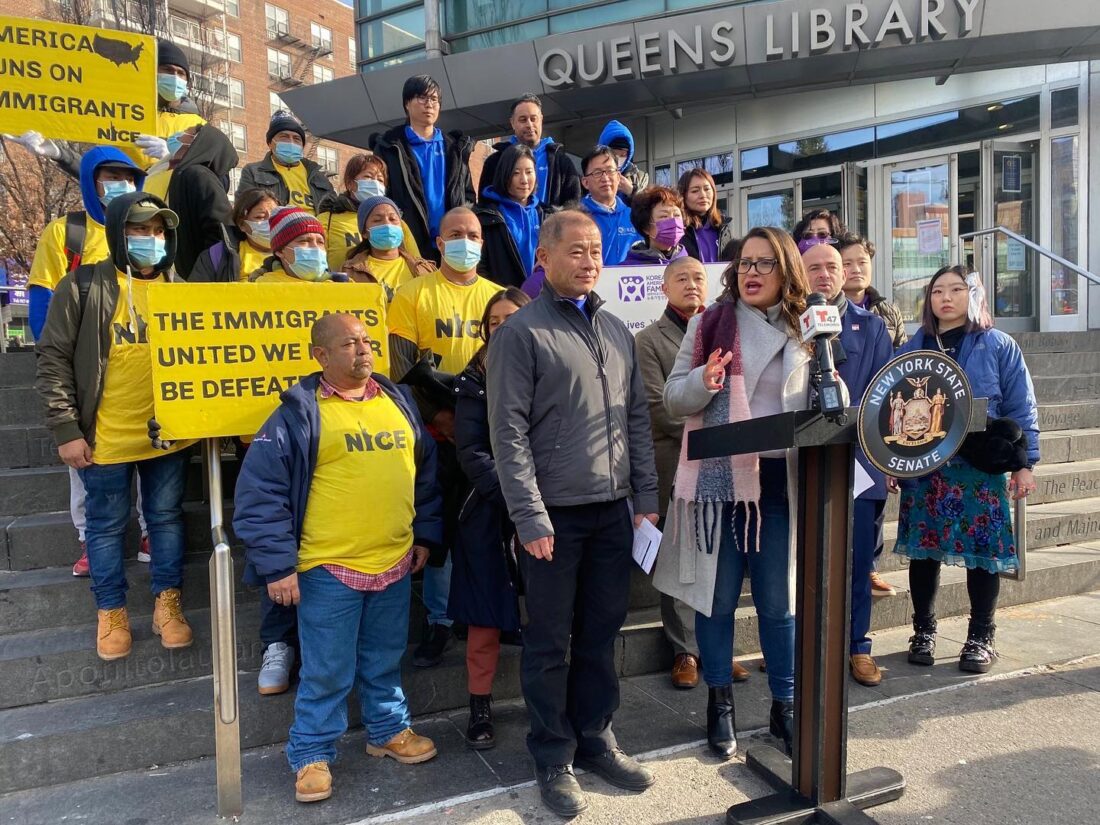
Assemblywoman Catalina Cruz, D-Corona, speaks at a December rally celebrating the signing of legislation protecting immigrants from discrimination in Queens as Sen. John Liu, D-New York City, looks on.
Among the hundreds of bills recently introduced in the state Legislature is a proposal to allow immigrants access to public benefits.
A.160, sponsored by Assemblywoman Catalina Cruz, D-Corona, is among 848 bills introduced in the state Assembly and Senate on Wednesday when the legislative session officially began. Many of those 848 bills are holdovers from previous years and come with no co-sponsorship support. Cruz’ legislation has no prior legislative history and is supported by fellow Democrats Jo Anne Simon, Rebecca Seawright, Marcela Mitaynes and Robert Jackson.
Cruz proposes allowing state and municipalities to offer certain local public benefits they say are necessary for an individual’s health, welfare and safety to those who would otherwise be ineligible for assistance due to federal law restricting eligibility to United States citizens. The federal sanction comes in the Personal Responsibility and Work Opportunity Reconciliation Act of 1996, but Cruz states the law allows states to expand eligibility to illegal immigrants after Aug. 22, 1996, citing Section 8 of U.S. Code 1621.
“This legislation would authorize the city of New York, other localities and the state of New York to provide certain public benefits and services to New Yorkers who would otherwise be eligible absent federal laws to the contrary,” Cruz wrote in her legislative justification. “At present, states are authorized to provide a range of services to individuals regardless of status, including: adult and child protective services, mental health interventions, shelter, medical care (with certain exceptions such as organ transplants), disaster relief as well as services and programs for victims of human trafficking. States and localities are severely constrained from offering post-acute services and programs directly related to the aforementioned emergency interventions already provided.”
California’s 2022-23 budget included a proposal by Gov. Gavin Newsom to remove exclusions for food assistance programs for undocumented California immigrants over the age of 55. That proposal came with a $35 million price tag for 2022-23 and could grow to cost as much as $113.4 million by 2025-26, according to Cal Matters. Advocates had pushed for California to expand the program to all immigrants, a proposal that could have cost an estimated $550 million a year. Cruz also cited programs in Illinois, Texas and Florida as reasons for New York to act. She does not, however, give a proposed cost for the benefits to be extended.
“New York State would not be the first to enact such a law. Currently, California, Illinois, Texas and Florida have authorizations in place whereby certain benefits ensuring health, welfare and safety are provided to individuals, regardless of their immigration status. This is not only the right thing to do, it is essential to ensure that vulnerable New Yorkers lacking an authorized immigration status are able to seek assistance and care that ultimately prevents additional costly emergency interventions.”
Cruz’ proposal comes at a time when New York City Mayor Eric Adams is calling on more federal government help to deal with the influx of immigrants who make their way to New York City on their own and on buses from Florida, Texas and, this week, Colorado. The city says it has absorbed more than 31,000 asylum seekers, putting further stress on emergency shelters, according to a recent Associated Press report. While Adams said his city is ready to provide humanitarian aid to asylum seekers, he urged the state and federal officials to do more.
“Our requests for assistance have been mostly ignored,” Adams said in December. “And while the New York federal delegation has repeatedly advocated for funding to be sent back to New York City, many in Congress — both Republicans and Democrats — have refused to lift a finger.”
Top stories

Chautauqua ZBA Rejects Golf Course Appeal
Molitor Cosponsors Offender Registry Bill

Attack On Teen Worries City Mother

Fenton History Center Hires New Coordinator To Bring More Students Into Museum

Wendel Shares County Highlights With Business Leaders