
New Cases Of COVID-19 Drop Across New York, Country
Trending
New COVID-19 infections have decreased or plateaued across New York state and the nation.
A panel of doctors and administrators from UPMC provided an update Monday morning on the status of the virus and a new drug, Evusheld, that reportedly helps prevent COVID-19. Dr. Donald Yealy, UPMC chief medical officer, said the decrease in infections and hospitalizations has been seen in all communities that UPMC serves.
"The omicron variant came quickly and, like we saw in other areas around the globe, it is dropping fast after very intense activity," he said. "It still has the ability to harm and it remains in our communities today. We still don't know what the future holds with COVID infections and serious illnesses in our regions -- what life after omicron might look like, but there's reason for optimism. No matter what happens, the fundamentals of managing the pandemic remain the same and we shared this with you throughout the pandemic. This is not the time to let up."
Yealy said while many might be "finished with the pandemic" due to fatigue regarding the sweeping changes the virus has brought with it, the pandemic is not over.
"The pandemic is not finished with us yet," he said. "Mitigation efforts like masking and vaccination against COVID-19 are still the most effective ways to protect yourself and all those around you from serious illness. Even though the trends are going the right way, hospitalizations are still higher than they've been for 19 of the last 22 months."
Yealy said the good news is the omicron variant appears to cause less severe symptoms than the delta variant, especially in those who are vaccinated. However, Yealy said the variant is "exceptionally transmissible."
"It really still can cause severe disease in unvaccinated people and those who are most vulnerable, particularly those that are immunocompromised," he said. "Let me hit this again: Vaccination reduces dramatically your risk of severe illness, your risk of hospitalization and your risk of death. Something that is true before is even more true now with omicron. Don't let someone else's mild experience with omicron give you a false sense of security. If you are not vaccinated, this virus can and often does cause severe illness in people who are unvaccinated. We see that unvaccinated people who are under 60 years old are nine times more likely to be hospitalized and they are 14 times more likely to die. More than 75% of our current hospitalized COVID-19 patients are not fully vaccinated. The remaining are almost all immuno-compromised. It tells the story of the benefit of vaccination."
Yealy encouraged the public to protect themselves and others around them by wearing face masks, getting the vaccination, the booster shot, staying home and getting tested when they are sick.
Gov. Kathy Hochul put out a statement Monday that concurred with UPMC's presentation. Hochul reported that the number of new cases in New York state dropped "nearly 50% since last week." Likewise, the governor reported that hospitalizations also decreased by one-third since last week.
"We are closing the month in a better place than we started and I want to thank New Yorkers for doing their part to help stop the spread during this challenging wave," Hochul said. "We're still not through this winter surge, and I encourage New Yorkers to continue using the tools to help keep our communities safe and our schools and businesses open. Please get the booster dose if you haven't already, get your children vaccinated and boosted when they're eligible and continue to mask up. Let's not let our guard down and risk reversing all of the progress we've made."
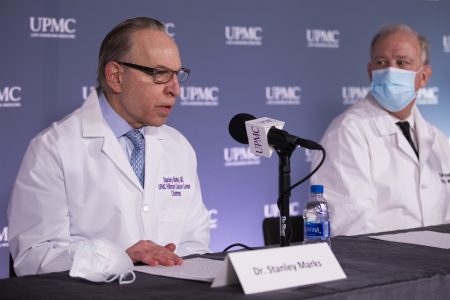
Dr. Stanley Marks, UPMC Hillman Cancer Center chairman, provided an update on the new medicine, Evusheld, which reportedly helps prevent COVID-19 infections.
"This is actually two monoclonal antibodies that we give before someone is infected with COVID-19," he said. "It lasts in their body for many months and is ready to stop the virus. It is given through an intramuscular injection, just like a vaccine. Like the vaccine, it protects you from very serious illness. We are giving Evusheld to our patients whose immune systems are not working properly or we refer to it as immunosuppressed. These patients are at the greatest risk for very serious outcomes if they get infected with COVID-19."
Marks said these patients are generally immunosuppressed due to underlying disease or taking immunosuppressive medication, such as those who have had an organ transplant or have a connective tissue disease such as lupus or who have various cancers. He added that the medication is not a replacement for vaccination -- those who are immunocompromised should still get vaccinated and boosted.
Tami Minnier, UPMC chief quality officer, said the hospital is working to "get the word out" about the drug and make sure those who need it have access.
"We have a knowledgeable team calling patients in our communities who are eligible, answering questions and scheduling appointments," Minnier said. "How do you recognize if you get one of these calls? It starts with an automated message that says 'Hello, this is UPMC calling to share information from your doctor about Evusheld,' followed by an explanation of what it is. You will then be asked to press one if you believe you qualify, and you will be called to schedule an appointment. Within a few days after that, someone from UPMC will call you back to schedule you for a location close to your home."
Minnier said the medicine is available in most areas they serve, including Erie, Pa., and Chautauqua County. When asked if there is a cost for the medication, she said the government supplies Evusheld, but there is typically a cost to administer the medication. She said it is a covered benefit by the UPMC health plan and many other insurers. She said those who feel they may be eligible for Evusheld should check with their insurer to verify what the cost would be.