UPMC: Monoclonal Antibodies Helping Patients
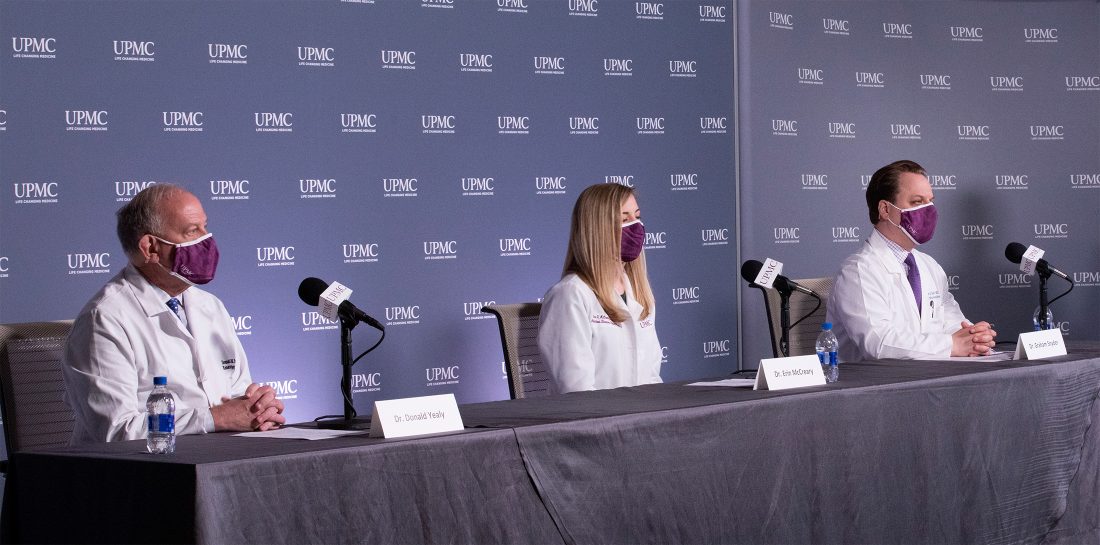
From left, Dr. Donald Yealy, UPMC senior medical director and chair of the Department of Emergency Medicine at UPMC and the University of Pittsburgh; Dr. Erin McCreary, UPMC infectious diseases pharmacist and clinical assistant professor in the University of Pittsburgh Division of Infectious Diseases; and Dr. Graham Snyder, UPMC medical director of infection prevention and hospital epidemiology; discussing the monoclonal antibody, which if used early is helping COVID-19 patients avoid hospitalization and death. Submitted photo
Vaccinations aren’t the only medical treatment being used to combat COVID-19.
On Friday, UPMC health care officials held an online news conference to discuss the successful use of Monclonal antibodies. Monoclonal — “mono” means “one” and “clonal” means “copy” — antibodies are a type of medication that seeks out the COVID-19 virus in a person’s body and blocks it from infecting their cells and replicating. Since late 2020, the U.S. Food & Drug Administration has granted emergency use authorization to three monoclonal antibody treatments — one from Regeneron and two from Eli Lilly– which are given through a one-time IV infusion. This is the same type of emergency authorization given to COVID-19 vaccines being administered in the U.S.
According to Dr. Graham Snyder, UPMC medical director of infection prevention and hospital epidemiology, the use of monoclonal antibodies in a recently infected COVID-19 patient has the ability to reduce the chances of hospitalization or death by 70%. He said UPMC has provided the treatment to more than 1,000 COVID-19 patients.
“If there’s one key take-away that we’re seeing in our data, it’s this: If you get COVID-19 and are at higher risk for severe illness, ask your doctor about monoclonal antibodies,” Snyder said. “Don’t hesitate. Early treatment, while your symptoms are still mild, may be essential.”
In an effort to share crucial information and save lives, UPMC and University of Pittsburgh School of Medicine physician-scientists are publishing the findings in medRxiv, a preprint journal, and announced the results Friday ahead of peer-reviewed publication.
Dr. Erin McCreary, UPMC infectious diseases pharmacist and clinical assistant professor in the University of Pittsburgh Division of Infectious Diseases, said the treatment is most effective if used within 10 days of a positive COVID-19 infection. She said it’s even more effective if used within four days.
“A one-time monoclonal antibody treatment has helped keep our patients with COVID-19 out of the hospital,” McCreary said. “If given early to high-risk patients, this treatment works to prevent COVID-19-related complications. We look forward to research with next-generation monoclonal antibodies and hope to continue to find safe and effective treatments for our patients.”
The strongest effect of the treatment was seen in older patients. Those age 65 and older who received monoclonal antibodies from UPMC were nearly three times less likely to be hospitalized or die in the following month, compared to their untreated counterparts. The results were less pronounced in younger populations, but overall, more positive results were seen in those who received monoclonal antibody infusions than in those who did not.
UPMC’s data also showed a stronger positive effect the earlier patients received the treatment after contracting the virus, and a very low rate of adverse reactions to the infusion, all of which were mild.
Dr. Donald Yealy, UPMC senior medical director and chair of the Department of Emergency Medicine at UPMC and the University of Pittsburgh, said the monoclonal antibody treatment is free. Preparing for high patient demand, UPMC created a weighted lottery to ensure fair allocation of its supply. However, demand was never high enough to trigger use of the lottery.
“This lower use surprised us, and we’re still debating why demand was less than expected,” Yealy said. “It likely had to do with so few health care providers investing in the infrastructure, staff and processes needed to administer the drug. This created lower awareness among both patients and clinicians about the life-saving benefits of monoclonal antibodies.”
Initially, eligibility was limited to patients 65 years or older, or to those with a body mass index of at least 35 because those were the people studies had indicated were most likely to benefit. UPMC has since expanded eligibility to younger people with certain medical conditions that place them at higher risk for complications from COVID-19, including children, in compliance with the emergency use authorization.
People can findout more information by visiting upmc.com/antibodytreatment, calling 866-804-5251 or by asking their doctor.