Women’s History Isn’t Just About The Famous
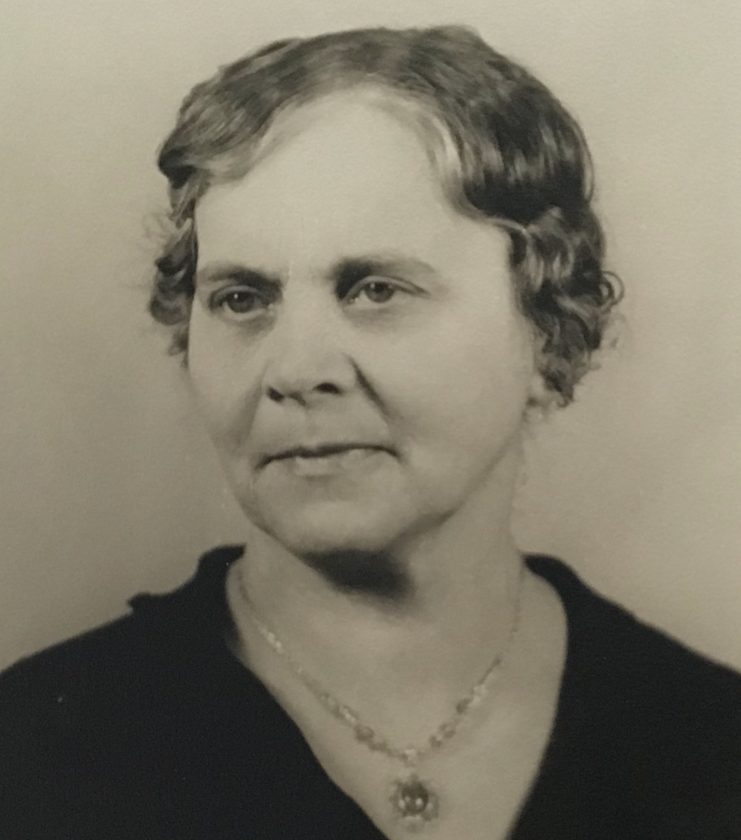
Pictured is Augusta Sofia (Swanson) Anderson, who arrived in Jamestown from Sweden at the age of 15.
In 1895, only a few months before her 16th birthday, Augusta Sofia Svensdotter/Swanson left her home in Sweden and headed west to Goteberg, Sweden. There she boarded a ship that took her to the east coast of England. From there, she boarded a train that took her to Liverpool, where once again she boarded a ship. That ship would take her to the port of New York. Then, she somehow made her way to Jamestown, New York, and joined her older sister, Mary, and two older brothers, Oscar and Emil.
A number of years earlier, her sister had come to Jamestown where an aunt and uncle were living. In 1892, both parents died in Sweden. Mary was married by then and as soon as the two brothers were confirmed, Mary had them join her in Jamestown. When Augusta was confirmed it was her turn to come to Jamestown. In 1902, the younger sister, Emma, and the younger brother, Henry, would join the others in Jamestown. Not an unusual example of chain migration for immigrants at that time.
The brothers all found work in wood working, either in furniture factories or as carpenters. Augusta married John August Anderson in 1900 and her son, Henry, was born in 1902.They resided on Benedict Street for awhile and then moved to Busti where John’s parents lived. In March 1912, Augusta became a widow when John died of pneumonia. Fortunately Augusta had her family as a safety net and she and Henry moved into Jamestown and resided with her sister, Mary. At some point, either as a new arrival or as a widow, Augusta’s family sent her to night school to learn English. As a widow, she spent a time in Bradford, Pennsylvania, as a cook or caterer, but soon came back to Jamestown.
One of the neighbors in Busti played “matchmaker” and introduced her to another neighbor, Andrew Anderson, who was a widower. They soon married and Augusta and Henry moved to a farm in Busti. Andrew insisted that Henry finish high school, bought him a bicycle and Henry got to school in Jamestown and graduated. He spent a semester at Bryant and Stratton in Buffalo but with the encouragement of the mail carrier who delivered mail in Busti, Henry took a civil service exam for mail carrier. He was offered the position of mail carrier and never returned to Buffalo. Andrew had a daughter, Bernice, from his first marriage. She married and she moved to California. Three daughters were soon born to Andrew and Augusta. Andrew continued to farm and do other jobs as he had done before. He grew white gladiolas for Nelson and Butts florists in Jamestown and had worked in Jamestown laying bricks at least the first year when brick pavements began in 1894.
During 1931, as the depression deepened, Andrew died probably of colon cancer, and Augusta was again a widow. This time with two girls in high school and one in grade school. Henry continued to live with them and became their support as he continued as a rural mail carrier. The oldest daughter, Doris, went to college with the help of an uncle and one of the “alphabet programs” of the New Deal. She became a teacher and librarian. The middle daughter, Helen, went to nurses training in Buffalo and continued a nursing career after her marriage and move to California. Martha, the youngest daughter, ended up as a secretary. All three married and had children.
Augusta continued to live in Busti until her death in 1958. Augusta became an American citizen probably when she married a naturalized citizen. She attended church in Busti-the Lutheran church when it was active in Busti, the Swedish Mission Church, and eventually the Busti Federated Church. She was active in the Ladies Aid of the churches and her life revolved around the church and her family.
Augusta did not have an extraordinary life that would give her a mention in the realm of Women’s History. She lead a life similar to that which many women of her time, and especially immigrant women experienced. She was successful in that she raised her children to become productive adults.
She never drove a car, but she did hitch up the horse and buggy when she needed to go somewhere. She did not become famous except within her circle of family and friends where she was famous for her excellent cardamom biscuits/sweet rolls. She was good cook and continued many of the traditional Swedish foods especially at Christmas time.
I encourage all readers to think back to the women in your family. What is their history? Maybe our readers should write a little something about the women in their family and pass it on to descendants and relatives. I have now started to do that because Augusta was my grandmother and I was lucky enough to have lived with her for my first 12 years.
Local News
Early voting begins Saturday for primary election
Registered Democrats in Chautauqua County are eligible to participate in an upcoming primary for both a state and ...
A-Plus Efforts
Lakewood looks to establish historic district
LAKEWOOD - Village officials are looking into establishing an historic district. Ted McAgue, Lakewood historic ...
County reviewing Agricultural District 10 boundaries
Per New York State Agriculture and Markets Law Section 303-a(1), the Chautauqua County Legislature is required to ...

U.S. history of division, freedom always tested