
Triple R Farm Receives Grant From National Grid
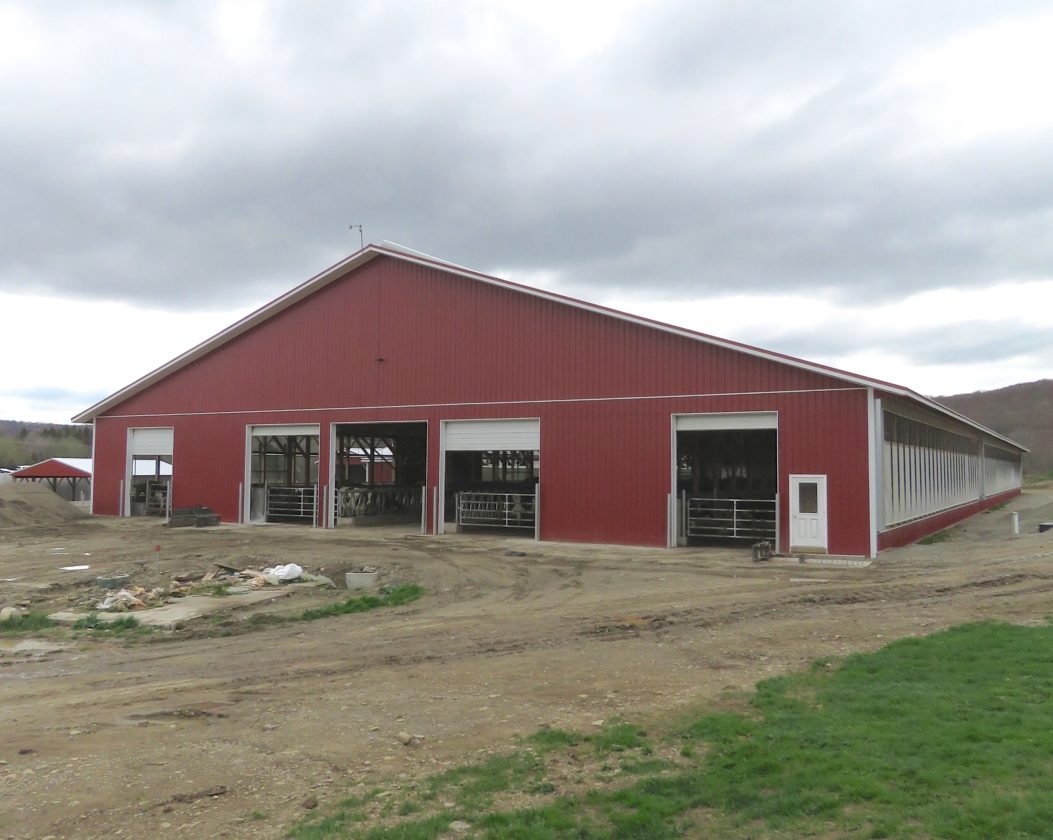
National Grid has awarded “Triple R Farm,” Atwood Hill in Randolph a $35,000 economic development grant to improve the efficiency of the dairy operation and position the business for future expansion. The new barn at Triple R Farm cost nearly $700,000 and has 324 stalls, including 204 cow stalls. Below, about 20 of the approximate 450 to 460 head of cattle at Triple R Farm. P-J photos by Deb Everts
RANDOLPH — Thanks to a $35,000 economic development grant from National Grid, Robert Spinler will be able to operate his business, Triple R Farm LLC, much more efficiently. Through this grant, Spinler will have access to three-phase electric service for his dairy farm located on Atwood Hill in Randolph.
The grant made through National Grid’s “Three-phase Power Incentive Program” helps rural businesses achieve better access to three-phase electric service. A three-phase electric system provides an increased level of reliability, and allows modern farm equipment to operate more efficiently.
“The dairy farm will use the funding as part of a $650,000 capital project that includes construction of a new barn for more than 200 cows,” said David Bertola, National Grid Strategic Communications/Upstate New York Office.
The new barn will include 204 cow stalls, as well as larger areas for the cows. It also will have an improved ventilation system and a new floor plan that will result in efficiencies during feeding and milking processes.
“Our investment at Triple R Farm included variable frequency drives for fans and high- efficiency lighting in the barn,” said National Grid Regional Manager Ken Kujawa.
“The main objective of this project was to improve the efficiency of the dairy operation and position the operation for future expansion.”
Spinler said the new barn built last year has a total of 324 stalls and 204 are cow stalls. He said the farm has 450-460 head of cattle, with 250 being cows, and the barn is currently full of heifers.
According to Spinler, the old barn was way over-crowded and it wasn’t a very efficient set-up. The new barn makes it much more easier to handle the cows and move them around. He said another advantage is the cows are spread out, so their production has increased quite a bit.
“We’re milking three times a day now. Most people milk twice a day, but the large farms milk more often — sometimes four times a day. In robotic milk parlors, some cows will get milked as many as six times a day,” he said.
“It’s actually better for the cows that are fresh because their udders never get super-full. That’s part of the reason we went to milking three times a day — because it’s better for the udders. When we switched to three times a day, we gained about eight-pounds of milk per cow per day. That’s almost a gallon of milk per cow per day more.”
Spinler said he found out about the economic development grant offering three-phase electric through a National Grid employee who happened to be at his farm to discuss grant money for energy efficiency through lights and fans.
The representative said the electric company could give them a percentage of funding if they installed L.E.D. lighting, instead of fluorescent lighting, and if the fans met their criteria.
“The main objective of the electrical part of our project is efficiency and positioning our farm operation for future expansion,” he said. “That was part of the reason for getting the three-phase now, if we could, because eventually we’ll either put in a new milking parlor or possibly robotic milkers. We are still using the old milking parlor down below in the old barn.”
Spinler said they would typically have to pay for the extra wire needed, but National Grid is covering the cost. Now they have the option of using the three-phase electric for their large motors. Just like regular electric, the three-phase electric service will come right to their pole and they can branch from there to anything, not just to the new barn.
According to Spinler, National Grid gives a business owner up to 30 percent of their project in an economic grant. In his case, it was for higher voltage, three-phase electric.
He said, with three-phase, it will be cheaper to run his equipment that has different motors. As time goes on, he plans to be running more and more electricity so, if he wants to add on, he’ll have more electric available.
“If we didn’t have this (three-phase electric) we’d have to run single-phase, which is more expensive,” he said. “When you get into large horsepower motors they run only on three-phase. We’ll have to get a generator to use as a backup for when there is a power outage to run any equipment requiring three-phase, because the voltage is different.”
Spinler said National Grid’s Economic Development Grant is a good program for anybody who wants to upgrade to three-phase electric, and they should inquire about it if they’re doing an eligible project.
Triple R Farm is named after three Spinler family members: Robert; his father who was also Robert; and his brother, Rodney. Spinler and his mother, Hazel, formed a partnership when her husband passed away.
They operate the farm with the assistance of four milkers, a few full-time employees and some part-time help.
Local News
When to adjust on Medicare coverage
Reps. Langworthy, Gottheimer introduce Buses Act
U.S. Rep. Nick Langworthy, R-23, and Rep. Josh Gottheimer, D-N.J., have introduced the BUSES Act, H.R. 9317, ...
Pieces of history
Coalition to participate in Rural Welcoming Initiative Cohort
Legislature’s July meeting to be held at Jackson Center
The Chautauqua County Legislature will be going on a field trip of sorts. During the June meeting, lawmakers ...
Pittsburgh University study explains why pollution affects some asthma patients more than others
Pittsburgh University study explains why pollution affects some asthma patients more than others PITTSBURGH – ...