
Trending
In the autumn of 1759 an Irish immigrant girl accompanied by her Seneca brothers walked the Indian path that wound through the Conewango region; a four month old baby in a cradleboard on her back.
Her name was Mary Jemison.
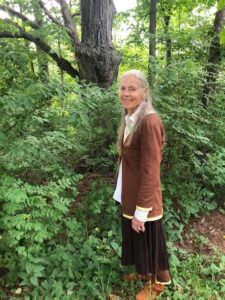
Recently, Leon Historical Society educator Tina Scherman portrayed Jemison and told the story of the woman who came to be known as The White Woman of the Genesee to a public audience in Leon's historic 1836 church.
Mary Jemison was born in 1743 on a ship sailing from Ireland to America. Her family settled on the Pennsylvania frontier in a place called Marsh Creek, not far from present day Gettysburg. One April morning of 1755, soon after the French and Indian War began, a group of Indians and Frenchmen captured her and her family. Her family died by their tomahawk, but Jemison was spared to begin given to and later adopted by two Seneca sisters who took her to an Seneca village on the banks of the Ohio River.
During the first summer of her captivity a group of Delaware Indians visited the village. Among them was her husband to be, Sheninjee. Mary and Sheninjee had a son whom she named Thomas. When Thomas was but three or four months old, Mary, her husband and two of her Seneca brothers went on trip to trade their fur and skins. Mary and her two brothers never returned to the village on the Ohio. On the trip they met a Seneca brother from the Seneca tribe to which Mary's adopted family belonged. He had come from the tribe's original homeland in the Genesee Valley. This visitor persuaded the brothers she traveled with to return "home " with him and to bring Mary and Thomas as well. Sheninjee parted from the group to return to the village on the Ohio so that he could join his brothers in the winter's hunt promising to join Mary in the Genesee Valley in the spring. They never did reunite. Sheninjee died soon after they parted. The journey to Genesee Valley was long and difficult. They traveled 500 miles through the almost pathless wilderness of Ohio into Pennsylvania and into the Conewango region before traveling on to the Genesee Valley.
Mary became fully adopted to Seneca life in her new home. Even when offered her freedom she chose to remain as a Seneca. She married a Seneca warrior, Hiakatoo, with whom she had four daughters and two sons, John and Jesse.
When Little Beards Town, the village where she lived, was destroyed by General Sullivan during the Revolutionary War, Jemison fled south to a place on the Genesee River called Gardeau where she lived most of the rest of her life.
In the 1797 Treaty of Big Tree the Senecas relinquished most of their land west of the Genesee River to land speculator Robert Morris for a sum of $100,000, with the land totaling 3.2 million acres. Morris then sold the land to the Holland Land Company with 200,000 acres were set aside for Senecas reservations. Jemison was given the Gardeau Reservation of 18,000 acres surrounding the Genesee River.
A major portion of her reservation Jemison leased to white settlers. With the settlers came whiskey, which caused her the loss of all of her sons. A drunken argument between Thomas and John ended with a fatal blow to Thomas's head from John's tomahawk Soon thereafter, John once again enraged by whiskey, quarreled with his brother Jesse and stabbed his younger brother to death. Finally John met his fate by whiskey when two drunken Indians attacked and killed him.
In her later years Jemison found overseeing the cultivation of the Gardeau Reservation too burdensome. In 1817 she became a United State citizen, which allowed her legal title to the land and the right to sell it. She sold all but a one by two mile tract along the Genesee River, where her home village of Gardeau was located. She lived there until 1831 when she moved to the Buffalo Creek Reservation, where she died in 1833 at the age of 90.
The Leon Historical Society offers Ms Scherman's presentation to other educational organizations, at no charge. To schedule a presentation contact Tina Scherman at tnelsonscherman@gmail.com, 716-489-7543 or 716-296-5268.