
How A Tragic Sled Ride Changed My Father’s Life
Trending
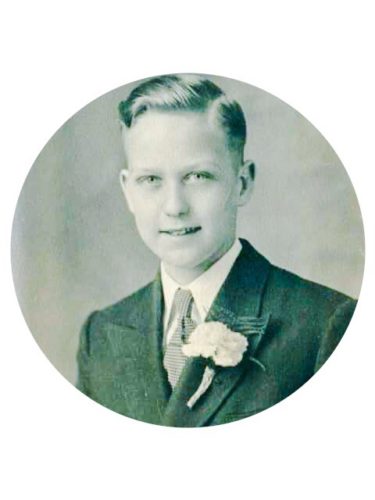
Ray Johnson at confirmation, the year of the bobsled accident. Family archives
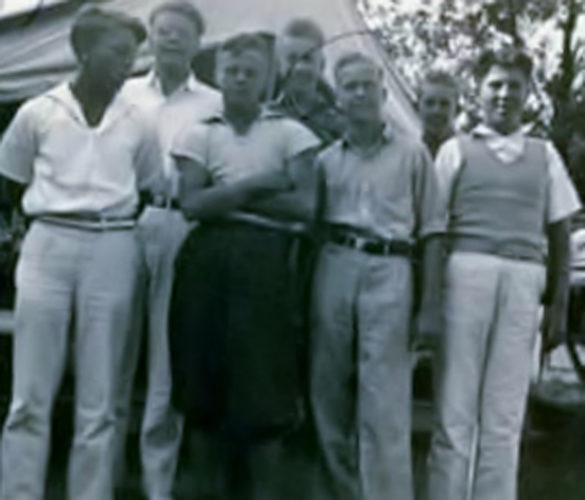
Pictured is my father Ray Johnson front row, second from right, with his childhood friends on the South Side circa 1931.
"Sometimes, something catastrophic can occur in a split second that changes a person's life forever," writes Jeannette Walls in her novel "Half Broke Horses." This was one of those tragedies. It happened to my father and four of his friends 81 years ago here on a bitter cold winter night in Jamestown. Two boys' lives ended that night. My father was terribly injured and spent months in the hospital but he survived. It altered his view of life, the way danger and death come like stalkers. He never spoke about this without a certain look of terror and pain. In the end of his life, a neurological illness killed him that doctors say was probably related to his head injuries on the fatal night when he was 14. We are colored by our past no matter how hard we try to shake it. It changes us. It is part of us.
On a frigid December night in 1935, five boys stood at the top of Barrett Avenue hill on the corner of Newland with their homemade bobsled. My father was one of those boys. He recalled looking up into a streetlight full of swirling snow, the air so cold it smelled like metal. The boys -- all close friends who lived within a few blocks of one another on the South Side of Jamestown -- had already swept down the hill without incident three times, swinging wide on McKinley curve and rushing past the General Hospital at the corner of what is now Steele Street and the Chadakoin River. The boys elected to take one last run. It was a week before Christmas.
"My ma's gonna kill me!" One boy muttered. The bobsled was a heavy, unwieldy beast, barely steerable, that required all boys to lean in unison around curves. A rudimentary brake provided some assistance but not much. They all worried about stopping in time at the bottom where the half frozen Chadakoin crossed their path.
The boys aged 13-15 were glad to be out of school for winter break and full of joy on a perfect sledding night -- snow three-feet-deep, icy brick streets, sky full of stars. One more ride, they agreed. It was icy cold, bitter, a night they should have been home by the warm fire. But they were boys, and they were having the time of their lives. They clapped their mittens and swung their arms in the cold. They pulled their caps down tight and retied their scratchy wool scarves. They stomped their half frozen feet. They grinned. As one, they yelled one two three and pushed off, each with a hand on the sled. They leapt in as the sled gathered speed. And down they swept, yelling and cheering.
My father's best friend Bobby Johnson pulled off my dad's woolen cap as he liked to do. He waved it in the air, shouting, "Here we go, Ray! Here we go!" My father remembered that all his life, his best friend shouting with joy, the wind in their faces, the speed of the run intoxicating. In the weird geometry of time and fate, the boys on their homemade sled sped down the long hill; who knows how fast they were going? They leaned like a practiced team and made the McKinley curve. It was their biggest fear, wiping out at that wide turn. So they cheered as they passed the hospital. No one knows if they even saw the truck approaching on Steele Street, its headlights flickering in the thickly falling snow.
In an instant, the bobsled hit the back wheel of the truck and slammed into the axle. The Jamestown Evening Journal reported they were thrown into the air like rag dolls. The headline the next night read "tragedy stalks boys on a bobsled. Two dead."
My father recalled waking up flat on his back in a snow bank, staring up at the heavens. Icy snow fell in his eyes. At first, he truly thought he was dead. His pelvis was shattered and a deep wound split his right leg from calf to thigh. But he didn't feel the pain yet. Across the way in the darkness, in the curious light, he heard moaning. One of the boys sat up and rubbed his head. It was the Finnish boy. Later he refused to go to the hospital, saying he was all right, and walked home by himself up Forest Avenue. But he was not all right. He died in his sleep in the middle of the night.
My father turned his head and looked across the snow. He saw the body of a boy lying face down. Instantly, he knew it was his best friend Bob. And he knew his friend was dead. Five went down the hill in that homemade bobsled; one died instantly and one in the middle of that night. Two others were treated at the hospital and released. The truck driver was cleared of any responsibility as the sled hit his truck on that fateful corner. I am telling the story as I heard it and from a newspaper article I read long, long ago. There may be people who read this article and remember more. I may inadvertently get some of the precise facts wrong; forgive me if I do. But I am telling it as I recall hearing it. The people who remember or who recognize this story, recall this tragedy, carry memories of that night too.
My father spent months in the Jamestown Hospital after the accident, unable to move for a long time, left with a lifelong scar on his leg and in his heart. A concussion kept him prone and babbling for two weeks. His Finnish mother hardly left his bedside, holding his hand, speaking quietly in her native language. She walked up and down Barrett Avenue most days in those wintry months to sit with her boy. He was out of school for the rest of the year.
But it was the head injury that probably got him in the end, 50 years later, when he lost balance one day, his left leg began to drag and Parkinson's syndrome descended upon him. His doctors shook their heads and surmised the cause might have been the brain trauma suffered that December night in the bobsled accident on Barrett Avenue all those years ago.
The tragedy on Barrett Avenue stuck with him all his life. He was a person of great joie de vivre, yet underneath lay a deep melancholia. He kept it covered well most of the time. But I know this, my father understood doom. Thereafter he could smell it coming like the air before a storm. He was never without the terrible knowledge that death can grab anyone in a second. It altered his perception of life. We are all an accumulation of who we have been, what we have done, what we have borne and survived.
I pass that very spot so often in my Jeep. I park by the bridge and right there in the spot where the accident happened. I'm aware of it as if tragedy floats and is carried by time in the very air we breathe. And so it is. Some of us make it through perilous childhoods and teenage years. Some of us fare well throughout life. As we go, so many are left behind. We never forget them. We carry those lost with us.