
Barbara & Ray
An American Love Story
-
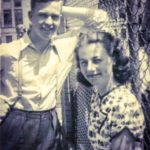
- Barbara and Raymond circa 1938 at JHS. Photos from family archives
-
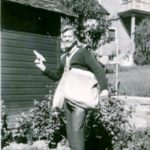
- Dad as a Morning Post newspaper carrier 1933-1940.
-
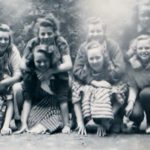
- Mom (second from left, back) with her school friends at JHS, circa 1941.
-
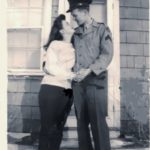
- Bangor Maine on Dow Air Base, 1943.
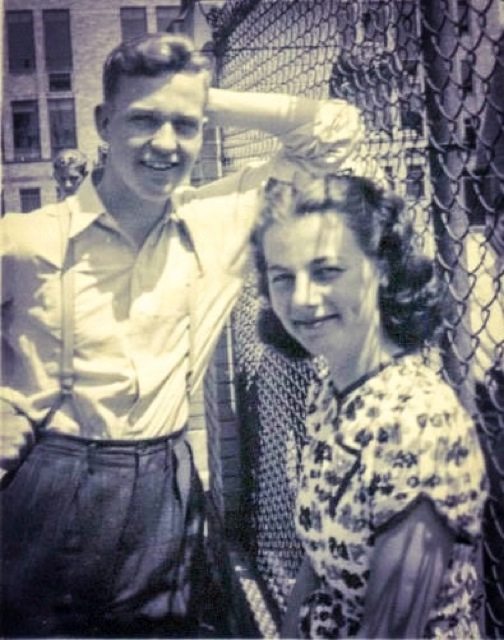
Barbara and Raymond circa 1938 at JHS. Photos from family archives
When I think of my parents, Raymond and Barbara Forsberg Johnson, I see them as movie stars whose lives were beautiful and tragic. They were the stars in our family, each in his or her own way, both competing for the top billing, maybe. Each one was special, unique, remarkable, gifted. They were both children of immigrants, my father the only son of a tall blond Swede from Jonkoping, Sweden, and his diminutive but scrappy Finnish wife, Martha; my mother the younger daughter of two to a red haired musician from Orebro and an elegant brunette from Karlskoga, Sweden. Though their parents were quiet introverts, both parents of mine were ardent extroverts. My sister and I adored them. We were shadowed by their towering personalities. But that was all right.
My mother, this Ingrid Bergman sort of beauty, dark haired and blue eyed daughter of Carl and Gunhild Forsberg, must have had the world at her feet in 1938, any suitor at her beckoned call. She sang in the A Capella Choir as first alto; she was a rosy cheeked JHS cheerleader. She got straight A’s, but she did not plan for college because most girls did not back then. They planned for marriage like that was a job. Later, she worked at Woolworth’s after school and saved all her money; during the war, mother took her place in the factories of America as did so many Army wives when she worked at Duramold up on Airport hill. She saved her money dutifully, enough to buy a home, enough to buy a car, enough to furnish an American life. Both my parents were glamorous yet more than this; both of them were hard-working people who took life seriously. Their Swedish upbringing had made fine citizens of them. My Granny Johnson liked to say, “work first.” These were people with ethics. These were dutiful people.
And so, Barbara chose Raymond, who smiled like the sun, who got up every morning at 4 a.m. to deliver the Morning Post from ages 12-18, who walked her home after school to the North Side then walked home to 221 Barrett Ave., turned around and walked back to her house every night after dinner and walked back home again. That’s a lot of hard walking up and down Jamestown’s hills. It’s enough to convince any girl you’re madly in love with her. And that he did.
Mother chose Raymond. He could make her laugh. Her parents adored him. He and her father, Carl built a boat. They fished together. They laughed at the kitchen table together. My father Raymond had that something — in the yearbook, he’s the “Oomph-man.” What was that? Qualities that drew women to him. Qualities that made him stand out intellectually. He did have movie star looks. But he was a hard and tireless worker, ambitious, goal oriented, full of politics learned at the kitchen table. He read Horatio Alger and believed in attaining the American Dream, making it rich, doing well in life, enjoying life to the fullest. He wanted a better world, a better life, a better job, all those good things. And he got them, one by one. Later in life, having left the Jamestown life he once loved behind, he remarked, “I could have stayed here. I could have stayed at The Post-Journal. I could have gone fishing with Carl every day. It would have been enough.”
We have my father’s handwritten in pencil journal from 1938-1941 in which he records his love for his “darling girl,” the changing responsibilities of his job at the Morning Post and later The Post-Journal, his wishes “to be better,” to do more, to make people happy. He signed his entries formally, Ray A. Johnson. He even signed a loving tribute to my mother in her JHS yearbook in this way.
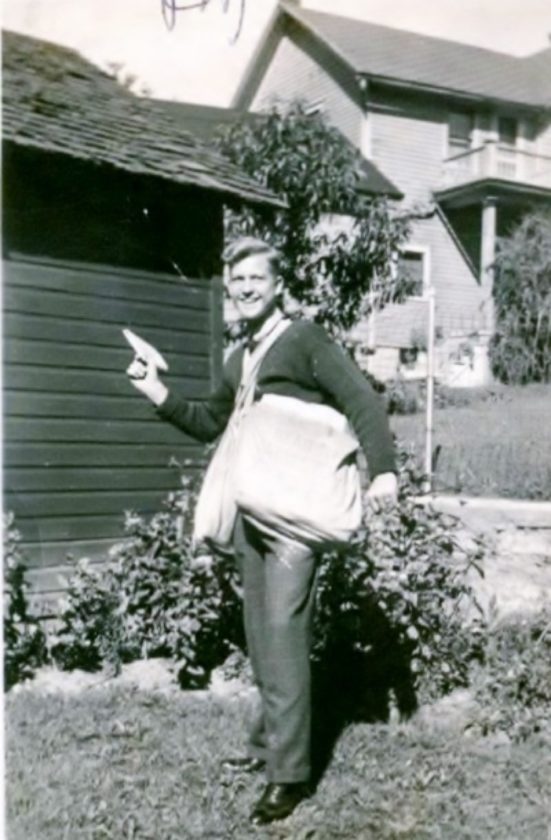
Dad as a Morning Post newspaper carrier 1933-1940.
When the war came in December 1941, Ray records it in his journal in reference to the newspaper he loves so much: “Got called into the paper at 7 p.m. because Japan declared war on the U.S. The paper ran a special press run. We delivered papers all night.” He writes things like, January 6, Monday, 1940: Saw Barbara on my lunch hour. She had been skating. I felt jealous or sad or something! That is silly!” or “She had been cheering. She looked so swell!” On Feb. 2, 1941, his 20th birthday, he wrote, (Barbara) “looked like an angel to me. She gave me a shirt and tie.” And from the same week’s entries, “She wore her new coat and looked so lovely.” On the 7th of February, he wrote, “Two years ago today I met my honey in Olean at the basketball game.” On the 27th, “We went to the show. I gave her the book Rebecca for her 18th birthday.” On March 19, he wrote, “Stuck in South Dayton in the PJ delivery truck for 12 hours. The snow came down like ice. I wanted to stay home the next day but mama said, work first, Raymond! Work first.”
My mother, Barbara Forsberg wanted nothing more than to be Mrs. Johnson. She gave up her music for the most part, moving the piano into the dining room at our house on Ivy Street and playing Chopin and Lizst only occasionally. She devoted her life to laundry, cooking, baking, cleaning, child rearing — in short, all the skills of housewifery. She seemed to love these things. She hummed in the kitchen as she pealed potatoes. She painted daily life in lovely colors. They both made us feel safe. I recall how beautifully she dressed, in shiny high heels and satiny suits, pretty dresses, white gloves. On parents’ day at Fletcher School, I could hear her coming towards the classroom, her high heels clicking on the tile. She would enter the room like a movie star, in a polished suit, white gloves on her hands, a tidy clutch. Her hair was shiny and curled. Her lips were suitably red and her face powdered. To me, she was the model of decorum and style.
Until I was about nine years old, my father read to me every night. Then mother would come into my room, smelling subtly of White Shoulders cologne — cool as linen, not too flowery, her hair tumbling onto her shoulders, her eyes smiling. She would sit on the edge of my bed and run her hand through my hair. She would sing, “Somewhere Over the Rainbow.” I’ll Be Loving You Always, Poor Butterfly … the melodies haunting and tainted with sorrow. I wondered even then why she chose such sad songs to sing every night. My mother was dramatic and extraordinary. I would never question her aloud. Later in life, I thought perhaps the sad songs were a kind of prescience because a melancholy fell on her later in life, past the years of planting marigolds along the driveway, past the years of cooking Swedish delights in the kitchen at Ivy Street.
As time passed, after we moved away — first to Ashtabula, Ohio, and later to Madison, Connecticut — my father became a visitor in our lives. Eventually, he left. His new family moved into our house, our rooms, our lives. It was a shattering adjustment for us, and I could say, our mother was never the same again. My mother-in-law said to me once, dismissively, “Everybody gets divorced!” But no matter who goes through it, there is no band-aid for divorce or its impacts on family, no succor, no kind ending. People endure and go on.
Barbara and Ray were married for 23 years and a couple for 31. They were good to us. They were fine parents. But in the end, they lost each other. For a while, they were the classic American love story — gifted immigrant children, willing to work hard and “make good,” as they both so often said, who fell in love, who made a family, who bought a white house on Ivy Street and built their American dream.
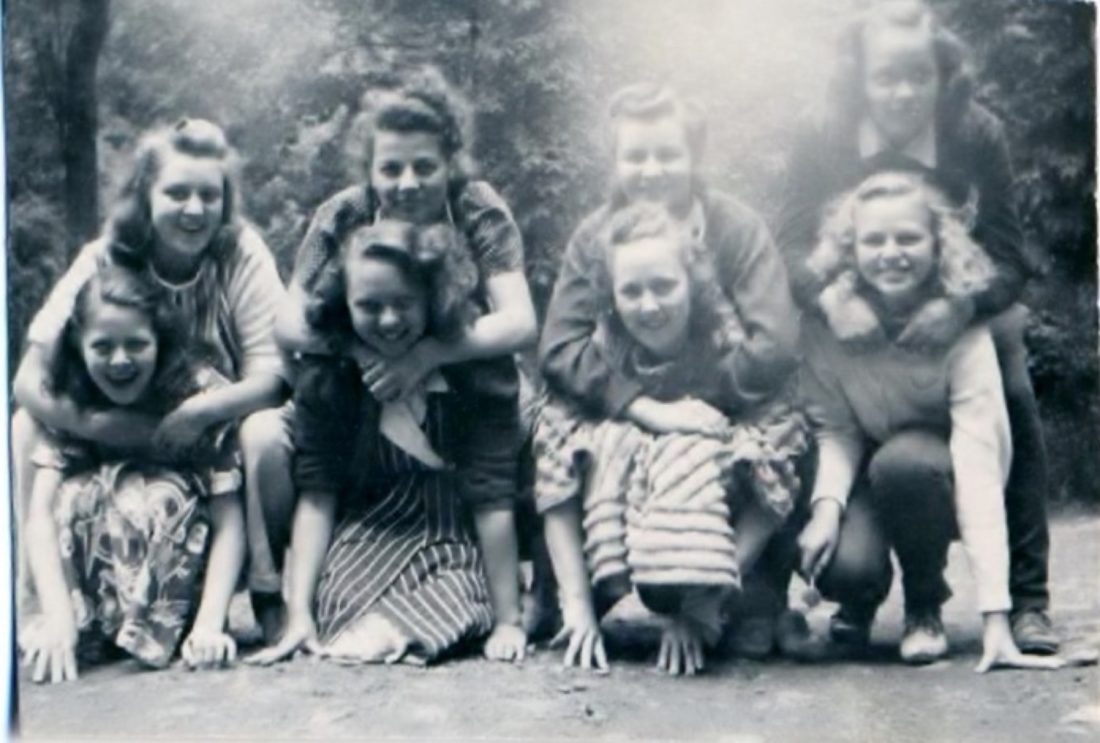
Mom (second from left, back) with her school friends at JHS, circa 1941.
I think of them on the steps of Jamestown High School, young people full of promise and falling in love. People who were in love are always in love somewhere in time. I see them there even now, still smiling.
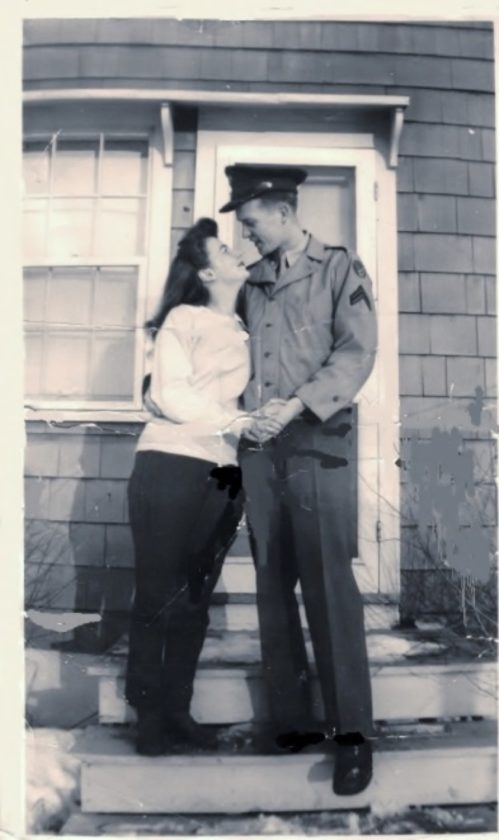
Bangor Maine on Dow Air Base, 1943.