
Trending
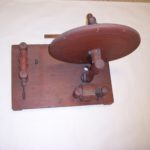
Today's item poses a lot of unanswered questions. It is clearly some form of apple peeling machine. It is almost entirely made of wood and very similar to a device shown on the Apple Parer Museum web site credited to an 1829 patent by Amos Mosier of Galway, N.Y. A review in the Journal of the Franklin Institute says it was similar to an item patented in 1803 by Amos Coates of Pennsylvania. It was cataloged here in 1985 as "found in collection" with no identification of the actual donor. The available patent information and the all -wood construction suggest an early 19th century date. Yet details like the nature of the screws, staples, and wires and even the quality of the woodwork itself suggest a later date even though all other examples of such machines in our collection, on line, or that I've seen elsewhere made after the Civil War are all metal.
The all wood handle spins a 14-inch solid wood disc which, by cord drive, spins the working shaft at a high rate of speed. An apple is impaled on the metal prongs of the driven shaft where it is pared lathe style. The knife that came with the machine is entirely separate but fits into a groove in another part. How it accommodates to the surface of the apple, how it is loaded with pressure against the apple surface and how it is advanced along the apple are not apparent to me. The other parts on the machine are also inscrutable both in terms of function and how they relate to the apple. Most enigmatic of all is a pivoting wooden pawl attached to the back of the drive disc. There is not much evidence of use.
The industrial revolution which started in England in the 18th century and completely transformed America and the lives of everyone living here in the 19th century was the most momentous event since the agricultural revolution thousands of years previous. The 18th century, and earlier times, were the age of tools, handheld and hand-powered. There were few exceptions, including animal–drawn plows and water-powered mills. But the industrial revolution, perhaps made possible by new concepts in law and patent rights that allowed smart and ambitious people regardless of wealth or social standing to profit from their ideas and labor, brought the age of machines; small, large and gargantuan engines harnessing inanimate power; huge and enormously productive factories filled with ingenious and complex machinery; mass marketing; and abundance never before dreamed of.
The ideas and the skills to create machines to one-up tools eventually extended down to such humble tasks as paring apples. Industrial as well as domestic versions were made. One of the other three apple parers in our collection may be from an industrial setting. Apple peeling machines, mostly hand cranked but some power-driven were used in the turn of 20th century apple driers in Boomertown and Ashville, for example.
I've seen iron peelers, some patented as early as 1875, demonstrated at shows. They work wonderfully and are breathtakingly faster than hand peeling. Simple, direct drive models are marketed today, including on YouTube, as kitchen gadgets. They are made of metal and plastic, but the design and concept are simpler than most 19th century models and even simpler than the early Moshier models. They aren't as fast, but they perform well, coring and slicing also as did many of the 19th century examples.