
The beast in him: Frank Hyde’s days in the ring
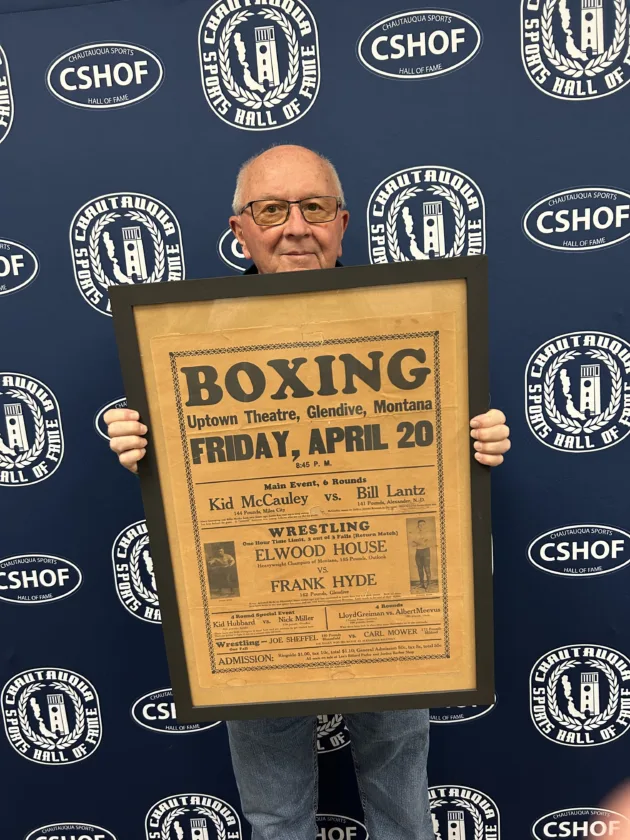
Chautauqua Sports Hall of Fame president Randy Anderson holds the original poster that promoted former Post-Journal sports editor and CSHOF inductee Frank Hyde’s wrestling match against Elwood House, which was held April 26, 1936 at Uptown Theatre in Glendive, Montana. The poster has been gifted to the CSHOF by Frank’s son, Tom. P-J photo by Scott Kindberg
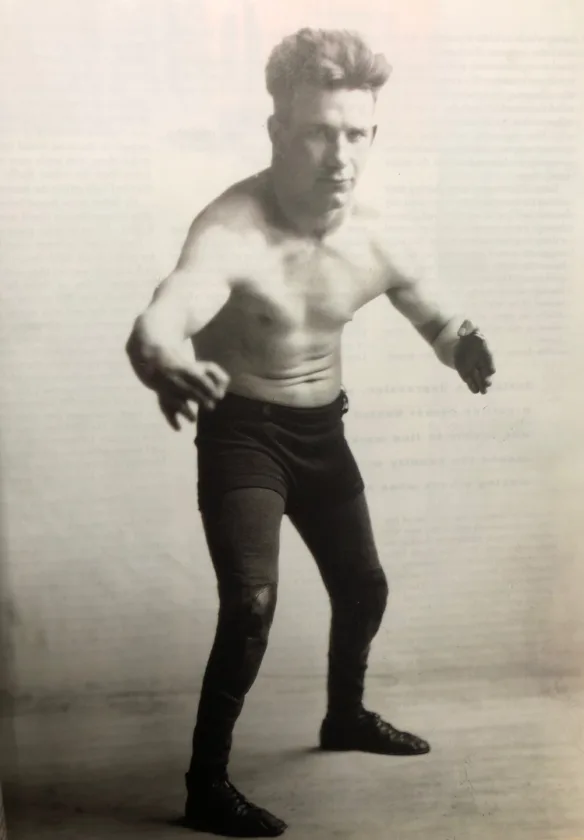
Frank Hyde in the 1930s. Submitted photo
Chautauqua Sports Hall of Fame president Randy Anderson holds the original poster that promoted former Post-Journal sports editor and CSHOF inductee Frank Hyde’s wrestling match against Elwood House, which was held April 26, 1936 at Uptown Theatre in Glendive, Montana. The poster has been gifted to the CSHOF by Frank’s son, Tom. P-J photo by Scott Kindberg
Frank Hyde in the 1930s. Submitted photo
Trending
EDITOR'S NOTE: Frank Hyde was the sports editor at The Post-Journal from 1945 to 1979. He was also a 1983 Chautauqua Sports Hall of Fame inductee. For anyone who followed local sports in that era, that is not news. What might be, however, is that Hyde -- in his younger years -- was an accomplished wrestler. In the story below, Frank's son, Tom, takes us on a trip down memory lane.
Among my father's most memorable heroes in sports was a man few fans today know of, fewer still remember. He was a wrestler named Ed "Strangler" Lewis who electrified the wrestling world in the1920s and 1930s when wrestling was a straight up, legitimate art form, not the "showmanship" (as Frank tactfully described it) that we know today.
Wrestling had what you might call its "the honest period" stretching from antiquity right up to the 1940s and World War II when promoters discovered they could attract a wider audience and make more money by inventing heroes and villains and staging matches with winners and losers determined by a plan.
Until then, matches were colloquially known as "bouts" made up of "falls" -- typically three "falls" to a "bout." And it should be noted that Ed Lewis got his nickname not by strangling someone. His nickname derived from his Sleeper Hold, a match winner that involved both forearms wrapped so tightly about a man's head it only appeared as if he was strangling someone. It was pain, not the loss of breath, that forced his opponents to quit.
Compared with the modern era of acrobatic, costumed showman, when good guys wear white and have ring names like Bobo, Junkyard Dog, and Mankind, and the bad guys wear black leotards and face masks and have names like Ivan, Abdullah and the Destroyer, Ed "Strangler' Lewis was the real deal.
I quote two sources.
Robert Herman Julius Friedrich (June 30, 1891 - August 8, 1966), better known by the ring as Ed “Strangler” Lewis, was an American professional wrestler and trainer. During his wrestling career, which spanned four decades, Lewis was a four-time World Heavyweight Wrestling Champion and overall recognized officially as a five-time world champion. Considered to be one of the most iconic and recognizable sports stars of the 1920s, often alongside boxer Jack Dempsey and baseball player Babe Ruth, Lewis notably wrestled in over 6,000 matches (many of which were real contests and lost only 32 of them. -Wikipedia-
Ed "Strangler" Lewis, a main attraction of the early 1900s, now has a hold on immortality, as he is enshrined in the first class of the WWE Hall of Fame Legacy inductees. Best known for his aggressive style, Lewis headlined many of wrestling's earliest shows at Madison Square Garden in the 1930s.
Lewis gained a reputation for taking on all comers, competing everywhere from the Chicago Cubs' Wrigley Field all the way to New Zealand. Regardless of location, Lewis' opponents feared his dreaded strangle hold, a variation of the sleeper hold, which many credit Lewis for bringing to the mainstream. -WWE website-
The first time I heard my father talk about Strangler Lewis was while we were living in Celoron in the 1950s and I was 8 or 9 years old. Frank used me to demonstrate the Sleeper Hold. He further used me to demonstrate the Headlock, the Toe Hold, and the Head Scissors, each a practiced technique of professional wrestling when the sport was as honest as the takedown, bridge, and cradle are today in Greco-Roman wrestling like the NCAA and the Olympics.
What I did not appreciate at the time, as my father had me in one of his skull-crushing headlocks, was that Ed "Strangler" Lewis was very likely his inspiration for jumping into the ring himself, in the 1920s, despite that fact that growing up on a farm in southwest Missouri he contracted polio.
His leg muscles were depleted, but his rigorous workouts with weights left his upper body stronger than the average man his age. His confidence peaked. To impress my mother, he once did a handstand on the edge of a cliff at the Grand Canyon.
Subsequently his decision to enter the ring was as successful as it could be back in the day. He became the light heavyweight champion of Montana, where he did most of his wrestling out of Glendive.
He was tough and in demand at state and county fairs and private promotions throughout Montana and sometimes farther afield. He told stories of wrestling in towns with evocative names like Miles City and Red Lodge.
Recently, and at my request, the brilliant staff at the Glendive Public Library searched "Frank Hyde" and came up with two newspaper reports from the Dawson County Review. One is dated April 16, 1933, and carries the headline: "Frank Hyde in Sensational Win Over Johnson."
It reads in part:
In the fiercest and most desperate wrestling match ever seen in Glendive, Frank Hyde topped Joe Johnson of Tacoma last Friday evening. At the opening bell, Johnson rushed Hyde, grabbed him about the waist, hoisted him over his shoulder, whirled him around, slammed him to the mat and in 45 seconds had his shoulder pinned securely.
(But) Hyde came back like a wild beast and, almost never relinquishing the offensive, threw Johnson in 13 minutes."
And another dated April 26, 1936, reported on his match with Elwood House for which, in searching Frank's home files after his death, I came across the original poster. I have kept it in my possession for years and have now gifted it to the Chautauqua Sports Hall of Fame. Meanwhile, the newspaper clip reads:
Elwood House, heavyweight wrestling champion of Montana also decisioned Frank Hyde in short order after losing the first fall. After 15 minutes of furious going, Hyde pinned House, but House came back strong and in five minutes had Hyde down. Another five minutes was enough for House to win the third fall.
We (I checked with my brother Dave) do not know exactly when our father's wrestling career began and when it ended, but we know how it ended. In a match he was forever reluctant to talk about, he tangled with an opponent in such a way that they both rolled out of the ring, the bigger man landing on top, leaving Frank with a broken hip.
It's easy to imagine that sports medicine in the 1930s was rough justice, subsequently his hip was never repaired in a way that allowed him to walk upright again. Not long after, he found a job with the Southern Pacific railway as a telegrapher and was assigned to the railroad's outpost in Newport, Arkansas. There he met Evelyn Young, the daughter of a Southern Baptist deacon.
They met on a blind date, and it must have been love at first sight because they wasted little time before eloping back to Glendive, where Dawson County happened to be one of the few counties in the country that allowed an 18-year-old woman to make her own decision to marry.
Back in Arkansas she would have needed her father's permission that, she always claimed, he would not have given. Meanwhile, in Glendive, where our late sister, Patsy, was born, Frank promoted wrestling and boxing while igniting his career as a naturally gifted sportswriter covering high school football.