Panama CS Grad Pays Tribute To Mentor
-
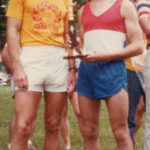
- Joe Lehnerd, right, poses for a photo with his running coach, Don Vining, in the early 1980s when the former was a student at Panama Central School. Photo courtesy of Joe Lehnerd
-
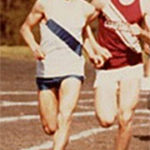
- Joe Lehnerd running during his senior year at Panama Central School. Photo courtesy of Joe Lehnerd
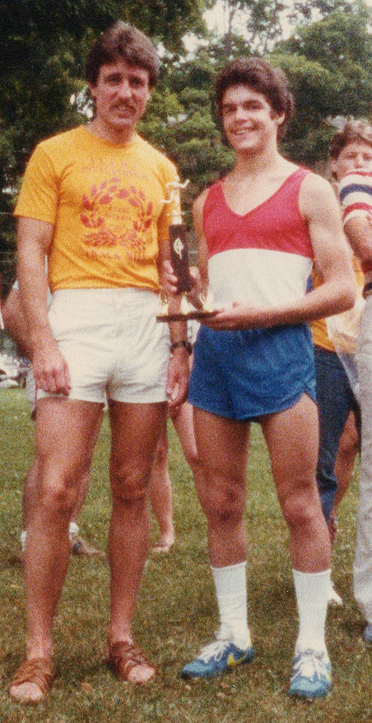
Joe Lehnerd, right, poses for a photo with his running coach, Don Vining, in the early 1980s when the former was a student at Panama Central School. Photo courtesy of Joe Lehnerd
Father’s Day is Sunday.
Some of us are — or have been — blessed with great dads. Others only had their dads for a short time. Still others never had the chance to know them at all. And then there are people, like Panama native Joe Lehnerd, who were fortunate to have a father figure in their life when they needed him most.
Thirty-five years after his first meeting with Don Vining, Joe decided to pay tribute to his late mentor, coach and friend via a Facebook post/video, because their relationship didn’t just begin and end his senior year at Panama Central School in 1983.
Instead, it survived the test of time.
ı ı ı
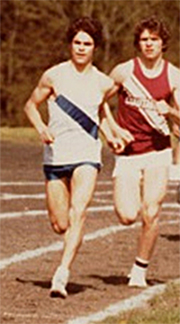
Joe Lehnerd running during his senior year at Panama Central School. Photo courtesy of Joe Lehnerd
Joe, who grew up on Route 394, now lives in Hot Springs, Arkansas where he owns a company that manufactures friction reducers for vehicles. His son, Josh, resides in Los Angeles and works in the film industry.
So when Joe decided he wanted to make a video as a tribute to Don and post it to Facebook last month, he asked Josh for some long-distance help. The project ended up being 7 minutes, 22 seconds in length.
“It’s a eulogy of sorts for my dear friend and high school running coach … who just passed away,” Joe wrote on his Facebook wall. “Don was a very human man with all the frailties and failings and struggles of any of us. He also did great things, and one of them he did for me. I would like to share the story of the impact Don Vining had on me as a 17-year old boy and (on) the rest of my life.”
“The reason I posted it to Facebook,” Joe told me last month during a cell phone interview, “is that hopefully people would watch it and think about some young person they can help.”
ı ı ı
By his own admission, Joe was a “hard-working, but underachieving” distance runner entering his senior year at Panama Central.
“I wasn’t competitive outside my school and showed very little improvement from year to year,” he said.
His best times, Joe said, were 5:03.1 in the mile and 11:01.5 in the two-mile, 35.6 seconds slower than the school record at the time. Frustrated at his lack of improvement, he figured he would ditch running in favor of tennis, so he spent the summer of 1982 working on the racquet sport.
Besides, Joe’s family — he was raised by a single mom — didn’t have extra money for running shoes, let alone someone who could train him, so when he returned to school in September he told one of his two-mile relay buddies of his decision to switch sports.
That friend wouldn’t allow it. Instead, he introduced Joe to Don, a sixth-grade teacher at the elementary school, who already knew of Joe’s love for running, even if the results didn’t necessarily show it.
“He said that with proper training he thought I could improve a great deal,” Joe said.
The next day after school, Joe said he asked Don, an avid runner himself who would compete in the Boston and New York City marathons, how he might improve his results. What happened instead was Don flipped the conversation, asking Joe questions in an effort to gauge Joe’s commitment level.
“He said, ‘I will train you, no money involved, if you will do two things: Do everything I tell you to do and commit yourself to breaking the school records,'” Joe said. ” … What ensued was like something out of a movie.”
But it wasn’t just about training for track. Don, then 37, was teaching Joe, then 17, a lesson that would last a lifetime.
“I would encourage adults that if there’s anything you can do to impact a kid, do it,” Joe said. “You don’t have to be perfect. The key thing is to get a kid to believe they can be good.”
ı ı ı
Training began in January, three months before the start of the spring track season. Baker Street in Jamestown was one of the first locations, because it featured about a mile of rather steep, steady incline. The first workout, Joe recalled, included running up that hill eight or nine times.
“This kind of workout will help you recover between the two-mile relay, mile and two-mile,” Joe said Don told him.
After one workout, Joe was convinced.
“Any training this man told me to do, I would do it,” he said.
And while the venues changed — from Baker Street to the cinder track behind PCS — the relationship between coach and student grew deeper.
“In April, the track meets began, and it was magical,” Joe said. “I was so much better than before. I was running personal bests and competing well.”
In fact, in the Youngsville (Pennsylvania) Invitational — a meet in which he finished dead last in both the mile and two-mile as a sophomore — he placed third in the mile with what he said was a personal-best time of 4:43.4. He also had a second-place finish in the two-mile, which was also a personal best.
But that was just the beginning of a remarkable finish to his competitive high school career, highlighted by the Section VI state qualifier in Buffalo where he said he shattered the Panama two-mile record in 10:08.1, a full 53 seconds better than what he’d run before he started training with Don.
“To me, that track season is a living thing,” Joe said. “It had, and continues to have, a positive impact on my life. Especially as a young adult, it gave me a real example of having personally achieved something which previously seemed impossible. It created a mindset that with hard work anything is possible.”
ı ı ı
Five months after that two-mile race, Joe was newly enlisted in the U.S. Air Force and was nearly flunking out of the Korean language program at the Defense Language Institute in California.
“I was totally getting my butt kicked,” Joe said. “My counselor said, ‘Oh, don’t feel bad about it, half the class is going to flunk out. That’s normal.’ I just told him flat out that there was no way I was failing.”
The reason why Joe was so confident was because of what he experienced during the spring track season.
“The gap from where I was and where Don Vining brought me was huge. Fifty-three seconds,” Joe said. “When I was on my own I only improved a few seconds a year. … Don taught me you just have to believe you’ll be successful. Period. Then you make a plan and go do it.
“It really gave me confidence. I just went all-out.”
And, guess what?
Joe graduated from the Defense Language Institute with honors. In fact, of the 16 people who graduated (out of 36 who started), Joe said he was No. 1 in proficiency scores.
A career was just beginning.
During the next three decades, Joe served in places all over the globe, including seven years in Korea, nine years in Japan and two years in China, before retiring in 2014 with the rank of lieutenant colonel. His last assignment was at the U.S. Embassy in Beijing.
“Basically I did international relations work, and I ended up learning how to speak Korean, Japanese, Chinese and Spanish,” he said. ” … It definitely would not have happened if Don Vining hadn’t convinced me that I could do it.”
In other words, Joe approached his professional life the same way he approached his high school track season from a generation before. And, now in his post-military career, he is encouraging others to learn a foreign language courtesy of his website, www.joeteach.com.
“If I could impact a kid the way Don Vining did me … I’ll do that.”
ı ı ı
Joe said that Don was diagnosed with cancer 10 years ago and passed away May 9 in Georgia. He was 73.
Not surprisingly, the two shared time together as Don reached his “finish line.”
“I was able to go there to spend time with him at his bedside,” Joe said. “I left and he died three days later. What was really, really good for me was that we had about one day where he was able to have conversation.”
It was good for both men.
And for Joe, going that “extra mile” for his longtime friend was the least that he could do.
Local Sports
Hoose Returns To Southwestern, Wins Second State Title
Was Love Potion No. 9 Really Hoppe’s?
Last month someone gave me an old bottle of Hoppe’s No. 9. Every gun enthusiast older than dirt knows and loves ...
2026 Post-Journal/OBSERVER Boys Wrestling All-Stars

Muddy Waters, Clear Fishing Opportunities
100 And Counting