
Virginia Visit: Heights And Depths Of Virginia Include Mountains, Caverns, A National Park And A Huge Book Store
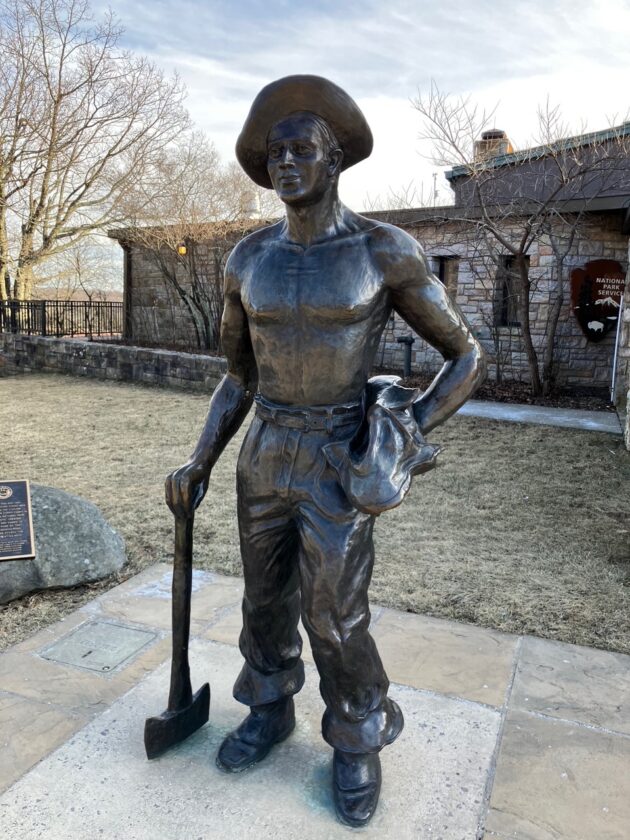
Iron Mike commemorates the Civilian Conservation Corps workers who were responsible for building trails, planting and moving trees, seeding and sodding land and much more to ready Shenandoah National Park in the 1930s.
Due to needing to use up some timeshare points, wanting to see our out of state kids and hoping to make good on a 10-year promise to visit my husband’s classmate in Texas, we hit the road.
Our choices of places to stay between Maryland and Charlotte were somewhat limited, so we took what we could find. After staying a week in Virginia Beach
-
- Iron Mike commemorates the Civilian Conservation Corps workers who were responsible for building trails, planting and moving trees, seeding and sodding land and much more to ready Shenandoah National Park in the 1930s.
-
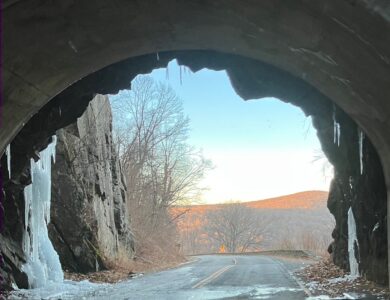
- Coming away from Shenandoah National Park at the end of the day. Photos by Beverly Kehe-Rowland
-
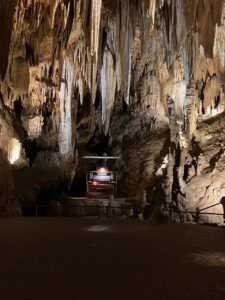
- The Stalacpipe Organ in Luray Caverns, VA produces symphonic quality tones created by electronic hammers tapping stalactites.
We went from a sixth floor condo that overlooked the Atlantic Ocean, to the first floor of a 10-12 unit two-story building, which was located in a wooded mountain setting.
BREATHTAKING VIEW SHARED WITH NEW FRIENDS
Our first full day was spent driving the side roads, in and out of small towns. While winding through the countryside, we passed many, many, too many vine-covered abandoned barns and houses, some with curtains left hanging in the windows. There was also an abundance of small roofless outbuildings. When in the south, it is not unusual to see small square signs beside driveway entrances with Bible verses or a line referring to Jesus.
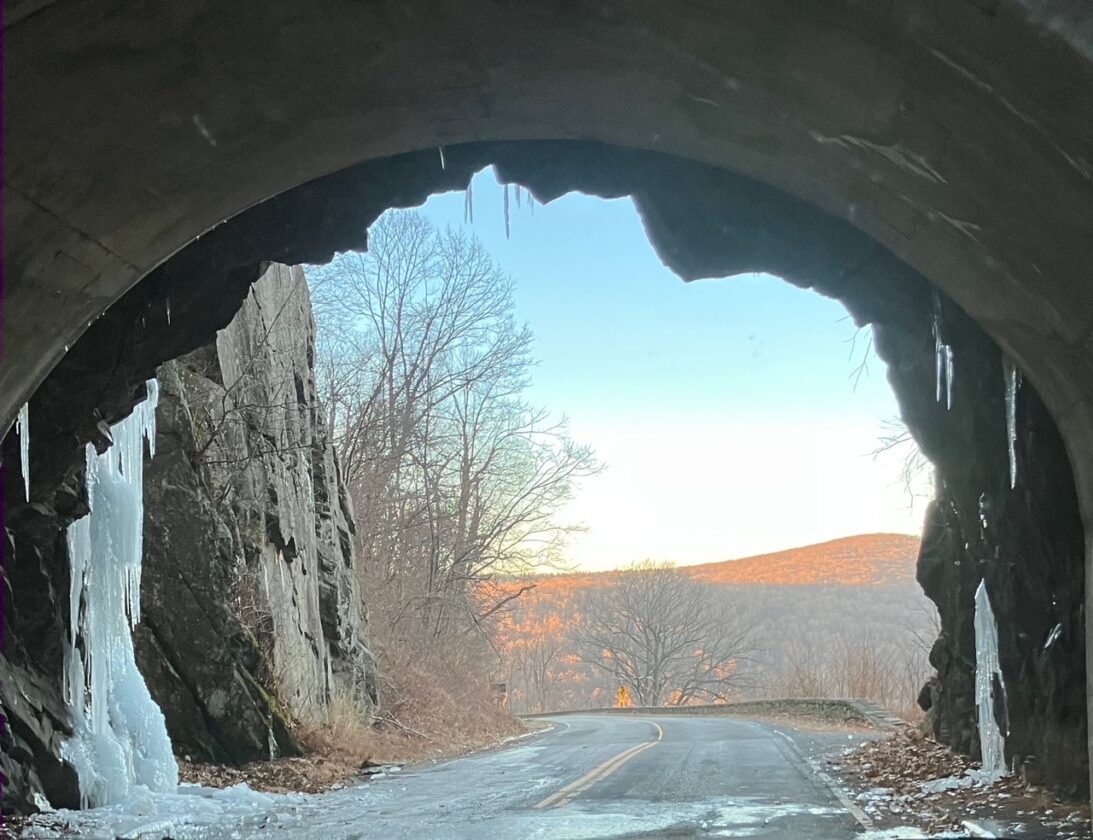
Coming away from Shenandoah National Park at the end of the day. Photos by Beverly Kehe-Rowland
After learning about a west-facing scenic overlook, we decided to head over to catch the sunset. It was a blessing when a car with three women drove up, just as we were about to take a selfie, not because we needed a photographer, but because they were awesome people. The friends were enjoying the last hours of a long weekend getaway. One of them told me she and her husband were on the cusp of retirement, wanted to travel and was interested in how we did it. I hope she gets advice from someone who is more organized and less impulsive than us, although we have traveled thousands of miles throughout 49 states and South America and wouldn’t change a thing. Well, maybe a few things.
From discussing traveling in retirement, we moved to religion and politics.
She shared how her faith had grown because of what she and her husband went through when he lost his job during the vaccine mandate, but was rehired later. While deep in conversation, we found we had lagged behind as the other three of our newly combined group had walked up a steep, rocky hill to get another view of the evening sky. As darkness fell, we parted with one another’s contact information in our phones.
BOOKS FOR MILES
I had made a list of a few options of things we might like to do and a tentative schedule after checking the weather forecast. As was expected, new adventures awaited the next day in Mt. Crawford where we visited Green Valley Bookfair. The name is misleading.
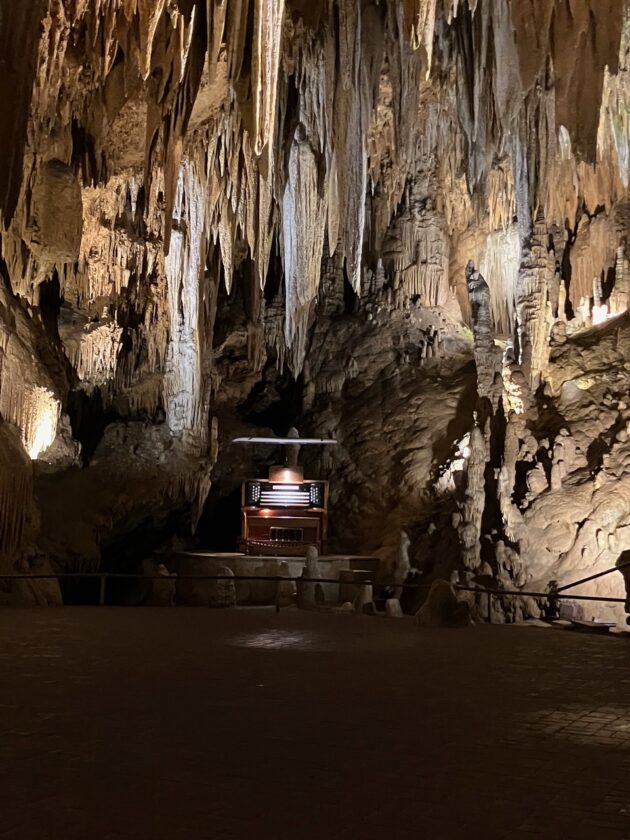
The Stalacpipe Organ in Luray Caverns, VA produces symphonic quality tones created by electronic hammers tapping stalactites.
The year-round huge bookstore is situated in three connected buildings. We barely walked through the door when we heard a cashier’s voice coming across an intercom inquiring about a particular book. Within three minutes a voice replied telling of its location. At that, my husband marched over to the closest cashier to ask if they had a copy of Larry Burkett’s Solar Flare. To his disappointment, they did not.
The gigantic room was mostly dedicated to toddlers through high school students. Row after row, shelf after shelf contained meticulously organized books. Surprisingly, there were toddler board books about political science, democracy, justice, Congress and the presidency. A section devoted to religion displayed books on Hanukkah and the Menorah, devotionals for young people and Noah’s Ark origami.
A connector to the next building held more than 50 different Wild Republic stuffies, including praying mantis, tarantulas and horned lizards. After I walked into the building, I found discovery boxes containing Space Academy, mission to the moon, human body, dinosaurs and what everybody has wondered about bowling alley science. For those looking for quirky gifts, The Office embroidery kit and a crochet kit to make Mr. Rodgers characters are a real thing.
The 25,000 square foot bookstore has been in business for 56 years. The prices of ever-changing inventory reflect a discount of up to 90 percent off retail, with a typical discount being 60 percent.
“The owner’s book collection became so large, he started book sales in the old bank barn, a barn built on the side of a hill,” said Clayton Robertson, the operations manager. “They would fill every field with cars and would sell out and then do it over and over again.”
They moved to selling only new books and estimate they have over 500,000.
“Our goal is to get inexpensive books into everybody’s hands. We try to keep it unique and try to have things not found in other book stores,” Robertson continued. “We’re constantly on the search for things we can make a profit on, make the customers happy and (sell) at a discount.”
The business caters to school systems and customers alike. They host story times and field trips for any school that wants to visit. Adults and children are invited to enter the annual bookmark design contest, which gets thousands of entries. Other exciting events are hosted throughout the year, including an Easter egg hunt for 25,000 eggs and a pet fair when local shelters set up. The community-minded business covers the cost of the adoptions.
“We’ve become a destination for travelers and people plan their vacations around us,” the 35-year employee shared. “We used to be open for a couple weeks, just six times per year.”
An online store was begun during 2020 when Covid-19 shuttered their business. Their gobookfair.com site carries about ten percent of what is available in the store and ships every day.
The stairway to the basement is at the back. For that reason, we nearly left the business without noticing. Books about investments, careers, economics, management and beauty, true crime, health and fitness were a small portion of what we found down there.
LURAY CAVERNS
We chose to go to Luray Caverns on one of the chilly days, because a year-round temperature of 54 degrees is maintained in the caverns, but due to high humidity, it feels like 65 degrees.
After leaving the visitor center where we bought our admission tickets, we followed a long, covered walkway to the cavern entrance. A164-foot tunnel leading into the caverns was opened a few years ago. This replaced steps that had been used for many decades. The caverns were discovered in August 1878. It is the largest series of caverns in the eastern United States and is one of the largest in the world. It was designated a National Landmark in 1973. Luray Caverns is visited by more people than any other caverns in the US. This may be because it is the most accessible with no steps and a paved walkway. We have visited a few other caverns therefore we have seen a lot of stalactites and stalagmites, but Luray Caverns has been the most impressive.
Of course, everything we saw was amazing, but I was especially taken with a very clear pool of water and that, although shallow, I could see the bottom. I didn’t expect to find an organ in a cave, but there it was in the aptly named Cathedral Room. The huge chamber was formerly known as the Ballroom because it was once used for dances. The tones of the Stalacpipe Organ are produced by electronic strikers tapping stalactites. Stalactites covering 3.5 surrounding acres produce the symphonic quality tones.
All caves in Virginia are protected by state law. Thankfully, acts that would deface, damage or take away artifacts are punishable. The cave bats are protected, as well.
After we walked the one and one-quarter mile underground paved path, we visited three museums, also located on the property. An amazing collection of more than thirty trains and toys from hundreds of years awaited us in the first. It was hard to decide which was more impressive, Toy Town Junction or the Car and Carriage Caravan Museum, one of America’s oldest transportation museums. There we found 140 cars, carriages and coaches dating back to the 1760s. On display was an 1898 Benz, one of the oldest cars in America that is in working condition and a 1908 Baker Electric, made when electric cars weren’t popular. The final museum, Shenandoah Heritage Village, represented a 19th century farming community made up of historic local buildings which had been restored. A separate building contained local artifacts from the 1750s.
We have a love for National Parks so we couldn’t bypass Shenandoah National Park and because it was very close to our week-long home in the mountains of Virginia. In my opinion, Shenandoah doesn’t compare to Arches, the Grand Canyon or even Theodore Roosevelt National Parks.
It was a sunny, but cool day, although the warmest we had experienced since our arrival to the area. Some of the bushes and trees had begun to flower. We spent a lot of time looking at the history of the park in a long semi-circle hallway in the Visitor Center. The nation was prosperous when the park was authorized, but when President Franklin D. Roosevelt took office in 1933, one-fourth of Americans were unemployed. Roosevelt began the Civilian Conservation Corps (CCC), which organized and put young men to work. It was estimated that 3,702 men in Virginia would get CCC jobs.
By 1938, these hardworking men installed 28 sewage/water systems, made 4,001 signs and markers, installed 136 miles of telephone line and planted or moved 147,595 trees and shrubs, seeded or sodded 361 acres of land, cut 1,149 acres of vistas and prepared 175 acres of soil. They built 101 miles of trails, 1,145 miles of fire hazard trails and 165 miles of horse trails. By 1942 more than 10,000 young men served in the CCC in Shenandoah National Park. Outside the Visitor center is a large statue of a man holding an axe in one hand and his shirt in the other commemorating the Civilian Conservation Corps workers.
The completion of the park was undoubtedly celebrated by some, but many families were reluctantly uprooted after a lifetime on their mountain property.
To be continued.