
Trending
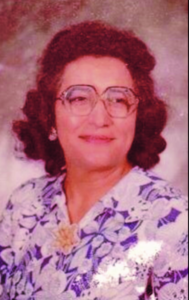
Dr. Hazel Virginia Dean (aka Dean-John; Muhlenbruch), an enrolled member of the Seneca Nation of Indians, Wolf Clan, passed away on Thursday, Sept. 26, 2024 after a long illness. Hazel was born in Coldspring, NY on Nov. 16, 1929 to Marjorie Marie and Norman Russell Jimerson.
Hazel was a Seneca oral traditionalist and Faith Keeper of the Allegany Reservation Long House spiritual way of life. She freely shared her cultural heritage as well as her Seneca language skills across the world. As an educator, she believed Native language was critical in determining a link between history and community.
She is survived by her daughter, Jacquelyn Marie (John) Cheek, and her son, Robert Lamont (Ginger) Dean; one niece, Marjorie Marie Pettit; two granddaughters, Kimberly Mae Dean and Charlotte Yerpestock; three grandsons, Cameron and Quentin (Jess) Dean; Brian Cheek, and seven great-grandchildren; as well as several sons and daughters who called her friend, mother, grandmother, and auntie. She was predeceased by her youngest child, Michele "Midge" Dean (Stock).
Hazel accomplished many firsts during her life. In 1948, Hazel received an accounting and secretarial degree with honors from the Bryant and Stratton Business Institute in Buffalo, NY. At that time, she also worked as an Executive Secretary for General Mills, Inc. in Buffalo. Over the years, she worked as a staff assistant, accountant, office manager for various companies and as a perforator operator for a publishing firm.
From 1961 to 1963, she served as a secretary for the Seneca Nation, later becoming the Seneca Language Translator and Bookkeeper. In this position she assisted in all phases of the relocation of 132 Seneca families who had lost their homes and lands as a consequence of the Kinzua Dam construction. During this difficult time for the Seneca people, Hazel coordinated many TV documentaries and became one of the on-site interviewers for radio and TV personalities who were exploring the effects of the Dam construction on relocated families.
In the mid-70's, at the request of Seneca Tribal elders she entered the Harvard Graduate School of Education (HGSE) to learn the skills necessary to preserve the Seneca language and the culture it embodies for the generations yet to come. At the time she entered college, she was serving as Acting Director and Cultural Program Coordinator/Language Teacher for an education program of the Seneca Nation.
In 1977, she received a Master's Degree in Administration, Planning and Social Policy. In 1978, she and her daughter, Jacquelyn, became the first Native American Indian mother and daughter graduates there. In addition, Hazel raised funds for the first Federal Indian Law course to be taught at HGSE and was the first Native American Indian member of the Subcommittee on Admissions.
While attending HGSE, one of her professors introduced her to a linguistics professor at the Massachusetts Institute of Technology (MIT), where she enrolled in linguistics classes. At the MIT professor's recommendation, she pursued a degree from the University of Arizona in Tucson, where she earned a Master's degree in 1980 and a Doctorate in Linguistics in 1983. Her doctoral dissertation, a phonological analysis of Seneca which incorporated instrumental techniques difficult to master and interpret, was so revolutionary that her findings caused many linguists to revise their theories of phonology.
Through her efforts, Hazel earned a national and international reputation. She became the first Native American Indian to address a meeting of the Bilinguists from the Soviet Union. Later, she became the first Native American Indian to address an international meeting of linguists in Austria.
Despite her remarkable achievements and the many honors bestowed upon her, Hazel remained a traditional Seneca woman. As a Longhouse Faith Keeper, she did not speak of her own achievements, instead she allowed others to speak for her. Scholars and others describe her as a warm and generous human being. They speak of how she never tired of sharing her life and her cultural experiences. They talked about her skill for organization, her capacity for work, and her ability to get things done. Others were impressed with her creativity and how she was able to make Seneca language classes "come alive" for students of all ages.
We will never forget her charm, wit, and remarkable memory for recognizing people and knowing their name even if she hadn't seen them in over 20 years.
Funeral arrangements were held at the Coldspring Longhouse and are under the direction of the O'Rourke & O'Rourke Inc Funeral Home, 25 River St., Salamanca, NY.
E-condolences can be sent to orourke.orourkefh@gmail.com or posted to facebook.com/onofh.