
New bill aims to keep AI out of court opinions
Trending
New legislation introduced in the state Senate aims to keep artificial intelligence from being used in court opinions in New York.
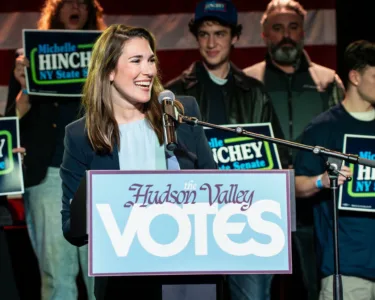
Sen. Michelle Hinchey, D-Kingston, recently introduced legislation (S.10741) that would add a new section to the state Judiciary Law that would prohibit judges from using fabricated legal authority in adjudicative writings. Hinchey proposes making knowledgeable use or reckless use of AI by judges professional misconduct.
The state's Unified Court System recently released its Interim Policy on the Use of Artificial Intelligence. In October 2025, Senate Judiciary Committee Chairman Chuck Grassley, R-Iowa, spoke on the Senate floor to discuss his oversight of federal judges' AI use after finding two federal judges whose court staff used AI to draft inaccurate court orders that the judges approved. During his floor speech, Grassley called on every federal judge, the Administrative Office of the U.S. Courts and the Judicial Conference to develop formal measures and meaningful guidance to prevent future AI misuse.
"New York should not wait for comparable judicial failures to cause harm in this state," Hinchey wrote in her legislative justification. "This bill will establish a clear rule of judicial accountability before such misconduct causes substantial harm in New York, while preserving lawful and responsible uses of AI."
Hinchey's bill would state that a judge who knowingly or recklessly includes, relies on or adopts fabricated legal authority as part of adjudicative writing is engaging in misconduct. The use of AI by a judge would not, by itself, constitute misconduct, however. A judge would not be found guilty of misconduct if the errors are based solely on good-faith interpretation, immaterial typographic or clerical errors, or other immaterial errors that can be corrected quickly without adverse consequences.
The state Commission on Judicial Conduct would be required to consider the number and materiality of fabricated authorities; whether errors affected the disposition of the case; applicable verification procedures or training received; and whether the error was repeated or promptly corrected when deciding whether a judge has committed judicial misconduct with the use of AI.
A Northwestern University study released earlier this year surveying federal judges across the U.S. on their use and outlook on artificial intelligence in and outside of the courtroom found that more than 60% of judges who responded reported using at least one AI tool in their judicial work. While judges reported broad adoption of AI tools, only 22.4% of judges reported using AI tools on a weekly or daily basis.
The research team, led by Daniel Linna, director of Law and Technology Initiatives and senior lecturer at Northwestern Pritzker Law, and V.S. Subrahmanian, Walter P. Murphy Professor of Computer Science and director of the Northwestern Security & AI Lab at McCormick School of Engineering, conducted a stratified random sample survey of bankruptcy, magistrate, district court and court of appeals judges.
"Even though some judges have been wary, there are plenty who think AI creates opportunities for improving access to the courts, access to justice and the quality of judicial decisions -- but that requires intentionality," Linna said in a news release when the study was finalized. "We need to think about how we bring these technologies into the courts, offer AI training to judges and analyze the benefits and risks."
The survey found judges are more likely to use "AI for Law" tools than general-purpose AI platforms. Researchers found that judges use AI tools mostly for conducting legal research (30%) and reviewing documents (15.5%). When it comes to others in their chambers, judges reported that those individuals also use AI tools mostly for conducting legal research (39.8%) and reviewing documents (16.7%). Researchers also found that AI training isn't being offered to most judges -- 45.5% said AI training was not provided by the court administration, and 15.7% were not certain. One in three judges permit (25.9%) or permit and encourage (7.4%) the use of AI in their chambers. Approximately 20% of judges formally prohibit AI use, 17.6% discourage but do not formally prohibit AI use and 24.1% of judges have no official policy on AI use.
In their survey responses, judges were nearly evenly divided between being optimistic about AI's potential for the judiciary and being concerned.
"Courts across the country are beginning to confront this reality of AI-generated legal citations," Hinchey said in her legislative justification. "Such failures can affect property, family relationships, employment, education, detention, liberty, and other substantial rights. A judge exercises the sovereign judicial power of the state, and while they may receive research and drafting assistance from law clerks, court personnel, or AI tools, the judge retains the
exercise of judicial power and judgement."