
Paying For Protection: Jamestown, similar cities approach fire department budgets differently
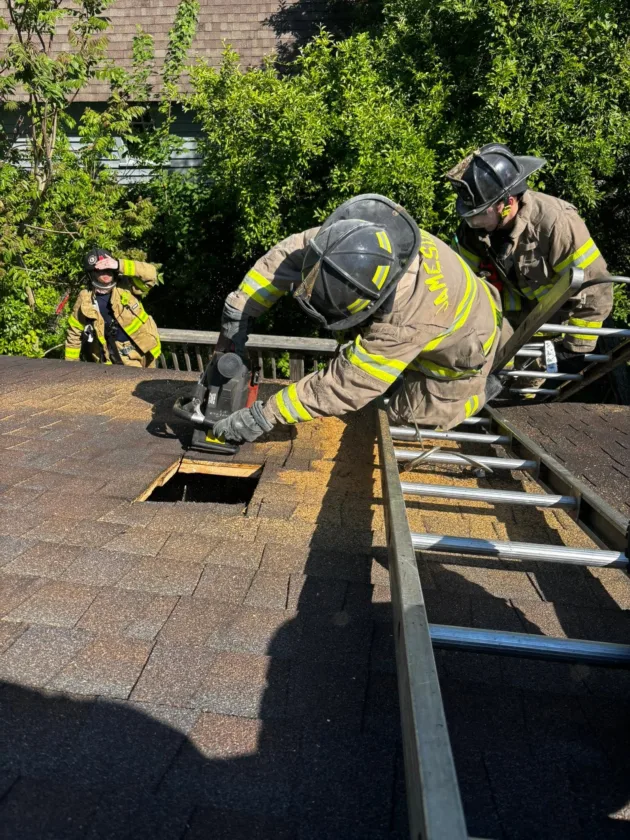
Jamestown firefighters are pictured training over the summer. Photo courtesy Jamestown Fire Department Local 137 Facebook page
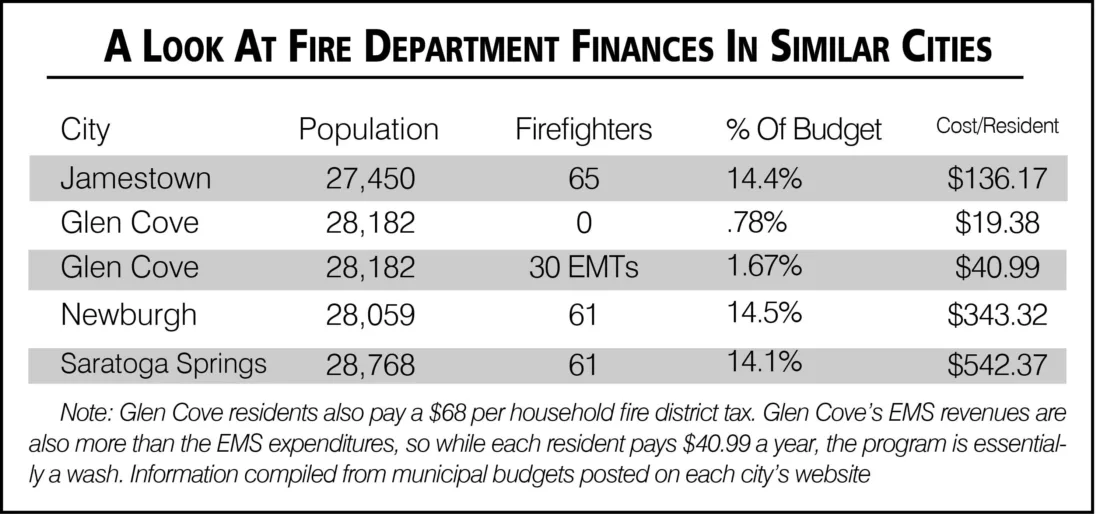
Residents of Jamestown, Glen Cove, Saratoga Springs and Newburgh - all cities between 27,000 and 29,000 residents in New York state - pay varying rates for fire and EMS services.
Jamestown firefighters are pictured training over the summer. Photo courtesy Jamestown Fire Department Local 137 Facebook page
Residents of Jamestown, Glen Cove, Saratoga Springs and Newburgh - all cities between 27,000 and 29,000 residents in New York state - pay varying rates for fire and EMS services.
Trending
The city of Jamestown faces a decision over 12 grant funded firefighter positions whose outside funding is expiring at the end of the year.
Jamestown’s fire department budget accounts for 14.4% of the city’s $47,342,691 budget, an amount that pays for 65 firefighters as well as an administrative assistant. Mayor Kim Ecklund is proposing to keep all 12 grant-funded firefighters at a cost of $1,500,000 to the city's general fund. She proposes paying for the four American Rescue Plan Act-funded positions with an allocation from the projected $450,000 2027 city EMS revenue. The remaining eight positions, whose federal SAFER grant funding runs out in February, are proposed to be paid from the city's general fund for the rest of 2027.
The budget realities of the grant-funded firefighters were known in 2023 when the city used ARPA funding for the fire department and accepted a federal SAFER grant, and what could happen to the positions after the grant funding ran out was a heavily debated topic in 2023.
The City Council will review Ecklund's budget proposal in the coming weeks, while the discussion of how to proceed with the grant-funded firefighters prompted a look at the way other similarly sized cities handle fire and EMS services.
While Jamestown grapples with how to handle the situation with the SAFER firefighters, some cities find themselves faced with similar situations regarding staffing and budgets – while another similarly sized city handles fire and EMS services completely differently.
CITY OF GLEN COVE
Glen Cove, a city of 28,112 located on Long Island, is slightly smaller than Jamestown and has a volunteer fire department. The City of Glen Cove fire tax is less than $68 per household and 2% of the city's overall budget. In 2024, the department responded to more than 700 calls for help that included fire calls, motor vehicle accidents, rescue calls and nature related emergencies.
Organized in 1985, Glen Cove Emergency Medical Services (EMS) is a municipal department of the city of Glen Cove. The Department operates as a state Department of Health-certified Advanced Life Support (ALS) agency, providing 24/7 emergency medical transportation and care to the community. In addition to responding to emergency calls, Glen Cove EMS supports community safety by providing medical coverage and first aid services at City of Glen Cove events. The Department operates out of a single station, EMS headquarters.
Glen Cove EMS is staffed by a combination of paid and volunteer members and currently operates four Advanced Life Support ambulances, a Mass Casualty trailer, a pickup truck, First Responder truck, utility van, mountain bikes, and a 6×6 all-terrain Gator, along with additional support vehicles. The department serves a 6.6-square-mile district with a population of approximately 26,964 residents, as well as 12.6 square miles of waterways and coastline along the Long Island Sound and Hempstead Harbor.
Glen Cove had a $69,335,987 budget in 2026. The EMS and Ambulance Corps brings in between $1.115 million and $1.380 million a year over the past three years, while spending for the fire department was $545,000 in 2026 and $1,152,425 for the EMS/Ambulance Corps. That means the EMS/Ambulance Corps more than pays for itself with revenue while the city subsidizes the volunteer fire department.
Glen Cove has about 90 volunteers on its active roster. Only fire department dispatch is paid, at a cost of about $500,000 a year.
SARATOGA SPRINGS
Saratoga Springs, which has a few hundred more residents than Jamestown, is proposing an 18% property tax increase in its $67,386,502 budget proposal for 2027. That budget supports a $9,772,338 to pay for the city's fire department, which has 62 firefighters.
Saratoga Springs found itself in a similar position as Jamestown. In 2022 the city received a $4.15 million SAFER grant to hire 16 new firefighters and paramedics to staff a newly renovated fire station. The city’s 2027 budget comes with a proposed 18% tax increase and staffing cuts driven by increased health insurance costs, retirement costs for city employees and liability insurance – as well as the new fire station and the expiration of SAFER grants to staff the station. The Department of Public Safety is being asked to cut 5% of its personnel costs in the coming year while other departments are being asked to cut 3%.
NEWBURGH
Newburgh is slightly bigger than Jamestown with 28,159 residents. It has a total all-funds budget of $109,832,987, of which $15,467,871 pays for the fire department, or 19.9% of the city’s budget. The fire department budget is increasing 4.64% compared to 2026. Salaries are $6,093,146 (39.4% of the department’s budget) with another $7,843,974 for benefits (50.7% of the department’s budget). Newburgh has 54 uniformed officers and 7 non-sworn staff.
In 2022, the fire department fielded 3,172 calls for service. This included responding to 52 building fires, 934 calls for rescue and emergency medical service, and 959 false alarm/false calls. Jamestown, by contrast, responded to 8,514 total calls for service and performed 1,043 ambulance transports.
The union representing Newburgh's firefighters has been pushing in recent months for additional firefighters, with seven firefighters working each shift.