
EPA announces $1M grant for Harrison St. clean-up
Trending
Some vacant land that previously had industry on it will soon be remediated so it can be used once again.
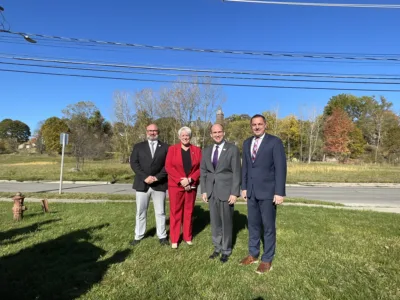
On Thursday, Rep. Nick Langworthy was in Jamestown, along with Mike Martucci, the regional administrator for Environmental Protection Agency Region 2, to announce that $1 million is being provided to clean up three parcels on Harrison Street to get them ready for future use.
"We are writing a new chapter for this city and I believe its best days will be ahead of us," Langworthy said during a news conference. "This funding is key to unlocking Jamestown's future."
The news conference took place across the street of 251 Harrison St. A few years ago, the YMCA proposed building a new facility there but ended up abandoning it, due to the costs.
After the YMCA walked away and joined Jamestown Community College's project, the Jamestown Board of Public Utilities took possession, buying the land in early 2025.
Martucci said the EPA Brownfields program "leverages billions of dollars across America to take polluted sites that represent the 'scars of industries' left in our communities and turn them into opportunities for the future."
Martucci said this funding will be used to help understand the environmental challenges the properties have, understand how to clean them up, and "leverage opportunities in both the public and private sector," so the properties can be used once again.
Martucci said the federal government is not dictating how the property should be used.
"That is the decision that we at the EPA strongly believe belongs at the hands of local communities," he said.
Jamestown Mayor Kim Ecklund was on hand and thanked both Langworthy and Martucci for the federal investment.
She said there has already been interest in the property.
"We've already had some requests of interest for development down here of growth of current businesses in town, so this will continue to remain a manufacturing corridor; it's just to what level," she said.
When asked for how soon residents could see the property developed, Ecklund was reluctant to offer a timeline.
"The remediation, it depends on what is found there," she said.
County Executive PJ Wendel also praised the funding announcement.
"We are revitalizing our past. To learn from our past is to move forward in our future and that's exactly what we're doing," he said.
Wendel noted how the Chadakoin River was the industrial corridor for Chautauqua County, especially Jamestown.
"There were some remnants left behind, but to now clean that up is paramount," he said.
Langworthy, too, highlighted the importance of the Chadakoin River corridor, noting it has a personal connection to him.
"My dad's a business owner in this community. I've seen first-hand what this city has been through and I know what it is meant for the families who call this place home," he said.
There are three contiguous parcels owned by the BPU with the addresses of 133 Winsor St., 251 and 289 Harrison St. They total around 2 acres of land.
According to the state Department of Environmental Conservation website, the 133 Winsor Street parcel was used for industrial purposes from at least 1886 to approximately 2009, when former buildings were demolished. Historic industrial operations reportedly included a lumber yard, a sawmill, printing, glazing, a chemical company, and manufacturing of doors and blinds. Site operations included a transformer room, a glue room, a paint room, a coal room, and lumber piles.
The 251 and 289 Harrison Street parcels were occupied by a variety of commercial and manufacturing operations, including a textile mill from about 1867 to 1881, a plating company, a chemical company, a dry-cleaning facility, and a number of metal working companies. Common contaminants associated with these types of commercial and manufacturing operations include solvents, degreasers, dry-cleaning fluids, volatiles, petroleum products, thinners, metals, cyanide, acids, and bases. Regulatory records indicate that the site was listed as a large quantity hazardous waste generator in the early 1990s.
According to the state DEC, "NYSDEC inspection records indicate that the last recorded tenant, Watson Manufacturing Co., was not in compliance with applicable hazardous waste regulations. Previous investigations have identified polycyclic aromatic hydrocarbons and metals, including arsenic and chromium, at concentrations exceeding Commercial and Industrial Soil Cleanup Objectives."