
Deer Solution?: State continues Urban Deer Management Pilot program; doesn’t implement changes or expansion
Trending
Gov. Kathy Hochul has signed legislation extending the Urban Deer Management Pilot program – a program that could help Jamestown with its urban deer issue if the program moves beyond a one-city pilot program.
A.10112/S.9098 was passed overwhelmingly in the state Legislature in May, with only Assemblyman Jeff Dinowitz, D-Bronx, voting against it in the Assembly and only Sens. Jabari Brisport, D-Brooklyn, and Monica Martinez, D-Hauppauge, voting against it in the Senate. There was no floor discussion in either chamber.
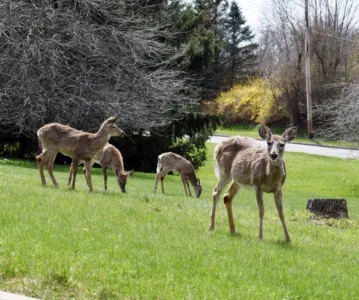
Jamestown has heard resident complaints for years regarding the presence of deer inside the city limits with just as many city residents opposed to taking action to try to cull the herd of deer that are seen roaming throughout the city. The last serious discussions on the issue came in 2021. One of the complaints that has been raised by city residents when proposals to allow hunters to harvest some of the city deer is safety for residents in areas where hunters were to be allowed.
One possible fix to Jamestown's issue may be found in the Urban Deer Management Pilot program that was recently extended by the state Legislature. The state Urban Deer Management Pilot program was approved in 2024 to study enhanced authorization of ways to reduce deer populations in Syracuse and Southold. The legislation specifically authorized the DEC to issue a Deer Damage Permit to Syracuse or Southold that allowed a nuisance wildlife specialist to take deer using additional techniques that aren't allowed under the typical Deer Damage Permit, including placing bait within 300 feet of a road, taking deer from a public highway, use of a spotlight from a vehicle while in possession of an unloaded firearm, and additional exceptions for the discharge of firearms, long bows or crossbows within 250 to 500 feet of an occupied structures with notification of landowners or at distances less than 250 feet with written consent of all owners or renters.
Syracuse had used Deer Damage Permits since 2019-20, and after taking 159 deer in the first year the success of traditional steps under the available permits had decreased over time to 44 deer taken in 2024-25. In 2025-26, traditional firearm sites resulted in the harvesting of 56 deer, according to a DEC report released in June, while the Pilot program took 35 deer from firearm sites and 54 from trapping sites – bringing the total number of deer culled from the herd almost back to 2019-20 levels.
"Wildlife Services reported that the pilot program improved land access for deer removal and their ability to operate in the urban environment of Syracuse," the DEC report states. "However, statutory restrictions continue to limit overall effectiveness and efficiency of the program. The inability to possess a loaded firearm in a vehicle and discharge a firearm from a vehicle-mounted elevated shooting platform remains the largest operational barrier for Wildlife Services to remove deer in Syracuse. Likewise, the city of Syracuse reported that the pilot program has been an effective tool to reduce damage to public and private property from deer while maintaining public safety. Syracuse also acknowledged that allowing the nuisance wildlife specialist to discharge firearms from a vehicle and increasing access to properties in Syracuse would enable more efficient removal of deer and greater benefit to residents."
DEC officials recommend several amendments, though the only change included in A.10112/S.9098 is extending the current Pilot program to six years. Among the DEC's recommendations are:
– Extending all DEC permits that authorize removal of deer by a nuisance wildlife specialist to use the enhanced authorizations in the pilot program.
– Authorizing nuisance wildlife specialists to discharge a firearm from a stationary vehicle mounted with an elevated shooting platform while also allowing the specialists to possess a loaded firearm in and on a motor vehicle, use spotlights and thermal detection devices from a vehicle while in possession of a loaded firearm and shoot across or from a road.
– Expand the definition of nuisance wildlife specialist to include private contractors that offer professional wildlife removal/sharp-shooting services equal to or exceeding current requirements.
– Authorize nuisance wildlife specialists to use firearms equipped with sound suppression.
"Sound suppression safeguards hearing of nuisance wildlife specialists, reduces disturbance to local residents from deer removal operations, and increases removal efficiency by enabling multiple deer to be taken from a group before the deer become aware and begin leaving the shooting site Sound suppression does not make firearm discharge silent but merely dampens sound, acting much as a muffler on a vehicle," the DEC report states.