
Questions abound during Panama town hall on school merger
Trending
PANAMA – Taxes, the future of sports teams, retirement costs, possible school board membership and the future of one pre-k through 12th grade building serving all of Clymer, Sherman and Panama are among the questions on the minds of Panama residents who are mulling a potential merger of the three school districts.
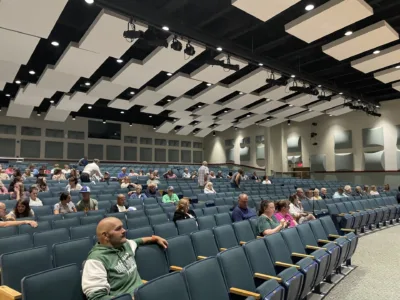
A town hall meeting was held at Panama Central School on Wednesday. Similar to the town hall held last month in Sherman, community members were welcome to come and express questions or concerns they had, and at Panama's town hall, this included some questions, concerns and rumors that those in charge of the merger process have seen circulating around Facebook and social media, or around the local areas.
The town hall began with a quick review of key points from the study and information shared at past meetings, along with the petition process -- which runs until October 1 -- , how it works, and the petitioners from all three districts. When open for questions from the community, Shelly O'Boyle, CSP Merger Study project coordinator, interspersed some of the things that have been seen on social media in between questions from the audience.
One more town hall will be held at Clymer Central School on September 24 at 7 p.m. before the petition process wraps up on October 1. If all three districts receive enough signatures -- 161 in Clymer, 301 in Sherman, and 154 in Panama -- the process moves on to a formal statutory, binding vote in December.
More information on the CSP merger process, along with a recording of both of the Sherman and Panama town halls can be found at CSPhub.org.
TAXES
One of the first topics like this that O'Boyle brought up was a rumor that taxes are going to increase upon merging.
"What we know from this study is that the merger incentive aid, the reorganizational incentive aid, is higher than it's ever been," Carrie Munsee, said Panama School Board president. "We have also been told that it is unclear how long the calculation that they're currently using is going to be in place, because it has been such a significant increase from what it used to be."
The total merger incentive aid from the state will be about $71 million to be used by a merged district over the first 14 years. The last time Clymer and Panama looked at potentially merging, merger incentive aid totaled about $16 million. The idea, Munsee said, would be to split that $71 million amount into thirds, with one-third going toward the tax levy. She noted that currently the three districts are at slightly different assessed values when it comes to school taxes.
"Clymer and Sherman will recognize a bigger benefit to that than Panama, but to flip that, if we don't merge the three districts know that we cannot continue to operate on the dollar amounts that we are currently raising," Munsee said. "The only way schools raise money is through taxes and money we get from the state. The state doesn't seem to be offering a lot of extra these days, so it's going to go to taxes. Taxes will increase if we don't merge."
Munsee also noted continuous rising costs, saying that this is an opportunity to use the money from the state and help decrease taxes instead of seeing them rise with the rising costs.
'GETTING EVERYTHING'
Another question that has been circulating on Facebook or in other areas that the districts would like to answer that O'Boyle brought up is "why is Panama getting everything?"
David O'Rourke, BOCES district superintendent, said Panama is not getting everything, noting the earlier mention that Clymer and Sherman would be seeing a bigger benefit from the tax change. He said he believes this perception is coming from grades seven through 12 being recommended to be housed at Panama with a merged district. O'Rourke noted that both Clymer and Sherman's elementary students are recommended to stay in their current school buildings, and something else that has been talked about in the study, at previous meetings, and earlier in the Panama town hall meeting on Wednesday was the possibility of pods. These pods would be for specialized courses, such as agriculture or welding, that Clymer or Sherman's current buildings would have the specific facilities for that students could travel -- similar to what currently happens with BOCES -- to be able to have the opportunity to have these specialized courses that they might not currently have the ability to have.
"So Clymer and Sherman might benefit in that an agriculture program could be held at one, and a technology or finance program could be held in another in the matter that was described earlier," O'Rourke said. "All three communities would retain their elementary schools as well. I don't think it's accurate; it sounds like a question that's as much of a claim as it is a question, and we encourage folks to read the study. There are benefits to all three communities that the study lays out."
FUTURE OF DOWNTOWNS?
Another question brought up from what has been seen on social media is if the towns and villages die without the school? Board members from all three districts reported that the use of the buildings if the merger were to go through were identified as something important not only to the community but to the board members in all three districts as well. The three districts have already gone through a process with an architect to determine future uses for the building space that isn't being used for education. There are options that include a multi-use building. With the elementary schools planned to stay at least at first in Clymer and Sherman, the buildings have the ability to be used for other purposes at the same time. Examples of this were given such as the former Findley Lake elementary and Mayville schools both being used now as community centers.
RETIREMENT BENEFIT
One other posed question or rumor circulating is that Clymer's current retirement benefit would bankrupt the merged district.
"The simple answer to that is no," said Lynda Quick with White and Partners, who did the merger feasibility study for the three districts, said. "It hasn't. We say in this report and all of these presentations that all three of these districts are very well run financially. They have managed their money well. The issue that all districts in New York State are facing right now is the lack of state support."
Quick said the retirement benefit has not bankrupted Clymer and will not bankrupt the new district, adding that when it comes to collective bargaining agreements, staff retirement is something that is negotiated and will continue to be negotiated as part of this process. Another recommendation from the study returns to the idea of spending one-third of the incentive aid on operational expenses. Bringing staff together and keeping them is part of that operational expenses for the new district. Quick also noted the difference in the amount of money a teacher gets paid at the beginning versus when they are a veteran teacher, which pays for a portion of that retirement incentive.
ONE BUILDING, SPORTS
Questions from the audience in attendance at the town hall included the possibility of constructing a unified, full Pre-Kindergarten through 12th-grade building in the future. While school officials noted that a single-campus model could be a long-term consideration, the immediate priority is to consolidate students as soon as possible, resulting in the decision to house grades seven through 12 at the Panama campus.
Moving forward, the new district will need to evaluate two primary pathways to address its long-term infrastructural needs: pursuing a brand-new build or renovating existing facilities. Because these options represent significant financial commitments, no definitive actions can be taken without exhaustive financial planning and capital project forecasting. Ultimately, the community will determine the final path forward, as any proposed capital project, new or renovated, will be subject to a public referendum for voter approval.
Many questions focused on sports, including concerns from students about not being able to be on certain teams with more players. It was noted that as it sits right now, the districts do not have enough to be able to field full teams as is, and the merger would offer the chance for students to be able to play sports they currently cannot. Other sports related questions included looking at Section 6, and if teams that are currently merged with other schools such as Maple Grove would be able to continue with that merged team if the school merger went through. Emily Harvey, Panama superintendent, said Section 6 does not determine what sports schools can be combined in, but they do have to approve them through an application schools submit to them. Most merged teams in the past have been to save programs, she said, but that is something that is determined at the local level. There is no reason why merged sports programs with other districts could not continue, and Harvey said it would be a local decision. It was also noted that with a merged district it would not mean they would jump up to a bigger class size, sports wise, since all three schools are small and the teams would still be small.
Other items of discussion at Panama's town hall included incentives for bus drivers, having a better tax rate with a merged district, maintaining staff, teacher organization at both the merged seven through 12 school and elementary schools, successful merged districts over the past decade including Chautauqua Lake Central School, an explanation of foundation aid, what educational benefits could be seen in a merged district, and the formation of a new school board.
BOARD MAKEUP
For the new school board, while there is no mechanism to determine an equal representation from each district on the board, it will be made up of five, seven or nine members. The size of the new board is approved by the community upon approval of the merger, and soon after that board members will be voted on and seated. Quick said typically existing board members from all of the involved districts will commit to running for the board, have a platform for what they would like to see with the merger process, and that is typically how things are voted on. It was noted that this has been a concern from the beginning, and that all three districts want equal representation, and that there will be a lot of interest from current board members. It was also noted that the boards want to start things off on the right foot, and while at first there may be a concern about having mixed representation, later on it may not matter. Munsee used Chautauqua Lake as an example again, saying that now 20 or 25 years later board members could probably not identify which member came from a Mayville or Chautauqua district. She added that while especially in the first few years equal representation from all three districts is important, looking down the line as one district, every member will be one district and tasked with the best interests of that district, no matter where they are from.