
Executive proposes $11M from surplus to balance budget
Trending
MAYVILLE - A combination of using a large portion of its reserves and the high value of homes in Chautauqua County has allowed County Executive PJ Wendel to propose a budget which has the lowest property tax rate in 50 years, while also keeping the levy, the amount raised by taxes, flat.
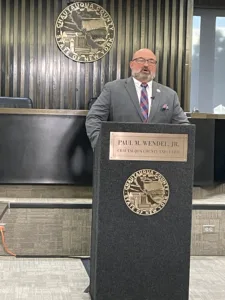
On Wednesday night, Wendel proposed a $330 million budget for 2027, with a property tax rate of $5.32 per $1,000 of assessed value, a decrease of $0.85 from the current year. He noted the last time the county had a property tax rate this low was in 1976, which was proposed and adopted in 1975 as the first budget introduced by a Chautauqua County executive. Before that, the county had a Board of Supervisors for its government.
The unveiling of his proposal was titled "Putting money back in your wallet" and was made during the county legislature's monthly meeting.
"As county executive, I have made it my priority to protect, strengthen, and expand the essential county services our residents rely on, ensuring that no matter the challenges we face, the people of Chautauqua County can count on their county government to be there when they need us most," Wendel said at the beginning of his 21-minute presentation. "Every resident deserves services that are accessible, responsive, and delivered with dignity. and we have a responsibility to provide them in the most efficient, effective, impactful, and fiscally responsible way possible."
Chautauqua County has had around $3 million to $35 million in its fund balance. County Democrats, in particular, have been calling for Wendel to spend the reserves down.
Wendel said his budget is using about $11 million from the reserves. With this move, the fund balance will be at 6.3%, which is still between 5% and 15% of the total budget, which is what the county's Financial Management Plan calls for.
Wendel said some of the challenges of this year's budget include inflation, the high cost of fuel, and unfunded mandates.
During his powerpoint presentation, he flashed an AI generated image of himself, state Sen. George Borrello and Assemblyman Molitor posed as heroes fighting against a green monster, with the phrase "Fighting back against unfunded mandates" as the caption.
"When Albany imposes costly mandates for their pet projects without funding them, the bill ultimately lands on you, the local taxpayer," Wendel said.
He specifically called on Gov. Kathy Hochul to not shift more of the administration of the SNAP program onto counties.
BUDGET BREAKDOWN
Wendel said 49% of the budget goes to human services; 21% goes to public facilities, including water and sewer; 20% goes to public safety; 8% goes to administrative services; and 2% for planning and economic development.
To fund the budget, Wendel said 56% of it comes from county funds. That breaks down to
21% from property taxes; 17% from sales tax; 14% from designated revenues; and 4% from fund balance. In addition, 20% comes from state aid; 12% from the federal government; and 12% is shared municipal sales tax - money the county collects but provides to cities, towns, and villages.
According to Wendel, there are more than 40 state-designed programs that the county must fund, which make up 67% of the tax levy. Examples include temporary assistance for needy families, safety net, Medicaid, early intervention, prekindergarten, special education, mandated medical services for incarcerated individuals, probation, youth detention, child welfare, pension, and the newly proposed SNAP administration costs.
"Despite having limited flexibility, Chautauqua County continues to deliver essential services, make critical investments in our infrastructure, and build stronger communities," he said. "We have done this without placing unnecessary burdens on our residents."
Wendel noted the assessed valuation of properties in the county is now more than $14 billion, an increase of nearly $2 billion from 2026.
"This demonstrates that the real estate market is solid and booming here in Chautauqua County," he said.
Wendel said the proposed budget includes $17 million in capital projects, $700,000 for JCC upgrades, $310,000 for economic development, and more than $700,000 to enhance public safety.
In 2026, Wendel proposed $500,000 to be used from the county's fund balance for government efficiency projects. He again said the county is willing to consider funding government reduction initiatives, although he didn't specify how much or how many the county will consider next year.
This is the seventh time Wendel has proposed a decrease in the property tax rate. In 2020, the tax rate was $8.46 per $1,000 of assessed valuation. Six of those seven years the county legislature adopted a budget with a lower tax rate. The exception was in 2021, when the legislature hiked the property tax rate by 5 cents per $1,000.
The legislature will be doing its budget review the week of Oct. 5. The budget will likely be up for final adoption at the next legislature meeting Oct. 28.