
Clymer, Sherman Panama reach merger petition goal
Trending
CLYMER -- The petition period for getting signatures to continue forward with the Clymer, Sherman, Panama merger process continues until October 1, but during Thursday night's final town hall of that petition period, held in Clymer, it was announced that with a week left to go all three districts have hit the required amount of signatures needed.
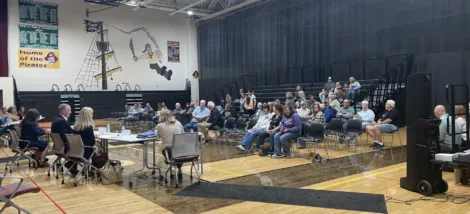
Clymer's town hall was held Thursday night at Clymer Central School, and similar to the last two, community members were welcome to come and have their questions addressed. One such question asked where the three districts currently sit with the required number of signatures each was required to get -- 161 in Clymer, 301 in Sherman, and 154 in Panama. All three districts reported exceeding the amount of signatures they were required to get. Signatures for the petition are still being accepted until October 1, and next steps following that are being scheduled, such as the final, statutory vote which is expected for early December.
It was also noted that that final statutory vote will need to pass by 50% of the vote, plus one, in all three districts for the merger to become official.
Similar to Panama's town hall last week, interspersed among the questions from the audience were questions and rumors that have been seen or heard on social media or across the three districts when gathering petition signatures, that the three districts also wanted to address.
BUS TRANSPORTATION
The first of these questions, addressed by Shelly O'Boyle, CSP Merger Study project coordinator, came following a question from the audience in regards to transportation, specifically looking at recruitment of bus drivers and hours increasing for drivers already there. The answer to the question from the audience was that the district would work with existing staff and have a focus on recruiting more drivers to help with the load, and it was also noted that many existing routes already overlap. The social media question was similar, asking about the amount of time for a bus ride from Findley Lake to Panama, and how those would stay less than an hour as recommended in the study.
"This is a question I know that has come up in all three districts, with the study referencing Panama initially being a joint high school location," said Carrie Munsee, Panama Central School board president. "It has become more of a concern for those on the north and west side of the Sherman district and the Findley Lake end of the Clymer district. We have taken the study a step further with the directors of transportation for all three districts to actually map out where those spots are and really look at it."
Currently, Munsee said people that are out in the morning or afternoon will commonly see buses from more than one of the three districts running down the same road, which is something that could be eliminated and made more timely. It has also been looked at where the pods of people are currently, and it is possible to send a bus to those pods, pick up those students, and bring them back and count it as a full route. Munsee said looking at the study and taking that into consideration it will be doable, and added that pick up for private schools such as the Amish schools will continue as well.
TAXES
Taxes were another area that was addressed, specifically that taxes will increase with the merger, and that Panama will not see a benefit with the taxes, as the other two districts will see a bigger benefit. Taxes are set to decrease with a merged district, and the study details splitting the $71 million incentive aid into three sections, including a section to address the tax levy, and that will decrease taxes all three districts with a little bit less of a decrease for Panama Using the incentive aid in what was referred to as the three bucket model, one part of it will also include the initial operating costs of a new district, and taxes will not have to increase to help with that. A graph was shown to those in attendance, outlining that the combined tax levy is not expected to hit where they currently sit now with the three districts until 10 years down the line. The rate will increase throughout the years, so long term financial planning will be an important part of the merged district continuing down the line, especially once reaching the 15 year mark when the district will stop receiving the incentive aid.
HOW SOON?
Another question that has been seen is if the merger goes through will the seven through 12th grade students be at Panama for the 2027-28 school year? While it is wanted to get the students together as soon as possible, it was noted that it also needs to be done successfully, so for the 2027-28 school year students will remain at their current schools, and students are expected to combine for the second year of the merger.
Also seen as a question posed on social media is in regards to the student opportunities that will be given with the merged district, and why students could not do that now in ways such as over Zoom. Panama Superintendent Emily Harvey said Zoom is not always a conducive way of learning for students.
"Honestly, all three of our schools do participate in some type of Zoom or distance learning type class format now, however, with that being said, it might not be the most conducive learning environment for all students," Harvey said. "In addition to the fact that we don't always have the same bell schedule, we don't always have the same start and end of the school day. It's just not the most ideal educational environment."
However, Harvey said, Zoom is also a way to bring things into the three small rural school districts that they are not always able to provide, so there is a benefit. With the push towards portrait of a graduate as part of new state Education Department graduation standards, which has a focus on more performance based learning, she added a Zoom-based learning environment might not be the best way to meet those standards.
CENTRALIZED LOCATION
Also heard on social media was a question about why a centralized building was not being considered.
"Our report includes a recommendation that students be brought together in Panama because Panama is the building most conducive to housing seven through 12 students more immediately," said Lynda Quick with White and Partners, who did the feasibility study for the three schools. "I believe it was stated that we would like the students together sooner rather than later, and by the second year of the merger to try and get your efficiency, you want them in one place, to start building your culture and your climate with your kids together, you really want them there by the second year."
At that point in time, Quick said there is an opportunity for committees to be put together to look at options going forward as a collective community, whether it is wanted to do renovations to the Panama building, or have a new building be built. That will take a lot of planning, Quick said, and ultimately the collective community would decide that, adding that in the short term Panama makes the most sense.
Other social media and community questions were addressed that were also addressed at the Panama town hall as well, such as if the towns and villages would die out without the schools. Building studies have been done at all three districts to show what else the school buildings could be used for, while also keeping the elementary students at the Clymer and Sherman buildings. Findley Lake was noted to be the "poster child" for what could happen to a school when closing, after the closing of the elementary school. Their building is now home to multiple different things, and Ed Mulkearn, Clymer Central School board president, noted the community would not be able to have a building like that if that had not happened.
Debt service was also addressed from social media, specifically what happens with the debt and if one school currently has more debt than the other. One district does not have significantly more debt than the other, and the debt would combine to become one, and capital reserve money would combine as well. Dan White from White and Partners said that a benefit to having the combined debt is that the state pays building aid to districts on capital improvement projects, and each district has a building aid ratio. Existing debt in a merged district will be paid by the state at the highest rate of the three districts.
Other questions addressed by the audience in attendance included similar questions and concerns heard at other meetings, including potential building uses and safety of students there, an increase in opportunities for students in a merged district, a potential loss of state aid if the merger does not pass, electric bus mandates, staff and employment opportunities, how administration will work, and when the state will officially consider the district merged if it goes through -- July 1.
WHAT HAPPENS IF A MERGER FAILS
One last social media question addressed that wrapped up the meeting was, what will the future look like if the merger does not happen? Mulkearn said the study has also identified that without a merger, all three districts will be looking at a $2 million deficit within the next five years. He noted it takes a lot of tax increases to get to that amount, adding that Clymer has been through that once with the need to have a 10% tax increase to "get the ship righted". Mulkearn said that this was very difficult for people when that happened, and for many a 10% or 20% tax increase would mean the difference between staying in the district or leaving. Looking at budgets, he said everything gets broken down and everything would be on the table for cuts before hitting that large tax increase. Mulkearn said if they do not merge the lights will not go out next year, but this is also something the districts have seen coming.
"There's not a pretty picture," Mulkearn said. "If we don't merge, the schools will be open. Kids will get picked up, we'll bring them to school and do what we have to do to put a diploma in their hand. Eventually, that will end too but it won't happen fast. The children that come through our school districts will be harmed for their lifetime, because they won't get the type of education they could get if we could've merged."
Mulkearn said, being on the school board, there are a few things that happen at the school that are important to him, such as graduation and seeing the kids who have worked very hard for 12 years finally get their diploma.
"For us to deny those kids the best education that we could possibly give them, it would be unconscionable," Mulkearn said. "You just couldn't do that with a clear conscience. We have an opportunity, I hope we act on it."
Continued information and updates on the CSP Merger process can be found at CSPhub.org.