
SKF officials explain entry into humanoid robot bearings
Trending
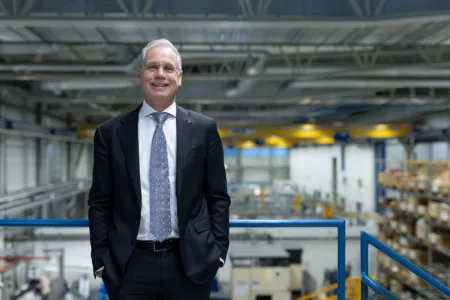
Rickard Gustafson, SKF president and CEO, is bullish on the company's entry into the humanoid component market.
SKF, which owns the SKF Aeroengine plant in Falconer, is entering a venture with Leaderdrive in China focused on high-precision transmission components for robot joints. SKF officials said the investment is a step into the robotics industry, with a particular focus on the application of humanoids powered by Embodied AI technology in industrial settings. SKF will hold a 60% majority stake in the venture, which supports the group’s strategic focus on high-growth segments.
Gustafson said during a recent conference call with investor analysts that SKF officials had done a thorough study to identify a potential role for the company in the humanoid market, concluding it should focus on humanoids for industrial applications. SKF officials decided that the company should remain a component supplier and partner with system manufacturers to rapidly build a proposition that covers most of the need for an industrial humanoids.
"But with that said, we also remain open to explore potential expansions to this as this market matures and we learn more," Gustafson said.
The venture will develop and supply high-precision transmission components for robot joints that support the reliability required for continuous operation of humanoids in industrial applications. Leaderdrive contributes with deep application know-how in automation products and humanoid robotics, while SKF brings expertise in bearing technology, scalable manufacturing and global supply chains. Together, the companies aim to accelerate time to market and support readiness for volume production in a fast-growing market for Embodied AI Humanoids.
Gustafson said there are more than 120 bearings involved in humanoids, 45% of which are found in cross rollers and flexible bearings that are used in harmonic drives. Another 35% of the bearings are related to thin sections and other types of bearings. SKF doesn't have offerings in some of the bearings related to harmonic drives, but has capabilities for other types of the bearings used in humanoids.
"And here, we already have capabilities and knowledge in-house that we intend to build further and accelerate internally," Gustafson said. "So from these two, we have some 80% coverage of the need for humanoids. Then the remaining 20%, they are related primarily to what’s called miniature bearings that you find in hands and in fingers of humanoid. This is an area we don’t really have a coverage of and where we are still assessing if we should do a greenfield here or if we should try to find a partner to also include this in our portfolio for humanoid or not. But 80% is what we now have coverage."
One area Gustafson said SKF is looking to get up to speed quickly is harmonic drives, also known as a strain wave gear. Harmonic drives are a gearing component that is compact, light, and produces no backlash. It is a component for the reliable and accurate operation of light industrial robots and manipulators, especially as a speed reducer. Gustafson said Leaderdrive is the clear number one company in China and clear number two company globally after the Japanese company, HDI, the first company to release a commercialized harmonic drive.
Prior to partnering with SKF, Leaderdrive produced cross roller and flexible bearings in-house for their harmonic drives. The partnership with SKF will move those bearings from production by Leaderdrive to the joint venture.
"And the venture, it will provide a fast track for SKF into a new exciting growth area," Gustafson said. "So Leaderdrive will contribute with the cross roller and flexible bearing production, and our contribution will be large-scale manufacturing know-how, support in actually scaling up and industrializing this, and then coupled with our own engineering innovation capabilities."
SKF will be the majority owner of the venture with 60% ownership while future intellectual property will be retained within SKF. SKF will still have the ability to form other partnerships outside of China, Gustafson said, and the company could also move into some adjacent areas to humanoids.
"Right now, we are focused on building this presence to really be a strong component supplier for industrial humanoids," Gustafson said. "As this market evolves, we will assess opportunities."