
State, Pennsylvania face higher SNAP cost-sharing

Secretary of Agriculture Brooke Rollins signs three new SNAP food choice waivers, with from left, Arkansas Gov. Sarah Huckabee Sanders, Secretary of Health and Human Services Robert F. Kennedy Jr., Indiana Gov. Mike Braun, and Rep. James Baird, R-Ind., during a Make America Healthy Again (MAHA) event about SNAP choice changes, Tuesday, June 10, 2025, at the USDA Whitten Building, in Washington. AP Photo
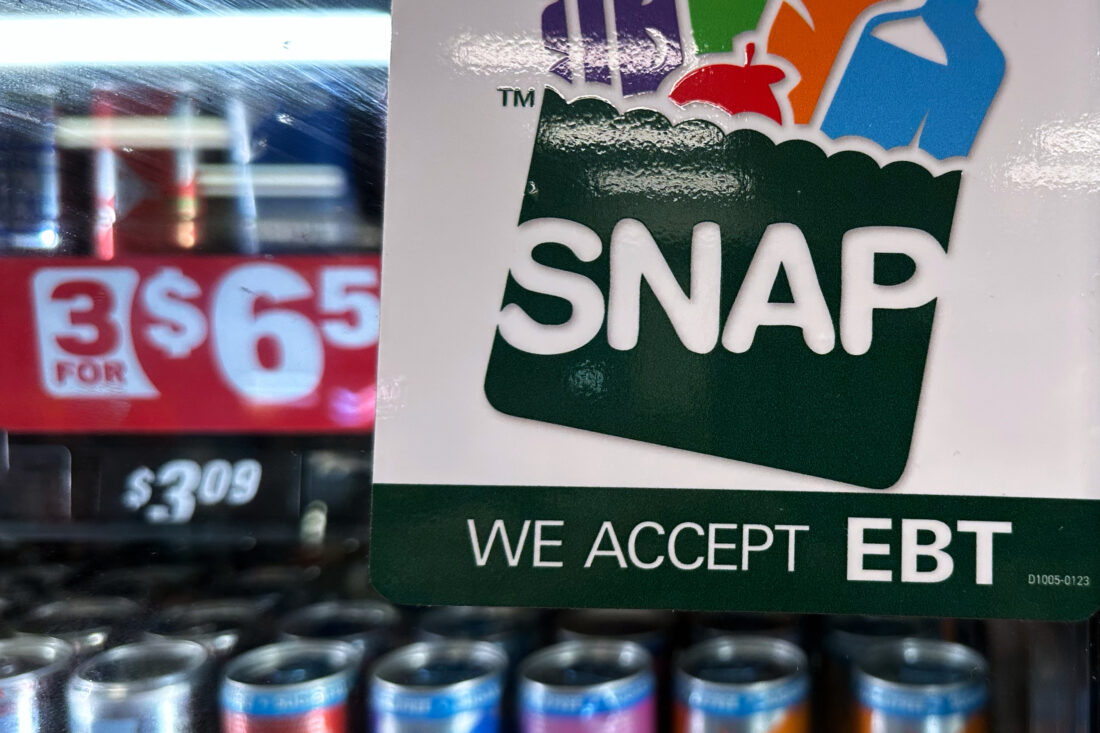
A SNAP EBT information sign is displayed at a gas station in Riverwoods, Ill.. AP photo
Secretary of Agriculture Brooke Rollins signs three new SNAP food choice waivers, with from left, Arkansas Gov. Sarah Huckabee Sanders, Secretary of Health and Human Services Robert F. Kennedy Jr., Indiana Gov. Mike Braun, and Rep. James Baird, R-Ind., during a Make America Healthy Again (MAHA) event about SNAP choice changes, Tuesday, June 10, 2025, at the USDA Whitten Building, in Washington. AP Photo
A SNAP EBT information sign is displayed at a gas station in Riverwoods, Ill.. AP photo
Trending
SNAP payment error rates in Pennsylvania and New York are still higher than congressional program requirements – and it could begin costing state taxpayers next year.
Pennsylvania’s error rate is 9.21% in 2025, with 8.03% of errors coming as overpayments and 1.18% being underpayment errors. New York had an error rate of 13.18% – 12.06% were overpayments and 1.12% were underpayments. The error rate refers to the percentage of SNAP benefits paid either above or below what people should have received, primarily because of mistakes. While low-error states are guaranteed to owe nothing when the annual cost-sharing requirement begins in October 2027, others will have another year to try to reduce their errors and decrease the hit to their budgets. Pennsylvania and New York are both among the states that will have to pay into the system next year unless their error rates decrease to less than 6%.
"These payment error rates are further proof that state accountability is severely lacking in SNAP," said Agriculture Secretary Brooke L. Rollins. "USDA has taken historic action to help interested states curb SNAP waste, and I hope other states, regardless of political leadership, prioritize needy families and the American taxpayer over politics."
H.R. 1 added new guardrails for states' payment error rates, implementing real financial consequences for states that mismanage taxpayer dollars. States with error rates at or above the 6% threshold will be responsible for covering 5%, 10%, or 15% of their states' benefits. The higher their payment error rates, the higher the percentage states will have to pay. The 2025 error rates released Wednesday are the year that could be used to calculate those percentages.
In addition to this matching fund requirement, states with PER at or above 6% threshold are required to submit a Corrective Action Plan to USDA's Food and Nutrition Administration detailing how they will address the root cause of their errors. Some of these states may also be liable for a separate financial penalty as part of the SNAP quality control process.
Some advocates for low-income residents want Congress to postpone the SNAP cost-share requirements for all states. That would require a change in federal law.
The error-rate data "really underscore the urgent need for Congress to delay this massive cost shift to state budgets," said Katie Bergh, senior policy analyst at the left-leaning Center on Budget and Policy Priorities, to the Associated Press
Many people already are struggling with high grocery prices, and "this is coming at a time when millions of people have already lost food assistance," Bergh said.
Pennsylvania officials announced in December a plan to use new computer tools as a solution to decreasing the state's high SNAP error rate. Driven in part by new federal requirements to lower the state's SNAP error rate, the new tools will also allow state residents to track their benefits applications in real-time and save millions in taxpayer dollars and thousands of hours in staff overtime. State Human Services Department and CODE PA officials have piloted the new tools late in 2025, cutting down on the number of illegible documents submitted by 80%, saving 700 hours of staff time. Likewise, the new SNAP case checker helped staff prioritize more than 1,000 cases for additional review, helping reduce the risk of additional SNAP case errors.
"Staff at DHS' County Assistance Offices work tirelessly every day to help Pennsylvanians in difficult situations access assistance that can help weather a crisis or take a step forward. This work requires constant attention to detail and focus on accuracy to make proper eligibility determinations - often under pressure from people who do not understand the care and diligence this team brings to their work,” Dr. Val Arkoosh, state human services secretary, said in December.
New York officials have criticized the federal government's shift of SNAP program costs from the federal government to the state government, but little has been said over the past year about state plans to decrease SNAP payment error rates.