
Proactive Approaches
CLA, CLP issue recent updates on lake work
Trending
In preparation for the Fourth of July holiday, Chautauqua Lake Partnership crews completed a second Eurasian watermilfoil herbicide treatment while the Chautauqua Lake Association pulled 190 tons of material from the lake last week and 1,105 tons so far this year.
About 50% of the areas permitted for treating Eurasian milfoil were treated with ProcellaCOR on June 17 with the rest treated June 29. There are no swimming or water use limitations with Procellacor, which is classified by the federal EPA with a "Reduced Risk" designation. Following application, there are no restrictions on swimming, fishing, or drinking water use.
The CLP held its annual lake rally on June 27. Among the highlights was a presentation by Frank Nicotra, CLP vice president, of adaptive management with the state Department of Environmental Conservation and a focus in 2026 on managing a rebound in Eurasian watermilfoil after the 2025 explosion of elodea in the lake. Both the CLP and the CLA noted less plant growth in the lake this year compared to the same time in 2025, though earlier algae blooms have been seen in the south basin of the lake while CLA officials say there has been weed growth in some of the lake's bays.
"We are hopeful that our proactive approach this season will make a difference," CLA officials said in their June 29-July 3 update.
As of Friday, most beaches on Chautauqua Lake were all opened after a temporary closure of the beach at Long Point State Park last week. The beach, according to the state, has been reopened. The Chautauqua County Health Department beach status table also said the College/Pier Beach at Chautauqua County had been listed as unsatisfactory on July 1.
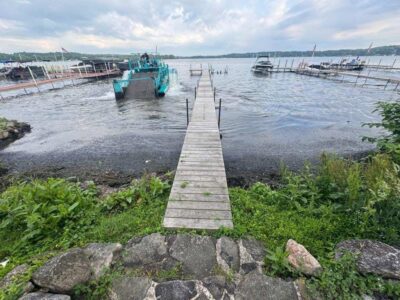
CLA harvesting and shore crews are now working from Lakewood, Mayville, and Long Point, with a north and south Mobitrac crew.
In April, the CLP announced that it had received $42,813 from the state DEC for a project that will focus on evaluating potential ecological trends and thresholds to help guide future lake maintenance work. Part of the study is also a field assessment of management approaches. Ten areas in the lake have been designated for this part of the project: three harvest-only zones, three areas with no management and four herbicide only areas. There are also designated herbicide application zones and habitat protection zones delineated. Jackie Damore of the Chautauqua Lake Partnership told The Post-Journal in June that the plots were selected by North Carolina State University scientists based on the historical and current presence of curly-leaf pondweed from the plant surveys in all study areas. Having three distinct areas will allow researchers to compare what happens in areas where weeds are only harvested with what happens in herbicide-only areas or areas where no management takes place at all. The researchers' preference, Damore said, was to keep the plots in the same general areas of the lake while maintaining sufficient separation for statistical replication. There was also discussion between Glenn Sullivan from Ready Scout, the contractor for CLP herbicide treatments, and the Chautauqua Lake Association to make sure the areas selected would have the least impact on their operations and on lake users.
CLA officials said last week they are working to find a balance between not harvesting in the no-harvesting zones and servicing the dock owners who have had weeds harvested in the past.
"We have been instructed that harvesting can continue around your dock areas, but we must avoid the no harvesting areas as best we can," the CLA said in its work plan.
For more information on the Chautauqua Lake Partnership, visit chqlake.org. For more information on the Chautauqua Lake Association, visit chautauqualakeassociation.org.