
Lake alliance working on starry stonewort plan
Trending
A consulting firm working with the Chautauqua Lake Watershed and Management Alliance is calling for a management plan for starry stonewort.
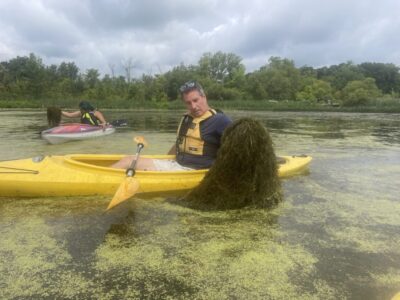
Starry stonewort is an invasive algae that functions like a plant but forms in dense stands that choke out native plant and fish populations. It has been seen sparsely in Chautauqua Lake since 2009, but has been seen more often in recent years, specifically in the towns of North Harmony and Chautauqua at Ashville Bay and Prendergast Point.
The recommendation comes after A.J. Reyes, project lead for GEI Consultants, presented a recap of the group’s 2025 work to alliance board members during a recent meeting. The starry stonewort plan Reyes is proposing would be a priority work item for 2026, according to meeting minutes posted on the alliance’s website, and include achievable goals, thresholds and milestones; utilize a Technical Advisory Group (TAG) made up of experts; and provide feedback to service providers and stakeholders.
Reyes said GEI is working to form the technical assistance group that includes local officials and outside experts and is working to draft a management plan as well as conduct novel reproductive bulbil sampling on Chautauqua Lake.
preliminary survey data from GEI's starry stonewort bulbil density sampling at Ashville Bay and Prendergast Point work areas, which shows a significantly higher number of bulbils at the Prendergast site relative to Ashville. Reyes said that GEI's 2026 will focus on questions related to management effectiveness; including how well current management actions are working. He said the state DEC has expressed a desire for this type of long-term analysis and review of past and present data. Starry stonewort management via diver assisted suction harvesting and mechanical removal is slated to begin sometime in July. Diver-assisted suction harvesting involves manual removal of the algae via suction hoses, which greatly reduces the chances of spread and comes with relatively few environmental concerns.
Andrew Goodell, alliance board member, said starry stonewort is a significant issue in Minnesota and asked if any of that state’s experience can help form best management practices to deal with starry stonewort in Chautauqua Lake. Reyes said Minnesota is likely the state with the largest amount of data relevant to starry stonewort management, and that he is hoping to involve experts from the state in the local Technical Advisory Group. Reyes also said he does not know if the state DEC utilizes data from Minnesota when considering permit applications for the chemical treatment of starry stonewort on New York lakes. Cassie Pinkoski of the county Soil and Water Conservation District asked if local stakeholders are using information from herbicide treatments of starry stonewort in the Finger Lakes. Reyes said he has been in contact with stakeholders from Keuka Lake, where they have utilized both diver assisted suction harvesting and algaecide treatment. The consultant said the state DEC will use data from New York state lakes where they have previously issued permits when making decisions on Chautauqua Lake, and Reyes said he is considering incorporating experts from the Finger Lakes region into the local technical advisory group.
One issue with starry stonewort is the difficulty in removing the invasive plant once it is established. Removing it by hand is time-consuming, and it has been difficult to correctly time chemical treatments because there is not a selective chemical that directly addresses the species and does not impact native plants. Reyes indicated that while some starry stonewort management tactics work well in isolation, they do not offer long-term control – which is why multiple management techniques is likely the best path forward to address the problem on Chautauqua.
Goodell said DEC officials have expressed a desire for buffer zones between areas where mechanical management is taking place and any proposed chemical treatment areas, asking why that is the case if both methods are likely to be used. Reyes said for a pilot test of chemical treatment, it makes sense to perform that work in an area that is not also being managed via mechanical removal. Reyes said once preliminary tests of chemical management have been done, a combined approach may be the best option moving forward.
While diver-assisted suction has not seen much opposition, there has been opposition locally to the use of chemicals to deal with starry stonewort. Jackie Damore of the Chautauqua Lake Partnership said during the alliance board meeting that the Chautauqua Watershed Conservancy had submitted a letter to the DEC opposing the CLP's proposed starry stonewort chemical management. That opposition led the CLP to drop its planned chemical pilot treatment of starry stonewort for 2026. The CLP received permits to test algaecides on starry stonewort in 2025, but treatment did not occur because the algae was not present in the exact locations that the permits were issued.